
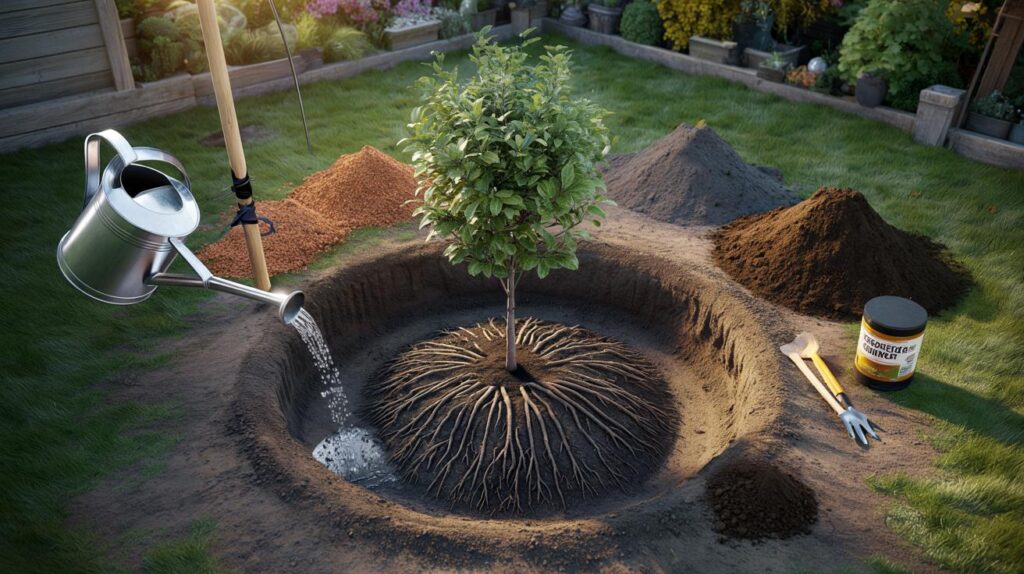
Across back gardens this autumn, a quiet shift is speeding up orchards with little cost and almost no gadgetry.
A growing number of British gardeners are adopting a nursery-style planting routine once kept behind trade gates. The approach sounds simple, yet the impact on young fruit trees is striking: stronger roots, faster extension growth and earlier first harvests.
Why copying horticulturists is changing home orchards
Professional growers plan for roots, not just trunks and leaves. They don’t drop a sapling into a tight hole and hope for the best. They prepare the soil well ahead of planting, dig wide, and feed gently. That trio shortens the stressful settling-in period and helps trees push on when spring warmth returns.
The pit that sets the pace
The centrepiece is the planting pit. Its size and texture govern how quickly roots spread into undisturbed ground. Digging wider than you think you need, loosening the base, and working in a balanced amendment gives roots a runway rather than a brick wall.
Target a pit roughly 60 cm wide and 40–50 cm deep, or about double the volume of the root system you’re planting.
Break up the sides and the base with a fork so water can drain and air can reach deeper layers. Keep the graft union above final soil level. Set the tree on firm but not compacted ground so it does not sink over winter rains.
October timing offers a head start
Planting in October uses warm soil and cool air to your advantage. Roots stay active long after leaves drop. That puts trees in place to burst into growth by April rather than wasting spring weeks establishing. In exposed gardens, choose a calm day and stake at once to prevent wind rock.
Feed the soil without burning the roots
Nurseries tend to underfeed early and build fertility slowly. Fresh, hot nitrogen shocks delicate roots and can stall growth. Gentle, steady nutrition lets trees lay down fine feeder roots that do the real work.
- One third well-rotted garden compost
- One third topsoil from the hole
- One third peat-free potting compost
Blend in 80–120 g of slow-release organic fertiliser such as bone meal or horn and hoof. Mix this through the backfill rather than dumping a rich layer under the roots. If you use a mycorrhizal inoculant, dust roots lightly just before planting rather than mixing it through the whole pit.
Avoid fresh manure, high-nitrogen pellets at planting, or any thick, rich layer that forms a barrier below the root zone.
Planting steps you can finish in under an hour
The pro routine, step by step
Expect stronger leader growth and 30–60 cm of new extension by June if water and wind are managed.
How big should the pit be for your tree
| Tree type | Recommended width | Recommended depth | Backfill mix needed | Stake |
|---|---|---|---|---|
| Dwarf apple on M27/M9 | 50–60 cm | 40–45 cm | 35–45 litres | Single stake |
| Semi-dwarf apple/pear on MM106/Quince A | 60–70 cm | 45–50 cm | 45–60 litres | Single stake |
| Cherry/plum on vigorous rootstock | 70–80 cm | 50–55 cm | 60–80 litres | Double stake in windy sites |
| Currant/gooseberry bush | 45–50 cm | 35–40 cm | 25–35 litres | Usually not needed |
Aftercare in the first 90 days
Water, mulch and vigilance
Keep the root zone evenly moist, not soggy. In dry spells give 10–15 litres once a week for the first two months, then taper. Top up mulch if it settles. Check ties monthly and leave a finger’s width under the strap to prevent rubbing. Watch for wind rock; a tree that wobbles will stall as roots struggle to knit.
In late winter, scrape back the mulch and apply a light compost mulch around the dripline. Replace the mulch layer. If leaves look pale by early summer, feed with a balanced, slow-release fertiliser at the label rate.
Visible signs your tree is surging ahead
- Bud break appears early and evenly along the framework.
- New shoots measure 30–60 cm by early summer on apples and pears.
- Leaves show a deep, even green without marginal scorch.
- The trunk stands firm after wind, with no soil cracking around it.
Common pitfalls and how to avoid them
Simple checks that protect your investment
- Planting too deep buries the graft and invites disease. Keep the union well above soil level.
- Waterlogging suffocates roots. Improve drainage or raise the planting area on heavy clay.
- Overfeeding with quick-release nitrogen triggers soft, pest-prone growth.
- Mulch piled against the bark encourages rot. Keep a clear collar.
- Unstaked trees in exposed sites suffer wind rock and poor establishment.
- Weeds steal moisture. Keep a 1 m weed-free circle through the first two seasons.
What gardeners are reporting this season
Allotment groups from Kent to Cumbria share similar results. Where last year’s trees put on 15–20 cm of shy growth, the nursery-style pits delivered 35–50 cm, with thicker shoots and fewer losses after winter. Cherries benefitted most from wider pits and early staking. Pears showed strong root establishment where soil stayed evenly moist under a leaf-mould mulch.
Doubling growth is not magic. It follows straight lines of preparation, water management and gentle nutrition.
A quick back-of-the-shed calculator
Three dwarf apples, one hour per tree. Each pit needs roughly 40 litres of backfill mix and 100 g of slow-release organic fertiliser. Compost costs about £6 per 50-litre bag, peat-free compost £6, bone meal £4 per kilo. Total outlay per tree: around £8–£10 if you already have garden compost. Water for establishment: 80–100 litres across two months, depending on rainfall. That spend and effort can bring forward the first useful crop by a full year on dwarfing stocks.
If space is tight, plant as a trio in a 2.5 m strip, pits overlapping slightly. Share a double stake between the outside trees and run a low windbreak mesh for the first winter. This reduces wind rock and keeps moisture near the root zone.
Beyond planting: small tweaks that compound gains
Add a ring of spring bulbs to draw early pollinators. Sow white clover between trees to act as a living mulch once the trunks thicken. Fit a simple 90-litre rain barrel by the shed and reserve it for these trees; rainwater reduces salt build-up from tap water on potash-hungry species like plums. If late frost threatens blossom in year two, throw a breathable fleece over a light frame at dusk and remove at dawn.
For heavy soils, consider a shallow mound 15–20 cm high rather than digging deeper. On sand, work extra organic matter into a broader area, up to 1 m across, and water little and often. Where vole or rabbit pressure exists, guard trunks with a ventilated mesh and bury it 5 cm into the soil.
The take-home is practical: dig wider, feed gently, plant in October, keep the wind off, and water on a rhythm.



Has anyone tried the 60 cm by 40–50 cm pit on very heavy clay? I can dig wide, but drainage is our biggest issue. Would a shallow mound plus a slightly wider pit be better, or should I lay a gravel sump first? Also, how tight should the figure-of-eight tie be to avoid wind rock in January gusts?
Planted two M9 apples last October using this exact mix (1/3 compost, 1/3 topsoil, 1/3 peat-free) and wow—30+ cm of fresh shoots by June 😊 I did underfeed early like you said and it was definatly the right call. Biggest surprise: staking before planting made everything easier.