
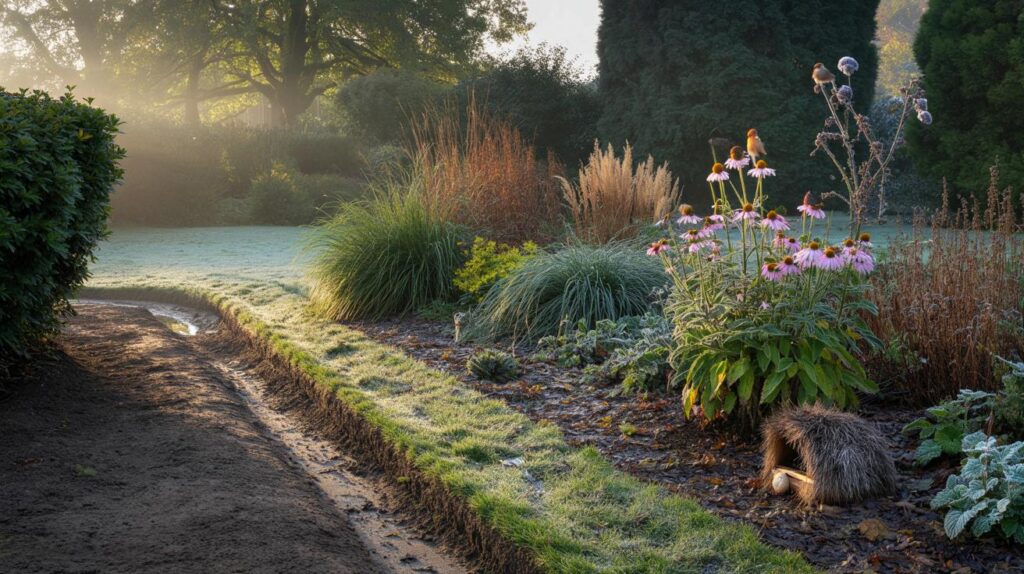
Mist drifts over quiet borders as frost nears, yet autumn’s leftovers still earn their keep in ways many miss.
Across Britain, landscapers are urging a cooler head as borders fade. Instead of ripping out spent stems, they suggest a softer hand that keeps wildlife fed, soil protected and your workload lighter until spring.
Why landscapers say to leave fading plants alone
What looks untidy at first glance carries real value through the cold months. Stems hold shape, seedheads feed birds, and the whole scene traps warmth at the soil surface. This living cover slows erosion from winter rain and cushions roots during freeze–thaw cycles.
Leave seedheads standing until late winter to feed birds and shelter beneficial insects. That single choice supports biodiversity when food and cover are scarce.
Shelter for wildlife you actually want
Ladybirds, lacewings and solitary bees tuck into hollow stems and dense tussocks to ride out the cold. Hedgehogs and toads use leaf piles as dry bedding. Insects hiding in seedheads become midwinter protein for wrens, robins and tits, which helps them maintain body weight during long nights.
Keep a few clumps upright near fences and hedges. These windbreaks reduce chill and create pockets where beneficial insects survive to tackle aphids in spring.
A living mulch that guards soil
Bare ground loses structure fast. Persistent rain pounds the surface, washing fine particles away and sealing the top. A mat of fallen leaves and withered stems acts like a free mulch. It slows runoff, conserves moisture, and feeds microbes as it breaks down. That activity unlocks nutrients for roots just as growth resumes in March.
Shapes, shadow and winter drama
There is beauty in restraint. Frosted umbels of sedum, bronze grasses and spent coneflowers catch low light and cast long shadows. This structure brings depth when colour fades. A few evergreen anchors, such as carex and hellebores, make a calm foil for the tawny seedheads behind.
The clean-up rethink that saves time and money
Dragging bags to the kerbside and hauling in mulch eats weekends. Holding back on hard clearance trims tasks now and sets up the soil to do some of your work for you.
Letting stems lie can save roughly £50 per 10 m² in mulch and green-waste fees by replacing a 5 cm bought-in mulch with natural cover.
Where the real savings come from
A 10 m² border needs about 0.5 m³ of mulch to lay a 5 cm blanket. At £90–£120 per m³ delivered, that’s £45–£60 each year. If last season’s growth covers the soil, you buy less and carry less. You also cut two trips: one to dispose of green waste, one to fetch mulch. Many gardeners report shaving a third off their autumn workload with this approach.
When tidying does make sense
Some material should still go. Anything diseased or pest-laden needs removing promptly and binning. Think rust on hollyhocks, blackspot on roses, blight on tomatoes, vine weevil-riddled roots in pots and lily beetle-infested foliage. Clear stems that overhang paths where ice is likely. Keep vents and air bricks unobstructed to prevent damp problems against the house.
Seven autumn mistakes that quietly hurt your borders
- Stripping everything bare too early: exposed soil loses structure, nutrients and microbial life.
- Cutting all stems to ground level: you remove winter seed and shelter used by birds and beneficial insects.
- Bagging every leaf: a thin layer on borders feeds soil organisms and insulates roots.
- Composting diseased plants: infected material can restart problems; bag and bin instead.
- Over-mulching with bark now: thick layers can trap excess moisture and invite slugs in mild spells.
- Ignoring slopes: uncovered banks erode fast; leave root systems and stems to slow runoff.
- Tidying wildlife corners: one undisturbed patch gives hedgehogs and amphibians safe winter refuge.
What to keep, what to clip and when
Not every plant earns a winter stay. Keep the best seedheads and shelters, and clear what spreads disease.
- Keep: echinacea, rudbeckia, asters, verbena, sedum, monarda, teasel, hogweed heads, grasses such as miscanthus, stipa and panicum.
- Clip and bin: mildewed phlox and monarda, rusted hollyhocks, blighted tomatoes and potatoes, blackspotted rose leaves, spotted iris foliage.
- Lightly tidy: collapse-prone perennials near paths; cut to knee height to stop flopping but keep some cover.
| Month | What to leave | Light touch care |
|---|---|---|
| November | Seedheads and grasses standing; leaf litter on beds | Remove diseased foliage; clear paths and drains |
| December | Most stems intact for shelter | Tie loose clumps with twine; check for waterlogging |
| January | Wildlife corners undisturbed | Top up grit in wet spots; brush snow off evergreens |
| February | Late winter interest still on show | On a dry day, cut back old growth to 5–10 cm |
| March | New shoots emerging | Chop and drop clean stems as mulch; add compost where gaps remain |
How to get a stronger spring with less effort
Plants reseed if given half a chance. Many cherished cottage-garden favourites scatter viable seed in late summer. Leaving them in place offers a free wave of colour next year with no packets and no sowing trays.
Let self-seeders fill the gaps
Cosmos, calendula, nigella, verbena and poppies scatter reliably. Mark areas where seedlings appear in March and thin with fingers to a hand’s breadth apart. This drip-feeds flowers through early summer and knits soil that would otherwise sit bare and weedy.
Cut back late and feed the soil
Wait until late February or early March for major cutting. Chop stems small and lay them around plants if they are clean. This “chop-and-drop” technique returns carbon and nutrients on site and reduces wheelbarrow miles. Where the debris is tough or woody, mix it into the compost heap with two parts brown to one part green material to keep it heating nicely.
Delay the big cut until new growth shows. You gain shelter through the worst weather and still make space just as plants wake up.
Extra tips gardeners ask for
Worried about slugs? Keep heavy, wet mulches away from crowns of hostas, delphiniums and lupins, and place spent stems a little further out. Rough grit rings help. Birds patrolling for seeds also patrol for slugs, which reduces early damage. Concerned about looks? Bundle a few stems with natural twine and stake them upright. This frames a border and keeps the wilder texture tidy without stripping it away.
Think about safety and neighbours. Clear sightlines at driveway exits and sweep pavements. If your area restricts hedgehog feeding or open compost heaps, provide a simple wooden hedgehog house under shrubs and cap heaps with breathable covers. For small spaces, dedicate one square metre as a no-dig wildlife patch. That modest area still delivers food, cover and soil care, and it asks almost nothing from you through winter.



Brilliant advice—leaving seedheads till late winter has boosted birds in my tiny yard. Also didn’t buy bark this year and saved close to £50. Definately rethinking the ‘tidy at all costs’ habit. Thanks!
Genuine question: doesn’t leaving lots of stems/leaves just turbo-charge slugs and vine weevils? I’ve had hostas shredded. How do you balance shelter for “good” insects with not creating a pest party?