
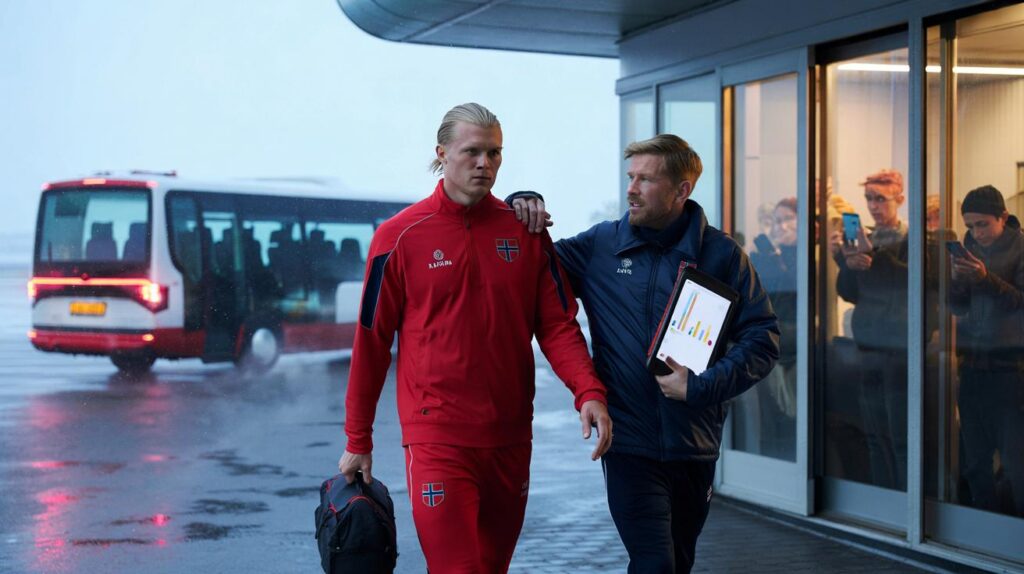
Haaland sent home. Norway speak up. The headline is simple; the ripple effect is anything but. A superstar steps off the stage for a beat, and suddenly every whisper sounds like a verdict. Is this caution? Is this crisis? Or is it the first sign that national teams are finally saying the quiet part out loud about player overload?
The airport coffee steamed in the chill, and the glass doors kept breathing open, shut, open. A handful of travelling fans stared down at their phones, thumbs scrolling through the same alert: Erling Haaland was leaving the Norway camp, with an unexpected statement from the federation to explain it. One man in a retro shirt shook his head, half-sigh, half-smile, like he’d heard this song before but couldn’t place the lyric. The team coach rolled past, half-empty, the driver tapping the wheel to a beat only he could hear. Football doesn’t often give you a pause button. This felt close.
Haaland sent home: the moment that jolted a quiet international week
Official words rarely travel light in international breaks. The Norwegian federation’s note arrived with a plain tone and a direct line: Haaland would return home from camp after assessments, with player welfare front and centre. No melodrama. No smoke. Just a decision and a hint of why it was made. That was the jolt. The statement read less like a cover and more like a conversation.
We’ve all had that moment when the room goes quiet and a message lands. For Norway, this was it. A talisman steps away and everything pauses for a beat — coaches reshuffle drills, commentators rethink talking points, rivals refresh their prep. Fans do the maths in their heads, all of us toggling between the next qualifier and the next league game. Football lives in the “what’s next?”, even on days when it tries to live in the now.
What made the note feel different wasn’t the act — big players are sent home from camp more often than people care to admit — but the posture. Instead of the usual foggy phrasing, this felt more transparent about the why. Workload. Timing. The human side of a machine that never switches off. This was not the usual vague update fans have learned to ignore. Read between the lines and you could hear a new kind of prudence: protect the engine before the warning light burns red.
Why Norway’s statement landed with such force
In elite football, words are currency. The federation’s choice to frame Haaland’s departure around wellbeing did more than fill a press release; it set a tone. It acknowledged that stars are not just assets but people with limits. It hinted that a big decision can be smart without being dramatic. And it gently asked supporters to sit with uncertainty, rather than demand instant clarity that doesn’t exist.
There’s a practical side to it. Clubs and countries now liaise day and night, sharing GPS data, medical markers, player feedback. That dialogue can be prickly, especially when schedules collide. Norway’s message sounded like the output of that grown-up conversation: a consensus, not a tug-of-war. Soyons honnêtes : personne ne fait vraiment ça tous les jours. The daily perfection social media expects — spotless updates, complete certainty — doesn’t live in the real world of tight calves, long flights and short turnarounds.
And then there’s the public mood. Supporters are more literate than ever about load management, even if they hate the phrase. Many would rather see a smart precaution now than an avoidable absence later. It felt strangely humane. A line like “player welfare” isn’t just corporate padding when the schedule looks like a conveyor belt. Norway made player welfare the headline, not the footnote. That carries weight, and it might set a template others follow when their stars hit the red zone.
How to read national-team bulletins without losing your mind
Start with the verbs. “Sent home” can sound brutal, like a punishment, yet in football it often signals controlled caution. “Assessment” tells you a process happened, not that panic is required. “Precaution” is the big one: it usually translates as “we could risk it, we won’t”. Treat those words as signs on a road, not as a cliff-edge. The map is the message.
Next, note the timing. Early in a camp? That suggests a quick decision to prevent escalation. After a light session? That points to feedback from the player, not a dramatic incident. Before a game with travel? That may be about avoiding back-and-forth fatigue as much as anything medical. Context is the quiet half of every statement, and it’s often where the truth lives.
When the update lands, take a breath and widen the lens. Ask what benefits all three parties: the player, the club, the country. Then listen for the tone — defensive, evasive, or, like Norway’s, refreshingly plain.
“This is not a crisis, it’s a recalibration.”
- Translate the buzzwords: precaution = low-risk choice, not emergency.
- Check the calendar: is there a cluster of matches looming?
- Watch for follow-ups within 48 hours from club staff.
- Remember the human: players now speak up early to avoid long layoffs.
What it might mean for Norway, for City, and for the season’s story
For Norway, the immediate task is tactical: replace gravity. When Haaland plays, defenders tilt toward him, space opens elsewhere, and the team’s rhythm gains a centre. Without him, patterns tweak — more rotation, more runners, perhaps more patience around the box. It can sharpen a team in unexpected ways, even if it costs you some bite in the penalty area.
For his club, the message reads like a small win for long-term planning. An international window that doesn’t drain its star is a gift wrapped in plain paper. The next league match, the following European night — they all matter more if the striker arrives fresh, not frayed. Caution in March or October can be the reason for fireworks in May.
For the season’s broader arc, moments like this add texture. They remind us that modern football is not just about goals but about judgement. A federation choosing transparency, a player leaning into self-awareness, a coach trusting the depth behind the headline name — these are little acts of maturity in a sport addicted to spectacle. Sometimes the bravest call is the quiet one.
| Key points | Details | Interest for reader |
|---|---|---|
| Norway’s unexpected tone | Plain language about welfare and assessment, minimal spin | Signals a shift toward honesty in injury and workload updates |
| “Sent home” decoded | Often precautionary, aligned with club-country dialogue | Reduces panic and helps fans read future bulletins calmly |
| What changes on the pitch | Norway adjust patterns; club likely benefits from managed minutes | Practical insight into tactics and fixture planning |
FAQ :
- Why was Haaland sent home from Norway camp?Norway framed the decision around assessment and player welfare, the kind of language that points to caution rather than alarm.
- Is he injured?The federation’s wording steered away from specifics. In international weeks, “precaution” usually means intervening early to avoid something bigger.
- Will he be available for his club’s next match?That depends on how he responds over the next few days. Clubs often release their own updates once the player is back in their care.
- Why did Norway’s statement feel different?It cut through the usual vagueness and placed wellbeing at the top, which reads like a cultural shift as much as a medical note.
- Should fans be worried?Worry less, watch more. If a follow-up arrives quickly and stays calm in tone, it usually means the plan is working.



Is ‘player welfare’ just PR for ‘City asked nicely’? Feels a bit convient tbh.
Finally, a federation treating players like humans. If this is precaution rather than panic, it’s the right move: protect the engine before the warning light. It also forces Norway to practice different patterns, which could pay off in tighter games. Clubs and countries cooperating shouldn’t be news, but here we are.