
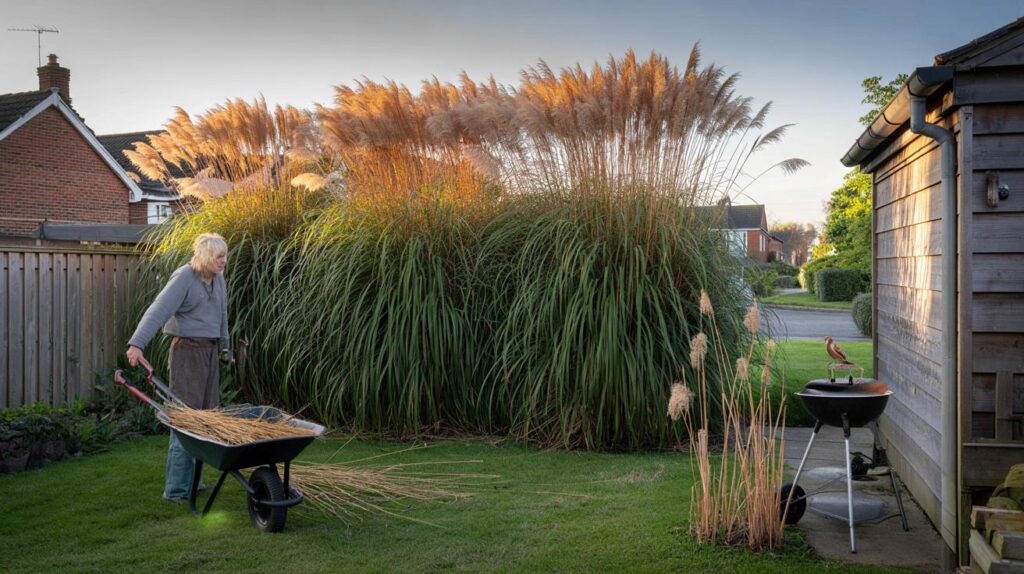
A towering grass is sweeping British borders, dividing households and horticulturists as autumn planning drifts into sharp focus this week.
With hedges tired, thinning or blighted by pests, many gardeners now eye miscanthus as a quick fix that looks stylish and promises height. The question sits awkwardly between hope and hazard: can this Asian grass really give you a soft, private screen without creating a maintenance headache next year?
Why this giant grass is suddenly everywhere
Miscanthus brings drama. It stands upright, rustles in the breeze and lights up in autumn with silky plumes. Designers use it to break up straight lines and to soften fences. Homeowners like the speed. In two summers, a young row can rise to window height and turn a busy street into a calm yard.
What people like about it
- Height without a hedge trimmer: many forms reach 2–3 m and hold shape without clipping.
- Seasonal theatre: fresh green in spring, feathery flowers in autumn, warm straw tones in winter.
- Low water once established: deep roots handle summer dry spells on most soils.
- Wildlife value: shelter for insects and wrens, standing stems for overwintering pollinators.
What raises eyebrows
Size and spread cause the most debate. Clump-forming miscanthus broadens each year and can overwhelm small beds. A few species creep via rhizomes and push into lawns or borders if you skip control. Dry stems can act as tinder during late winter if sited beside barbecues or sheds. And in tight terraces, neighbours may object when foliage leans over a boundary.
Expect a clump to hit 2–3 m in height and 1–1.2 m in width within two growing seasons. Plan space before you plant.
Can it really replace a hedge?
It depends on your site and your patience. Miscanthus does not give a hard, evergreen wall like laurel. It offers a soft, shifting screen that thickens from June to October, then thins as leaves fade. Many gardeners find that balance more human and less boxy, especially in windy plots where it bends rather than snaps.
Privacy, wind and wildlife
For mid-level privacy in summer and autumn, it works. It filters gusts better than a solid fence and reduces traffic noise by diffusion rather than by reflection. Birds use the dense clumps as cover. In winter, stems still filter views, but you will see more through them. If year-round seclusion is non-negotiable, mix miscanthus with evergreen shrubs or use it in a double row with native hedging.
Maintenance calendar you can actually stick to
- Weeks 1–8 after planting: water 10–15 litres per plant weekly in dry spells.
- Late winter (Feb–Mar): cut old stems down to 15–20 cm with loppers or a hedge trimmer.
- Spring (Apr): mulch 5 cm of composted bark to lock in moisture and suppress weeds.
- Summer: no feeding on rich soils; stake only in very exposed sites.
- Every 3–5 years: lift and split congested clumps to refresh growth and control width.
Planting guide without the headaches
Site and soil
Pick full sun to light shade. Waterlogging in winter is the main enemy. Loosen compacted ground to a spade’s depth and mix in organic matter on sand or chalk. On heavy clay, raise the bed by 10–15 cm and avoid hollows where cold water sits after rain.
Spacing and varieties
For a fast, even screen, space plants 60–80 cm apart. Stagger two rows 50 cm apart for a denser finish and better wind filtration. Choose clump-forming, non-seeding varieties for small gardens. Taller forms suit deep plots and boundary screening.
| Type | Typical height | Spread habit | Hedge suitability | Notes |
|---|---|---|---|---|
| Miscanthus sinensis (clumping cultivars) | 1.5–2.4 m | Clump-forming | Good for small to medium gardens | Many named forms; choose sterile or low-seeding cultivars |
| Miscanthus × giganteus | 2.5–3.5 m | Clump-forming, vigorous | Strong screen for larger plots | Triploid and generally sterile; used in biomass fields |
| Miscanthus sacchariflorus (some forms) | 2–3 m | Rhizomatous, can creep | Only with a barrier | Install root barrier to 40 cm to prevent spread |
Space at 60–80 cm centres for a single row. Plant in April–May or September. Water well in year one, then let rainfall do most of the work.
Costs, controls and the small print
Budget matters. A 2-litre pot often costs £10–£18 in garden centres, or about £12 online. Screening five metres with a single row needs 7–9 plants, so expect £84–£162 in plants, plus mulch and a morning’s labour. A two-row stagger lifts the count to 12–14 plants. Running costs stay modest: one annual cut and a top-up mulch.
Containment takes planning, not panic. For clump-formers, a spade edge once a year keeps the border crisp. For any rhizomatous selection, fit a recycled-plastic barrier 40 cm deep with a 5 cm lip above soil, and overlap joins by 30 cm. Check edges every spring for runner shoots. These steps keep lawns clean and patios free of invading blades.
Regulation is light in the UK. Miscanthus is not on the schedule of prohibited invasive plants. That said, local biodiversity groups advise against letting seed heads ripen near sensitive habitats. If you garden beside a wet meadow or a stream, pick sterile cultivars and deadhead before seed set to minimise spread by wind.
Real-world risks you should plan for
Fire and winter dieback
Old stems dry to straw by late winter. Keep them 1 m away from fire pits and barbecues. Bag cut stems or compost them in a covered heap to prevent them blowing across the garden on a windy day. Expect partial see-through in winter; pair with evergreens if you need solid cover year-round.
Allergies and sight lines
Flower plumes shed some pollen and fine fluff. People with grass sensitivities should wear a mask when cutting in March. If your hedge sits at a junction or near a drive, maintain a 60 cm set-back from the pavement so arching leaves do not reduce visibility for cars or cyclists.
Neighbour relations
Discuss height before planting. Many councils recommend keeping vegetation near front boundaries under 2 m where it abuts footpaths. A clear plan helps avoid complaints when summer growth peaks.
Should you plant it this autumn?
If you want height fast, have at least 1 m depth of bed, and accept a softer screen from November to March, miscanthus earns its place. Choose clump-forming, mainly sterile cultivars for smaller plots, set a consistent spacing, and commit to one decisive cut each late winter. Walk away if you need a narrow, formal, evergreen wall or if your soil sits wet all winter.
A quick decision tool for busy gardeners
- Yes, plant miscanthus if your bed is 1 m deep, sunny, and you like movement and autumn plumes.
- Choose M. × giganteus for 3 m privacy in big gardens; pick compact M. sinensis forms for terraces.
- Fit a 40 cm barrier only for rhizomatous types or when planting near lawns you prize.
- Combine with evergreen shrubs if winter privacy is non-negotiable.
- Budget roughly £120–£200 for a 5 m single row including mulch.
Extra notes the brochures rarely mention
Want a zero-irrigation screen? Trial a “bio-wick”: lay a 5 cm compost mulch in April, then add a 3 cm gravel cap on top. The compost feeds and the gravel cuts evaporation and slugs. In year one, you still water in dry spells; from year two, most loams cope on rain alone.
Concerned about bulk? Mix two heights on purpose. Alternate a tall cultivar with a compact form at 80 cm centres. The rhythm breaks wind more evenly and reduces winter flop. For a family garden, thread in pollinator perennials—verbena, rudbeckia, salvias—at the sunny edge. The flowers carry colour when the plumes fade, and the miscanthus still frames the space with gentle movement.



Love the idea—how fast would M. × giganteus hit 3 m in a windy coastal plot? 🙂 Also, any UK nurserys you trust for sterile forms? 🙂
This reads like free PR for miscanthus. It’s still a giant grass that’ll hog 1.2 m of bed and look scruffy in Febuary—why not just a mixed hawthorn/privet hedge that’s wildlife-friendly year round?