
A basket of laundry can look like chaos with buttons. Yet there’s a quiet, almost old-fashioned sort of peace in turning that heap into neat, squared stacks. Not the flashy kind of calm—and that’s exactly why it works.
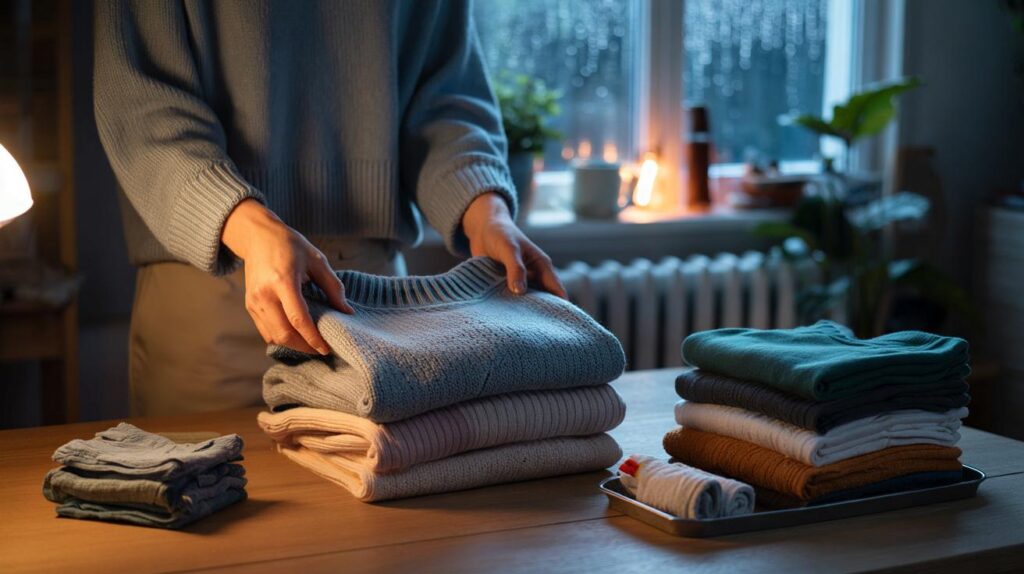
The kettle clicks off and the flat falls into that soft between-noises hush. A grey jumper, still faintly warm from the radiator, lands in my hands. I smooth the shoulder, pinch the hem, and fold it into a careful third. The air smells of soap and rain. My thumbs trace the seams, corners line up, the fabric falls obediently into a clean rectangle. A small victory. No screens. No opinions. Just cotton and gravity doing what they do. I don’t chase thoughts away; they soften on their own, like steam fading from glass. Something in my chest stops bracing for the next thing. A T-shirt follows, then a pair of socks, rolled like tiny scrolls. It’s ordinary. It’s strangely absorbing. And then, quietly, something shifts.
The quiet order of cloth
Folding brings a kind of **low-stakes order** that a restless mind finds merciful. Each crease is a decision you don’t have to think too hard about. Hands lead, head follows. There’s rhythm in it—lay, smooth, fold, stack—and rhythm has a way of lowering the volume on mental noise. You can feel the edges; you can see progress in inches. It’s the opposite of doomscrolling: no cliff-hangers, no cliff.
Think of the last time you sorted a suitcase on a hotel bed. Ten minutes later, shirts were stacked, socks corralled, and you could actually breathe. A friend of mine, Hannah, swears her Sunday night reset lives or dies on the laundry pile. She puts on a podcast, folds ten items, and finds her shoulders drop. We’ve all had that moment when a small, tidy corner makes the room—and your head—feel bigger.
There’s a practical psychology at play. Repetitive, tactile motion can cue the nervous system to downshift, because the task is unrisky, embodied, and predictable. The brain likes patterns; it likes finishing. Each finished fold feeds a tiny loop of control and reward. Another quiet factor: folding narrows attention. When you’re lining up sleeves, you’re not juggling a dozen tabs in your mind. That single-point focus, paired with touch, is a gentle antidote to mental scatter.
How to fold your way to calm
Start small and make the space kind. Clear a patch of table, soften the light, and set a ten-minute timer. Pick one category—T-shirts or towels—then use a simple method: flatten, fold in thirds lengthways, fold up into a rectangle. Align edges with your fingertips and smooth once with your palm. Breathe in as you open the cloth, breathe out as you close it. Call it a **mini-ritual** if that helps. You’re not chasing perfection. You’re inviting stillness.
Begin where resistance is lowest. A dozen socks is easier than a dozen shirts. Keep stacks shallow so they don’t slump and annoy you later. If you like the “file fold” popularised by Marie Kondo—items stored upright like books—use it for drawers you open daily. If not, don’t force it. Let’s be honest: nobody really does that every day. The point isn’t Instagram. The point is that your hands are moving and your brain is resting.
When it gets fiddly—tiny baby grows, slinky gym tops—give yourself permission to fold “good enough” and move on. The calm comes from the rhythm, not the geometry.
“When life feels messy, I fold something I can finish,” a reader told me. “It’s proof I can bring one small thing to heel.”
- Keep a “quick fold” basket: only items you can fold in under 20 seconds.
- Pair folding with gentle audio: rain sounds, a familiar album, easy radio.
- Stop on a high note—leave one neat stack so you see success next time.
- Store by use, not aesthetics: top of the pile gets what you reach for daily.
- Use a tray or shoebox lid to carry finished stacks in one calm sweep.
A small habit with bigger echoes
There’s no medal for best folded towel, and that’s liberating. Folding lives in the humble middle of the day, where big self-improvement schemes rarely survive. Over time, the practice teaches a quiet lesson: your environment can answer back kindly when you treat it with steady hands. That seeps into other corners. You start editing your calendar the way you refine a stack—lighter, clearer, easier to lift.
It also reframes time. Ten minutes isn’t a poor cousin of an hour; it’s a unit that works. A short session can be a boundary between parts of the day—work to evening, noise to quiet—without the fuss of a full reset. You might find your mind returning to problems with less jagged edges. Or not. Either way, you’ve created a small island of order that costs almost nothing and returns more than it looks like it should.
So yes, it’s just shirts and socks. But it’s also a chance to practice presence in the safest, most forgiving way. The stakes are low. The payoff is steady. You can feel it in your breath, see it in your drawers, and carry it in the way you move through a busy week. **Tactile rhythm** is a language, and the body speaks it fluently. If you try it tonight, what else might quieten with your hands?
| Point clé | Détail | Intérêt pour le lecteur |
|---|---|---|
| Ritual over results | Use a repeatable, simple fold sequence and stop after ten minutes | Gives calm without demanding perfection or time you don’t have |
| Tactile focus | Let fingertips guide edges; sync breath with folds | Anchors attention and lowers mental chatter naturally |
| Small wins stack | Finish one category; keep visible, neat piles | Visible progress fuels motivation and softens stress |
FAQ :
- Does folding really help anxiety or is it just a chore?It’s a chore that can double as a grounding practice. The repetitive, predictable motion offers a calm focus that many people find soothing.
- Is there a “best” folding method?No single method wins. Choose one that feels easy in your hands—thirds, halves, or file folding—and keep it consistent for a few categories.
- What if I hate folding?Try a five-item limit with music you like. If it still grates, swap to another tactile task: stacking books, rinsing fruit, wiping a counter slowly.
- How do I stop the pile from exploding again?Fold in micro-bursts: ten minutes after the wash cycle, five minutes before bed, a quick sort on Sundays. Small, repeatable slots beat heroic sessions.
- Can I involve kids or a partner?Yes—make it a short team routine. Give each person one category and a shared playlist. It turns obligation into a gentle moment together.



Merci pour cet article, je ne pensais pas que plier un tee-shirt pouvait calmer autant. Votre idée du minuteur 10 minutes m’a aidé ce soir: j’ai respiré, plié, et—surprise—mon anxiété a baissé. Simple, pas “instagrammable”, mais efficase.