
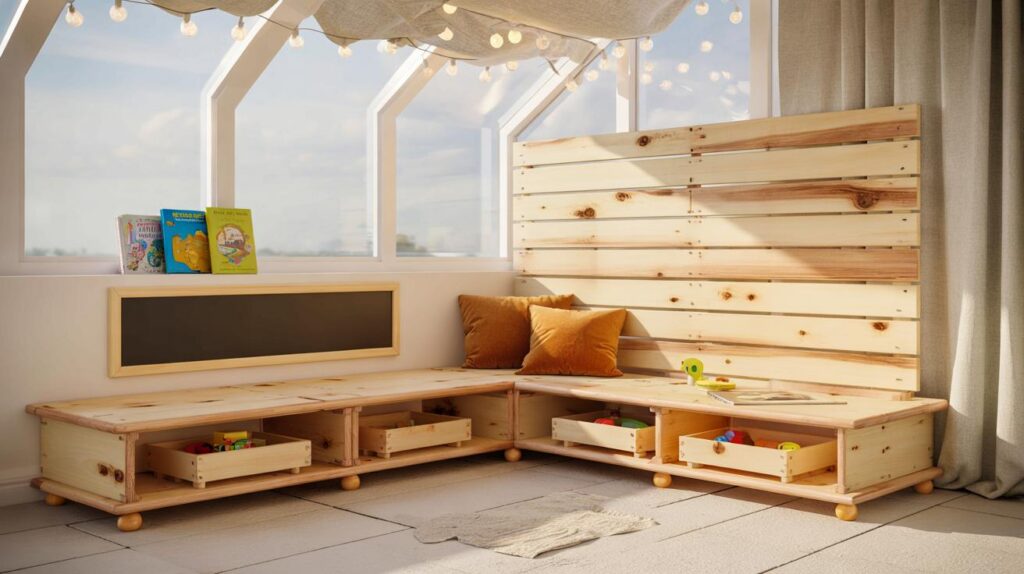
The conservatory was the room that never quite earned its keep. Morning light puddled on the tiles, toys drifted in and out, and the small radiator never quite won against a chilly sky. We’ve all had that moment when a space becomes a corridor for clutter rather than a place to be. On a drizzly Saturday in late spring, one family in Leeds decided to flip that script using only what was at hand: leftover timber from a garden project, a few sheets of plywood, and a handful of screws that had been knocking about in a tin.
The brief was pure life: make a corner where two small kids could build, read and spill crayons, and where grown‑ups wouldn’t step on a stray brick before coffee. A nook, not a room. A promise of calm in the place that had become a pass‑through. They started with scraps, not a shopping list. All from leftovers.
From scrap pile to snug corner
The idea arrived mid‑tidy: a corner bench with toy storage under, a slatted back for warmth and texture, and a low picture ledge for favourite books. Dan’s offcuts from a raised bed build turned into the main frame. Sarah found the old cot base and wondered if it could be a shelf. The conservatory had the light, so the family leaned into it, adding a canopy of string lights and a soft rug that asked for bare feet. **The best bits are the imperfections you can still read in the wood.**
They kept it simple. An L‑shaped bench about 30cm high, box lids that flip without trapping little fingers, and a shallow chalkboard panel made from a leftover MDF strip. Cost? A pot of primer, a small tin of water‑based eggshell, and a pack of wall plugs. The rest came from the shed. By Sunday evening, Mila, four, was “opening a library” while Theo parked cars in a crate under the seat. The room stopped echoing and started humming.
Why did it work? Scale. Everything speaks at kid height: hooks at tiny hands, ledges at small eyes, toys in open bins not tucked behind doors. It’s also climate‑aware. Conservatories swing from toasty to chilly, so the bench floats a few millimetres off the floor on rubber feet, and the slatted back leaves an air gap to the wall to keep condensation away from timber. The design looks warm because it feels warm, even when the sky is moody Leeds grey.
The method you can copy, using what you’ve got
Start with a quick sketch and two measurements: the longest wall and the return. Mark a rectangle with painter’s tape to test the footprint. Build a simple seat frame from 38×63 CLS or equivalent offcuts, fixing a ledger to the wall with wall plugs and 70mm screws, then making a front rail and two or three cross braces. Skin the top with leftover 18mm ply or floorboard offcuts, sand the edges, and round them slightly with a block. The back gets 45mm battens, spaced a finger‑width apart, rising to about 1.1m. Paint in a durable, water‑based eggshell for a soft sheen that wipes clean.
Toy storage is a miracle when it asks nothing of you. Use open crates on felt pads, not heavy drawers, so kids can drag and sort without wrestling hardware. Add a low book ledge made from a ripped pine offcut with a 10mm lip, and a peg rail cut from an old broom handle running along two brackets. Let’s be honest: no one actually does that every day. Keep finishes child‑safe and low‑odour, and leave a tiny gap at the back of the bench for airflow. Attach everything that’s tall or heavy to a stud or solid masonry, not just plasterboard.
Sun is a gift and a bully in glass rooms, so plan for shade. A small linen canopy or a simple curtain on a tension rod softens glare and calms a busy view, and it also makes the corner feel like a secret. **Total spend: under £50, time: a weekend, payoff: a ritual of play that sticks.**
“We’d been swiping past gorgeous playrooms online and thinking we needed a bigger house,” Sarah told me, laughing. “Turns out we just needed to look at our scruffy timber pile differently.”
- Cut list: seat height 300mm, depth 400mm, back slats 1100mm, spacing roughly 15mm.
- Tools: saw (hand or mitre), drill/driver, sander, square, countersink bit, tape, pencil.
- Finishes: primer for knots, water‑based eggshell, low‑VOC varnish on the seat if you like wipe‑clean.
- Smarts: rubber feet or packers to lift wood off the tile, clear silicone along the back if condensation is frequent.
- Nice‑to‑have: battery puck lights under the seat lid, soft‑close toy box hinges, cable clips for fairy lights.
Why small projects like this change a home
There’s a quiet psychology to corners. Kids read corners as safe, knowable, theirs. Parents read them as containable. This little conservatory build carved purpose out of glass and echo, turned leftover wood into ritual, and made the room part of everyday life rather than a seasonal fling. *The home we keep is the childhood our kids remember.* When we make eye‑level spaces for small people, we tune the whole house to their pace. You don’t need a new extension to earn that feeling. You need one good idea and the nerve to begin with what’s already in your hands.
| Key points | Details | Interest for reader |
|---|---|---|
| Use leftovers first | Frame from CLS offcuts, ply scraps for lids, old cot base as shelf | Save money, reduce waste, start today without a big shop |
| Design at kid height | 30cm seat, low ledge, open crates, soft edges | Kids play longer, tidying becomes natural, fewer battles |
| Respect the conservatory climate | Air gaps, rubber feet, shade cloth or curtain, wipe‑able finishes | Longer‑lasting build, less warping, more comfort year‑round |
FAQ :
- What kind of wood works best for a conservatory play corner?Pine offcuts and plywood are great if you lift them off the floor and let air circulate; hardwood battens are tougher but not essential.
- How do I stop condensation from ruining the timber?Leave a small gap behind the back panel, use rubber feet or packers to lift the bench, and wipe down glass on damp mornings.
- Is paint safe for kids to touch and chew?Choose low‑VOC, water‑based paints and allow proper curing; food‑safe oils on the seat edge are another gentle option.
- What’s the quickest storage win?Open crates under a flip‑top bench; label with pictures for pre‑readers so tidying feels like a game.
- Will the bench make the room feel smaller?Not if you keep the lines low and light; slats let the wall breathe visually, and pale colours bounce the conservatory light.



Brilliant reuse of scraps! Love the slatted back and the idea of floating the bench on rubber feet. Any tips for making the flip‑top lids not slam? Soft‑close toy hinges worth it, or overkill for a cheap build? Defintely stealing the book ledge idea.