
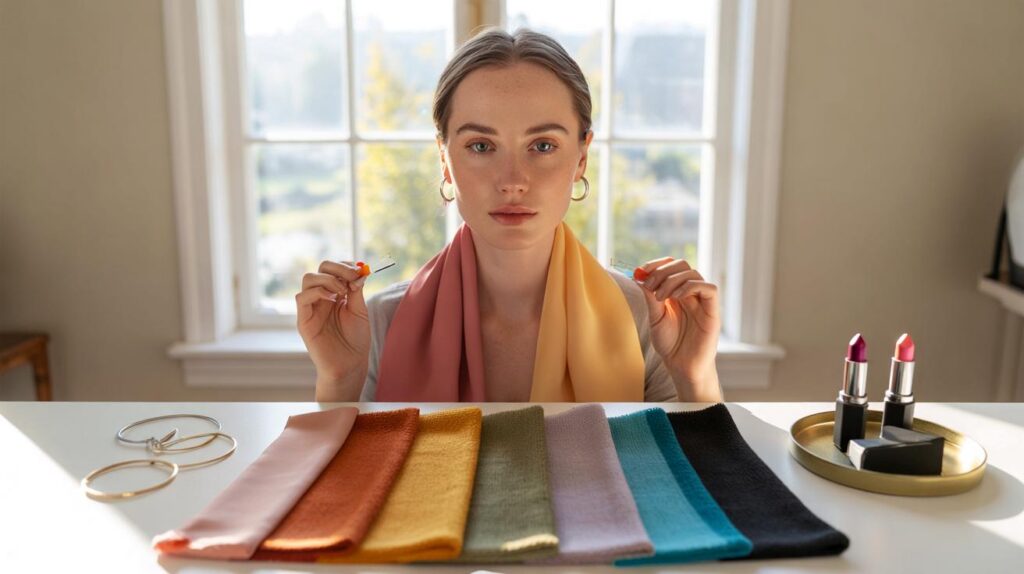
You keep buying “safe” black, a new nude lipstick, another beige trench. Then the photos roll in and your face looks a touch flat, your eyes less bright. It’s not you. It’s the palette you’re feeding your wardrobe and make-up bag. Finding your colour season flips that script and suddenly the mirror feels kind again.
The shop had those punishing lights that make everyone the colour of porridge. My friend, Lily, was trying on a butter-yellow jumper. She looked… tired. Then the assistant tossed her a cool, raspberry scarf. Her eyes sharpened, her skin looked rested, and the whole room seemed to lift a notch.
We’d done nothing clever. No contour, no filters, no magic. Just a better colour against her skin. It looked like sleep in fabric form. You could feel the click. What else has been quietly working against us?
What “colour seasons” really mean — and why they can change your face
Colour seasons are a tidy way of matching clothing and make-up to your undertone, depth, and clarity. Think four families: Spring and Autumn (warm), Summer and Winter (cool). Within each, there’s a spectrum of light-to-deep and soft-to-bright that makes your features hum.
The trick is simple. When a shade echoes what’s already in your skin, hair and eyes, everything syncs. Your undertone never clashes with itself. That’s why some reds make you look posh and awake, while others make you reach for concealer.
A tiny stat to hold onto: stylists estimate we wear 20% of our wardrobe 80% of the time. Not because we’re lazy. Because that 20% just works. We’ve all had that moment when the “right” white tee makes your teeth look whiter and your hair shinier, while another white turns you oddly sallow.
I watched it happen on a shoot years ago. Two near-identical blouses: one creamy, one crisp white. Our model slipped on the creamy one and her freckles glowed; in the white, the freckles faded and her lips looked cool. She wasn’t “better” or “worse”. The palette either backed her up or muffled her.
Your season is a shorthand for that backing. Spring colours are warm, light, and clear — think warm coral, daffodil, turquoise. Summer is cool, light, and soft — dusty rose, slate blue, misty aqua. Autumn runs warm, rich, and mellow — rust, olive, mustard, teal. Winter is cool, deep, and high-contrast — fuchsia, emerald, black, icy pastels. Black is not universal, and that’s oddly freeing.
How to find your colour season at home — without a full-blown studio
Start with daylight near a window and a clean face. Pull back your hair and drape different colours under your chin: true white vs cream, silver vs gold jewellery, tomato red vs blue red, warm camel vs cool grey.
Watch your skin for clues: do shadows soften or sharpen, do under-eye areas recede, do lips look more pigmented, do your eyes brighten. If cream looks lush and white goes chalky, you’re probably warm-leaning. If silver wakes you up and gold turns brassy, you’re likely cool. If bright colours overwhelm you, your best palette is softer; if they make you look alive, you need clarity.
Let’s be honest: no one does that every day. So keep it practical. Grab two lipsticks you already own — one orangey-coral, one blue-toned berry. Try them bare-faced in daylight. Which shade makes your skin look smoother and your teeth cleaner without effort? That’s a big arrow towards warm (coral) or cool (berry). Repeat with navy vs black, and olive vs forest green. Patterns can trick the eye. Solids make it obvious.
Missteps are normal. Fake tan, heavy bronzer, and tinted SPF can skew your read. If your hair is dyed far from your natural level, you might need to imagine your original contrast. Don’t chase your favourite colour out of loyalty. Chase the colour that loves you back.
People also mix up “I like bright clothes” with “I suit bright colours.” Soft seasons can rock bold shapes in gentler shades and look incredible. And warm people often think they “can’t wear pink”. Wrong. Salmon, watermelon, and coral are your best friends.
*A quick gut check helps.* If a colour makes you want to add more base, blush, or bronzer, it’s probably not your season. Lighting is half the battle, so step away from bathroom bulbs and try near a window. Your mirror is allowed to be your ally.
Here’s a phrase from a veteran stylist that stuck:
“The right colour removes the need for make-up you didn’t want to wear in the first place.”
- Build a drape kit from your wardrobe: white tee, cream knit, navy jumper, black tee, grey scarf, camel coat, red jumper (cool blue-red), red jumper (warm tomato), gold and silver earrings.
- Photograph each pairing in daylight. Look only at skin and eyes, not the garment.
- Keep the winners on one side of your wardrobe. That becomes your living palette.
Turn your season into everyday choices — and shop with clarity
You don’t need to throw everything out. Start with pieces that frame your face: scarves, tees, blouses, coats, lipstick. If you’re Summer, swap stark white for soft white and icy pink for your daily lip. If you’re Autumn, lean into rich browns, moss, and burnished golds.
Winter can keep true black and sapphire; add a punchy fuchsia lipstick for instant polish. Spring thrives in warm corals, apple green, and sunny turquoise; go for glossy peach cheeks. Matching metal to undertone is the quickest lift: cool loves silver, gunmetal, and platinum; warm loves gold, bronze, and copper.
On a budget, use contrast tricks. Winters often look best in high contrast (dark coat, light top). Summers glow in low contrast (soft top, soft cardi). Autumns look luxe in textured layers — suede, knit, leather. Springs sparkle in light, bouncy fabrics. Your palette is a filter, not a prison.
You’ll save money because your wish list gets shorter. Those “almost right” buys stop tricking you. And getting dressed becomes faster. The not-so-secret bonus: your wardrobe starts to match itself, so outfits assemble on their own.
For make-up, think undertone first, formula second. Cool skins brighten with blue-reds, cool roses, and plum; warm skins sing with tomato reds, terracotta, and apricot. Neutral skins can borrow across seasons at the right depth. Foundation? Match your neck in daylight and pick a truly warm or truly cool base. If that scares you, keep a neutral bronzer to blend the edges.
One more thing: colour changes with age, but your undertone rarely does. Hair greys, contrast lowers, and you might shift within your season (from Deep to Soft, for instance). That doesn’t erase your palette; it just nudges the volume control.
Your “no” list is just as liberating as your “yes” list. Summer can skip mustard; Autumn can skip icy pastels; Spring can skip charcoal; Winter can skip camel next to the face. Wear them as trousers or accessories away from the face if you love them. No need to be perfect. Shop with a wink.
Now the fun bit: try a colour experiment for one week. Pick three tops from your suspected season and wear each with minimal make-up and your usual jeans. Take a quick selfie by a window. Note the days people say, “You look fresh.” That’s data.
Then find your power red. Every season has one. Winter: fuchsia or blue-red. Summer: raspberry or rose. Autumn: brick or paprika. Spring: coral or poppy. That one lipstick or knit will do more than a new foundation ever could.
And if you still can’t tell? Book a colour consult or try an online drape kit. Valuable, yes. Essential, no. Your life is lived in daylight, not in theory. Your mirror will tell you the truth if you give it a chance.
Shop smarter with a tiny rule of thumb: three yeses before you buy — undertone match, depth match, and clarity match. When all three align, you’ll feel it. When only one aligns, that piece becomes closet clutter.
There’s also joy in contradiction. Winters can wear icy mint with red lip and look cinematic. Autumns in teal silk at dusk? Spellbinding. Summers in a column of dove grey feel quietly expensive. Springs in butter yellow on a rainy day are sunshine for everyone else on the bus.
Your colour season isn’t about shrinking your world. It’s a language to decode the best of you. Use it to find the clothes and make-up that make you feel unforced. Then bend the rules for personal flair and story. The end goal isn’t perfection. It’s presence.
| Point clé | Détail | Intérêt pour le lecteur |
|---|---|---|
| Find your undertone | Daylight drape with cream vs white, silver vs gold | Instant clarity on warm vs cool |
| Match depth and clarity | Light/Deep and Soft/Bright cues from face contrast | Colours that lift skin and eyes |
| Buy near the face first | Tees, blouses, coats, lipstick in-season | Maximum impact, minimal spend |
FAQ :
- Can I belong to two seasons?You sit in one home season most of the time, but you can live near a border. Many people wear neighbour palettes with tweaks to depth or clarity. Start with your strongest yeses, then borrow carefully.
- Do I have to toss everything that’s “wrong”?No. Move off-season colours away from your face, layer with scarves in your best shades, and balance with make-up that corrects the undertone. Edit slowly as pieces wear out.
- What if I love black but it drains me?Keep black trousers and shoes, and soften near the face with charcoal, navy, or a scarf in your season. A bright lip for Winters or a warm necklace for Autumns can bridge the gap.
- Will fake tan change my season?It can alter depth and contrast, not undertone. Tan won’t turn cool skin warm or vice versa. Re-test your best shades after a tan to check the level of brightness you can handle.
- How does hair dye affect my palette?Dramatic colour shifts raise or lower your natural contrast. Blondes going dark may lean towards deeper versions of their season; heavy highlights can soften a palette. Your undertone still leads the way.



Wow, this finally explains why my “safe” black tees make me look oddly tired. I tried your coral vs berry lipstick test and it was an instant yes for coral—my teeth looked whiter and skin smoother, no extra base. Definately stealing the drape kit idea to sort my wardrobe this weekend. Thank you for making this feel practical, not preachy.
I’m intrigued but sceptical: how much of this is just lighting and confirmation bias? On different days my face reads warm, then cool. Any tips to control for mood, sleep, or camera auto-white balance when testing at home? I want data, not vibes, tho.