
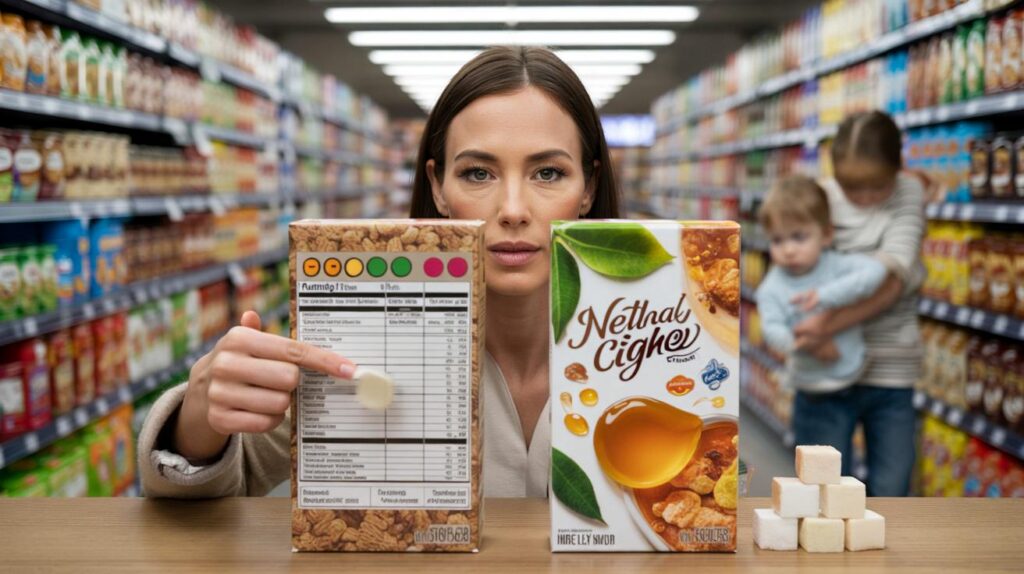
Supermarket shelves are a stage, and food labels do a lot of acting. Bright badges, cosy words, tidy serving sizes — all designed to soothe you into tossing the box in your trolley. You want real food, not clever branding. That’s where a little label literacy changes everything.
The cereal aisle was a low hum of wheels and whispers when I met a shopping coach named Anita by the “healthy” granolas. She held a box with leaves on the front and a promise of “No Added Sugar” in a friendly font. A mum drifted past, phone in one hand, toddler in the other, and grabbed it without looking. Anita didn’t rush. She flipped the pack, traced the ingredients down with a finger, then paused, smiling, like a magician about to reveal a card. I’d been reading labels for years; I realised I’d been reading the wrong side. She tapped the per 100g column, not the serving size. Then she pointed at the syrups hiding in plain sight. “The front is a pitch,” she said. “The back is the truth.” Watch the fourth ingredient.
The front-of-pack theatre: why the show is so convincing
Brands know your weak spots — speed, trust, and a need for shortcuts. So the front shouts “natural”, “light”, “protein”, “plant-based”, and steers your gut feeling. Traffic-light labels help, yet placement and portion maths still nudge choices. A bar labelled “under 100 calories” per bite can be three bites per pack. A yoghurt with fruit on the label may contain more added sugar than an ice lolly. That friendly green leaf? It’s there to make you feel virtuous before you’ve read a single number.
I followed Anita to a granola that boasted “wholegrain goodness”. The back told another story. Oats were first (good), then a trio of sugars split into honey, glucose syrup and apple juice concentrate. Per 100g it carried more sugar than some biscuits, and “a serving” was 40g — smaller than most people pour. The traffic light was amber for sugar per portion, but if you ate a normal bowl you’d tip into red. The cereal wasn’t wicked. It was just wearing a halo it hadn’t quite earned.
Behind the show are rules — and workarounds. Ingredients are listed by weight, so splitting sugar into several names lowers the appearance of any one sweetener. “Light” means 30% less of something than a comparison product, not an absolute low. “No added sugar” allows fruit concentrates, which behave like sugar in your body. “Source of fibre” has a threshold (at least 3g per 100g in the UK), just as “low sugar” has one (5g per 100g). The front can be true while still leading you away from what matters most day to day.
How a shopping coach reads a label in 30 seconds
Start with the back. Scan the top three ingredients; they tell you what you’re really buying. Jump to the nutrition table and compare per 100g (or per 100ml), not per portion. Use the traffic lights as a quick gut check, then confirm with numbers: sugar under 5g per 100g is low; salt under 0.3g per 100g is low; saturated fat under 1.5g per 100g is low. For everyday foods, look for at least 5–6g fibre per 100g in cereals and breads. High protein claims are nice, but fibre and salt usually say more about how you’ll feel after lunch.
Common traps? “Gluten-free” biscuits are still biscuits. “Plant-based” can be brilliant, or it can be starch, oil and additives with a soy flourish. “No refined sugar” often swaps in syrups that spike you just the same. We’ve all had that moment in the aisle where fatigue wins and the halo wins too. Let’s be honest: nobody really does that every day. When time is tight, pick two checks: ingredients’ top three, and the per 100g line for sugar and salt. That tiny pause stops the priciest errors.
This was Anita’s mantra as we wheeled past sauces, cereals and snacks. She made it look almost relaxing.
“If sugar shows up three times under different names, that’s three votes for sweet,” she said. “If the first word is water, you’re buying a diluted product. If fibre is invisible, your hunger will be loud before midday.”
- Fast filter: read per 100g first, ignore the portion trick until the end.
- Sugar aliases: dextrose, maltose, fructose, syrup, nectar, concentrate.
- Fibre wins: aim for 6g per 100g in cereals; 8g per 100g in breads is excellent.
- Salt sanity: under 0.3g per 100g is low; over 1.5g per 100g is red territory.
- “Light” means 30% less than a reference product, not necessarily low.
- “Natural” and “wholegrain” aren’t strictly defined across all products in the UK.
Beyond buzzwords: choosing food you’ll actually enjoy and feel good about
Real life shopping isn’t a tidy lab test; it’s a rush between work and home, half your brain elsewhere. The trick is to turn labels into quick, kind decisions. Think patterns, not perfection. Build default picks: a bread you trust for fibre and salt; a yoghurt with simple ingredients and under 5g sugar per 100g; a sauce that isn’t 40% sugar and oil. Swap the “healthy” cereal for plain oats plus fruit on weekdays and keep the fancy crunch for weekends. You’ll feel the difference before you see it.
| Key points | Details | Interest for reader |
|---|---|---|
| Read per 100g, not per portion | Portions shrink on paper; per 100g reveals the true density of sugar, salt and fat | Fair comparisons between brands, fewer sly surprises once you’re home |
| Top three ingredients tell the story | Ingredients are listed by weight; repeats of sugar under new names are a red flag | Faster decisions without memorising every synonym for sugar |
| Prioritise fibre and salt | Fibre keeps you full; excess salt creeps in via bread, sauces, snacks | More steady energy, fewer afternoon crashes, better heart health long term |
FAQ :
- What does “no added sugar” really mean?It means no sugar was added as sugar, but fruit juices or concentrates can still sweeten the product. Check per 100g sugars and the ingredient list for syrups and concentrates.
- Are E‑numbers always bad?Not at all. Many are simply vitamin C, plant gums or natural acids. Use them as a prompt to scan the rest of the list; short and clear is often best.
- How do I compare yoghurts quickly?Look for plain versions with live cultures, under 5g sugar per 100g, and a short ingredient list. Add your own fruit or a drizzle of honey for taste control.
- Should I avoid sweeteners?They cut calories, yet can keep your palate tuned to very sweet tastes. If you use them, do it knowingly and try to dial down sweetness overall across the week.
- How much fibre should I aim for daily?In the UK the target is about 30g per day for adults. Choose wholegrains, beans, nuts, veg, and aim for 6g per 100g in cereals to make it easier.



I never knew to compare per 100g first—no wonder those “40g servings” make everything look halo-worthy. Great walk-through on ingredients too; the sugar-splitting trick (honey, glucose syrup, apple juice concentrate) has fooled me for years. Consider me a reformed lable reader.
Honest question: if a cereal uses fruit concentrate instead of refined sugar, is the metabolic impact really the same? Any sources on glycemic response or satiety differences would be apreciated.