
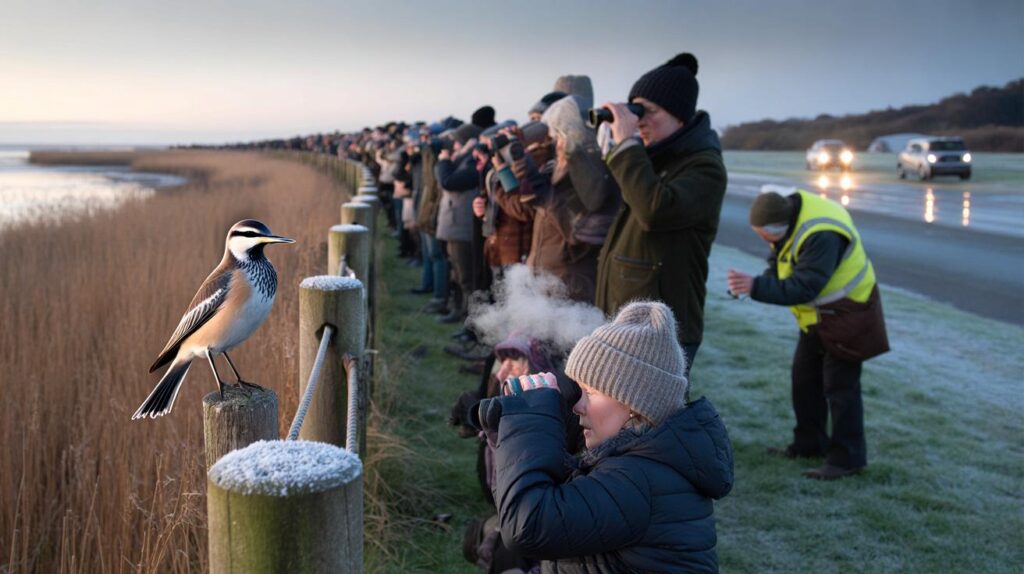
After a tip-off rippled through birding groups overnight, a coastal car park filled before sunrise. Hundreds lined a seawall in near-silence, strangers passing biscuits and swapping grid refs with numb fingers. Somewhere beyond the reeds, a bird not seen on British soil in 34 years flickered into view, sending a gasp rolling across the marsh like a gust. A rare visitor, almost mythic in its absence, was finally here — and the country came running.
It started with headlights kissing puddles at 5am. People padded out of cars with scopes on shoulders, coffees steaming, eyes raw from the drive. You could feel the tremor in the hush, the way crowds hold their breath together. Then, a soft ripple: someone whispered, “There.” All bodies tilted. The bird hop-flew to a fencepost, light catching its markings, and the line of watchers finally exhaled as one. **For a few heartbeats, time stopped on the seawall.** Phones stayed low. Binoculars lifted like a choreographed ballet. And then it vanished.
A once-in-a-generation sighting
The first thing you noticed wasn’t the bird. It was the feeling. People who’d never met shared thermos lids and tiny triumphs — “I’ve got it at ten o’clock, same line as the gorse.” The species, last recorded in the UK in 1991, perched briefly, then melted into cover, and that was enough to spark a collective surge of joy. Some folks cried and laughed at the same time. Scopes pivoted like lupins in a breeze. The marsh seemed to lean in, too, as if the reedbeds themselves were listening. And somewhere in that excitement was relief: we hadn’t imagined it. This legend had a heartbeat.
One man, a postie from Leeds, mumbled that he’d swapped his round with a mate and driven through the night. A mother lifted her daughter onto a fence bar so she could see over the shoulders, the girl’s cheeks pink with cold. Cars kept arriving, their tyres crunching the same frosty grit, and the access road snaked into a patient, idling queue. By mid-morning, the crowd stretched along the path for what felt like fields. Radios hissed. A warden in a hi-vis moved gently along the line, reminding people to hold the path and leave the sacrificial crop untouched. “It’s still in the same patch,” someone said, and heads turned like sunflowers.
Why did this matter so much? Because rare birds are tiny time machines. They connect us to weather patterns, shifting seasons, and the real distances of the world. A single vagrant blown off course hints at jet streams that kinked, insect hatches that rose, headwinds that eased for one fragile window. It’s also about a British subculture with its own folklore: the twitch. The chase, the tick, the shared lift, the volunteer who holds the line. There’s a village-economy side, too. A café can take a week’s takings in a day. B&Bs fill midweek in November. And there’s a conversation about care — how wonder and restraint can share the same frame.
How to see it well — and do right by it
Start with patience. Let the bird settle. If wardens have placed a rope or a sign, treat it as the edge of a living room. Take a spot with stable footing, set your tripod low against the breeze, and watch the vegetation, not just the empty air. Birds reveal themselves in patterns — a twig shiver, a sudden pause, the invisible string between a perch and a food source. Read the light. With the sun behind you, the colours lift and the heat-haze softens. If you’re new to scopes, keep both eyes open for a beat before you focus. It clears the wobble.
There’s a rhythm to big twitches that’s kinder for everyone. Park where directed. Keep dogs on short leads or leave them at home for this one. Stand short, not tall, and offer eyepiece time to kids who can’t see over the hedge. Zoom with your feet, not your voice. We’ve all had that moment when excitement boils over; take a breath and let it settle. Let’s be honest: nobody really does that every day. *You don’t need to sprint to the front to have a better day.* Turn off bird-call playback. Stay on paths. If the bird backs off or flicks its tail like a metronome, that’s a cue — give it space.
People who guard these places aren’t spoilsports; they’re stewards of future mornings like this.
“This is the sort of bird you wait a lifetime for,” said a warden, smiling behind a scarf. “If it leaves fed and calm, the next child in that line gets the same magic.”
- Warm layers in thin stacks, plus a windproof shell
- Spare battery for your phone and a power bank
- Binoculars (8x–10x); a scope helps at 40–60 metres
- Cash for honesty boxes, cafés and car parks
- Snacks you can share without crumbs in the optics
- OS map offline; signal vanishes when you need it most
- A small rubbish bag — leave it better than you found it
Why this fleeting moment lingers
The rarest thing here wasn’t a feather pattern. It was the way a hundred strangers became a single, generous crowd. Britons are good at this — the quiet queue, the polite shuffle, the collective intake of breath when a far migrant steps into our little weather window. **A bird we hadn’t seen since 1991 stood for a minute on a fencepost, and it rearranged people’s weeks, even their moods.** That might sound over the top, yet anyone who’s watched a kingfisher flare electric blue across a canal will get it. A sighting like this turns all of Britain into a small island again, ringed by luck and tide. It sends us home not with a trophy photo, but with a story that needs telling. Maybe you shared a brew with a stranger. Maybe your kid asked their first field question. Maybe you just remembered how to look.
| Key points | Details | Interest for reader |
|---|---|---|
| — | A bird absent from UK lists for 34 years drew hundreds to a coastal reserve | Understand the scale and significance of a once-in-a-generation twitch |
| — | Practical etiquette and viewing tips to see it well without stress | Make your trip smoother, kinder, and more rewarding on the day |
| — | What the sighting says about weather, migration and community | Connect a rare moment to bigger stories you can feel and share |
FAQ :
- What bird was it?A long-absent vagrant species, last recorded in the UK in 1991. Exact details were kept tight at the site to limit disturbance and crowding.
- Where did it show?At a small coastal reserve in eastern England, along a reed-fringed marsh and fence line. Sensitive habitats mean precise spots aren’t always published widely.
- When’s the best time to go?First light and the last hour before sunset. That’s when wind drops, insects stir, and a wary bird is likeliest to move between cover and favoured perches.
- How long will it stay?Vagrants can vanish in minutes or linger for days if they find food and calm. Good fieldcraft from visitors often makes the difference.
- What gear should I bring?Binoculars in the 8x–10x range, a spotting scope if you have one, warm layers, boots with grip, water, snacks, and a power bank for maps and updates.



Goosebumps reading this. Which species was it, acutally? The hush-then-gasp moment sounds unreal.