
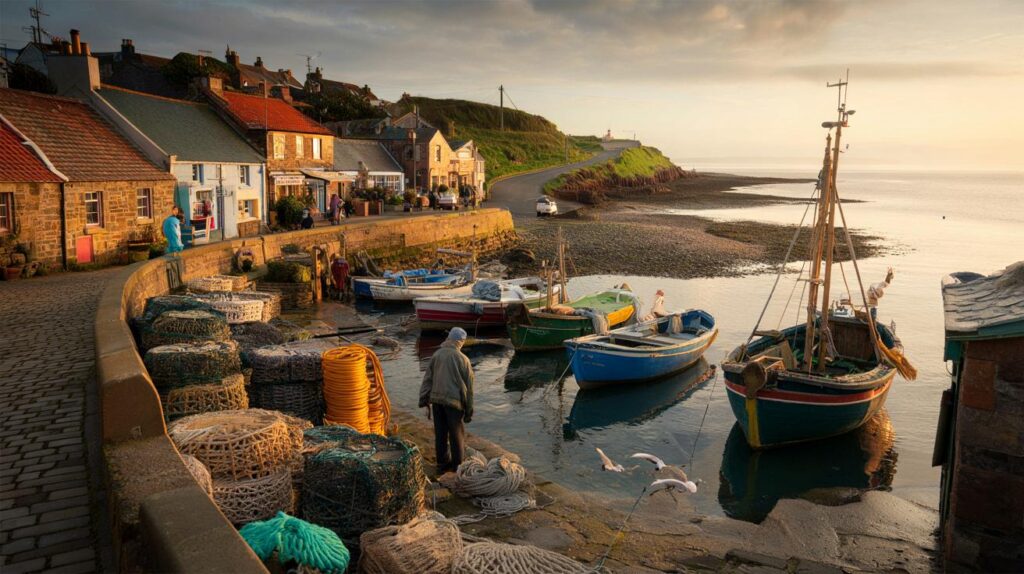
Between cobbles and sea spray, a small Scottish village is quietly drawing crowds for reasons that stretch far beyond postcard views.
On the East Neuk of Fife, Crail pairs a handsome, working harbour with a high street that still hums with everyday life. Visitors speak of a place that feels unchanged yet full of energy, where red-tiled roofs lean into sea winds and the scent of fresh baking carries down to the quay.
A harbour shaped by tide and time
Walk downhill and the village narrows into a pocket of stone, rope and salt. Low cottages in honeyed sandstone gather around a tiny harbour that seems lifted from a painter’s sketchbook. Lobster creels stack up on the quay. Fishing boats rise and settle with the tide. In the right light, the water turns a deep bottle-green.
Crail’s harbour is often named among the UK’s most beautiful: compact, authentic, and unmistakably lived-in.
This is no museum piece. You will meet skippers, not stewards. The clink of rigging and the shout from the slipway tell their own story about work at the water’s edge. Photography is irresistible here, but allow time to pause; the detail rewards a slower look.
A high street that still works
Up the hill, life continues around the butcher, the bakery and the grocer. Independent cafés keep doors propped open through most of the year. A pottery and a small gallery sell pieces fired and framed locally. In summer, the Crail Food Festival draws crowds with produce from the East Neuk and beyond.
A thriving high street of independents anchors Crail’s charm — not curated, just used.
That everyday bustle matters. It means you can plan a day without a car-bound detour for basics, and it hints at something rarer: a village built for its residents that still welcomes guests.
Roots that run for a millennium
History sits in plain sight. Crail’s story stretches back more than a thousand years. Its parish church carries stones from the 1100s, and the settlement gained royal burgh status in 1310 under Robert the Bruce. Markets once filled the streets and spilled into a generous central space.
Marketgate, the village’s old centre, was said to be the largest market square in Europe.
That legacy shapes the present. The plan of the village still funnels movement towards trade, and the scale invites walking rather than driving. You feel the pattern of old rights and routes with every turn onto another cobbled lane.
On the map: routes, paths and greens
Crail sits just under 10 miles south of St Andrews and roughly 90 minutes by car from Edinburgh, depending on the day and the season. The Fife Coastal Route passes the village, and the 117-mile Fife Coastal Path places Crail on a walking line that links sandy bays, rocky shelves and weathered harbours up the East Neuk.
Golf brings its own faithful. The Crail Golfing Society is one of the world’s oldest clubs, where fairways tip towards the sea and the wind sets the day’s test. Even non-golfers will appreciate the views from the headlands and footpaths that fringe the course.
By the numbers
- c. 1,000 years of recorded settlement
- 1310: royal burgh status granted by Robert the Bruce
- 117 miles: length of the Fife Coastal Path
- 90 minutes: typical drive from Edinburgh
- About 10 miles south of St Andrews
What people actually do with a day in Crail
Morning starts with a flat white and a warm roll from the bakery. The first stroll runs downhill to the harbour for photos before the light hardens at midday. A loop along the shore picks out rock pools and sea birds. Lunch is informal: fish and chips on a bench, or a bowl of soup in a café if the wind gets up.
Mid-afternoon brings a browse through ceramics and prints, then a second spell by the water as the day’s boats return. If you have time, push a few miles along the Coastal Path for broad views back towards the village. Golden hour can be spectacular; the stone glows and the roofs turn russet.
Practical pointers for your trip
- Timing: arrive early on fine weekends; parking and tables go fast when the tide of visitors turns.
- Footwear: cobbles and harbour steps can be slick; wear shoes with grip, especially after rain or in winter.
- Respect the quay: this is a working harbour; keep clear of gear and give crews room.
- Weather window: wind changes the mood; bring a layer even on warm days.
- Walking tips: the Coastal Path is waymarked; check tide times if you plan to explore the foreshore.
The mood that keeps people coming back
What sets Crail apart is the balance. Beauty is not polished to perfection; it is lived-in, slightly weather-beaten, honest. The village offers enough bustle to feel lively and enough quiet to hear the sea. For many, that mix is rare on Britain’s popular coastline, where commerce often drowns out character.
Conversations with shopkeepers add texture to a visit. You learn which fisherman hauls which pots, which baker uses local flour, which storms carved last winter’s bite out of the rocks. Those small exchanges fix the place in memory far more than any postcard image.
If you have longer than a day
A second day opens more options. Stretch the walk to nearby harbours along the East Neuk, where each village carries its own shape and story. Book a tee time if golf calls, or plan your trip to coincide with the food festival to sample Fife’s larder at pace.
Families can turn a visit into a low-cost coastal break. The short distances between beaches and harbours suit small legs, and the mix of cafés, benches and open space keeps scheduling simple. Bring binoculars for seabirds and a bucket for the rock pools.
Why Crail matters beyond the pretty picture
Crail shows how coastal places can thrive without shedding their skin. Independent shops survive because they serve residents first. The harbour earns its keep because boats still work the water. Visitors fit in because the village’s pattern—compact streets, human scale, clear routes—was built to handle footfall long before tourism had a name.
Crail’s model is simple: keep the working parts working, and the beauty looks after itself.
That approach brings practical lessons for other small towns. Invest in everyday services. Protect walking routes. Keep heritage useful, not fenced off. When the basics hold, a place can welcome new eyes without losing its own.
Extra context for planners and first-timers
If you are weighing a weekend, think seasonally. Spring delivers fresh greens on the fields and calmer paths. Summer is lively and broadens opening hours. Autumn light flatters the stone. Winter storms reshape the shoreline and crowd the cafés with locals; it is atmospheric, and cheaper stays are easier to find.
Combine Crail with a wider Fife loop to spread visitor spend. Small changes help: carry a reusable cup, choose local producers, and give yourself time. The reward is a richer day and a village that feels as good on your second visit as it did on your first.



Definately one of the most charming corners I’ve seen. The red tiles, the bottle‑green water, lobster creels piled high—feels lived‑in, not polished. Love that the high street actually works for locals too. The balance of bustle and quiet sounds perfect. Putting this on my next Fife loop; I can almost smell the bakery and hear the rigging clink already.