
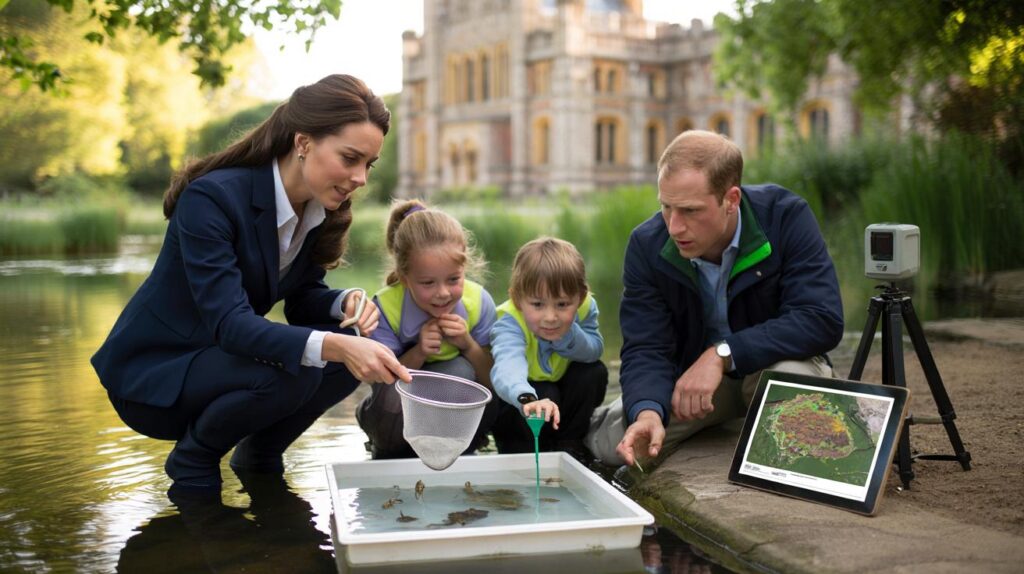
New term, new rhythm, and a polished wardrobe hint at a fresh chapter for the Waleses’ public engagements in London.
The Princess of Wales returned to the spotlight alongside the Prince of Wales at the Natural History Museum, pairing a smart blazer with a crisp shirt as they picked up royal duties after the summer break. The visit combined two of their long-running priorities: William’s push for conservation technology linked to his Earthshot Prize, and Catherine’s work with children’s social and emotional development through nature-based learning.
A poised return with William
Arriving in South Kensington, Catherine cut a refined figure in a tailored jacket and shirt, keeping accessories minimal. The look framed a practical, on-the-move engagement that blended scientific briefings with hands-on learning in the museum’s outdoor spaces. William, meanwhile, focused on how data-led tools can accelerate conservation research, a field his Earthshot platform has pushed into the mainstream.
Earthshot thinking met museum science: ideas that once lived on pitch decks are now being tested in ponds, plots and labs.
For the museum, the royal visit shone a light on active fieldwork. For the couple, it underscored how technology and education can reinforce each other when the goal is protecting nature, not just admiring it from afar.
What brought them to South Kensington
William looked at how new technology supports the museum’s conservation projects, from monitoring habitats to analysing species recovery. He heard how better data can point teams to the right interventions faster, and how partnerships with universities and start-ups are shortening timelines between trials and impact.
Catherine headed outdoors with schoolchildren for pond-dipping sessions. Nets, trays and field guides turned the garden pools into mini-labs. Staff also briefed her on the National Education Nature Park, a programme that helps schools connect lessons with local biodiversity and build skills like teamwork, patience and reflection.
Seven moments you might have missed
- The Waleses chose a joint outing to align tech innovation with children’s wellbeing in nature.
- Catherine’s blazer-and-shirt look signalled businesslike intent rather than red-carpet fanfare.
- William examined conservation tech with real-world uses for museum field teams.
- In the gardens, Catherine joined pupils at the water’s edge for pond-dipping and species ID.
- Teachers discussed how outdoor learning supports emotional regulation and confidence.
- Museum staff outlined the National Education Nature Park’s tools for mapping school grounds.
- The visit echoed Catherine’s recent nature films and her personal focus on recovery and balance.
A longer story of nature and recovery
Catherine’s return to the museum links to a broader strand of her work. Over recent months she has championed short seasonal films that encourage people to reconnect with the outdoors. In the spring instalment, released in May, she framed nature as a place to steady the mind and rebuild after difficulty, emphasising how time outside can nurture growth at every stage of life.
To her, nature functions as sanctuary: a setting that steadies the mind, supports healing and invites small daily resets.
That message sharpened last July when, during cancer treatment, she publicly backed the reopening of the museum’s gardens. She praised the project as a space that would help visitors of all ages reconnect with the natural world and understand how to care for it. She also reflected on how being outdoors had supported her physically, mentally and spiritually.
April’s mountainside conversation
In April, Catherine joined a group of young explorers near Lake Windermere for a short film with Chief Scout Dwayne Fields. It was their first on-camera conversation since his appointment in September 2024. Dressed for the weather in a beige wool turtleneck, jacket and a flat cap, she spoke about the intense, almost spiritual quality she finds in wild places. Her point was simple: not everyone feels it the same way, yet the outdoors can offer a powerful reset in a busy world.
At a glance: the numbers
| Number | What it refers to |
|---|---|
| 2 | Key focuses: conservation tech and pupils’ wellbeing in nature |
| July 2024 | Kate’s message supporting the museum gardens reopening during treatment |
| September 2024 | Dwayne Fields named Chief Scout |
Why this matters for schools and families
The National Education Nature Park is designed to help teachers turn every patch of school ground into a learning resource. Pupils can survey their site, map habitats and plan small improvements. Confidence grows as children spot change week by week: more pollinators on a verge, clearer water in a barrel pond, richer soil in a planter. These tasks also build soft skills—listening, patience, turn-taking—that underpin classroom life.
Small, regular actions add up: a 15-minute wildlife check each week can transform how pupils notice and care for their surroundings.
For families, the museum gardens offer a low-pressure way to try outdoor science together. A short visit can anchor a term’s worth of questions. Start with one tiny mission—find three water creatures, identify two plants, note one bird call—and let children lead the pace. Pair observations with sketching or a quick tally to make progress visible.
Try this at your next visit
- Set a mini-challenge: list three pond species and describe one adaptation each.
- Bring a notebook: draw what you see, then write one question to check at home.
- Use your phone sparingly: take a single photo, then keep eyes up and hands free.
- Safety first: supervise near water, and wash hands after handling trays or nets.
- Link to school topics: habitats for science, adjectives for English, tally marks for maths.
Context for William’s tech focus
Conservation teams have shifted towards smarter, faster tools—sensors, imaging, and better data handling—to track change and target effort. The museum’s researchers showed how partnerships turn trials into fieldwork, and how clarity on the problem saves money and time. William’s interest sits at that junction: make innovation useful, not just impressive, and measure success by outcomes on the ground.
Pond dipping, explained
Pond dipping is a simple survey technique. You sweep a net through shallow water, transfer finds to a tray, and identify creatures with a guide. Children learn to handle equipment, observe carefully and return wildlife safely. The exercise supports calm focus and gives quick feedback: every net brings a new surprise. It works in school ponds, community gardens and museum sites.
Taking it beyond the museum
If you have access to a local park or water feature, you can adapt the activity. Swap nets for a clear jar on a string to check shallows. Focus on noticing rather than collecting. Log what you find, then repeat after rain or a warm spell to compare conditions. Risks are manageable with supervision, non-slip footwear and handwashing. The advantages stack up: fresh air, teamwork, and a shared sense of care for nearby nature.



Thrilled to see Kate back—substance over spectacle. The pond-dipping segment was the higlight, and the tech angle felt useful, not flashy. The 3 numbers are 2, July 2024, and September 2024, right?
All for conservation tech, but where’s transparent evidence of impact? “Faster timelines” sounds nice; show species recovery rates, control sites, and costs saved. Less vibe, more verifiable data, pls.