
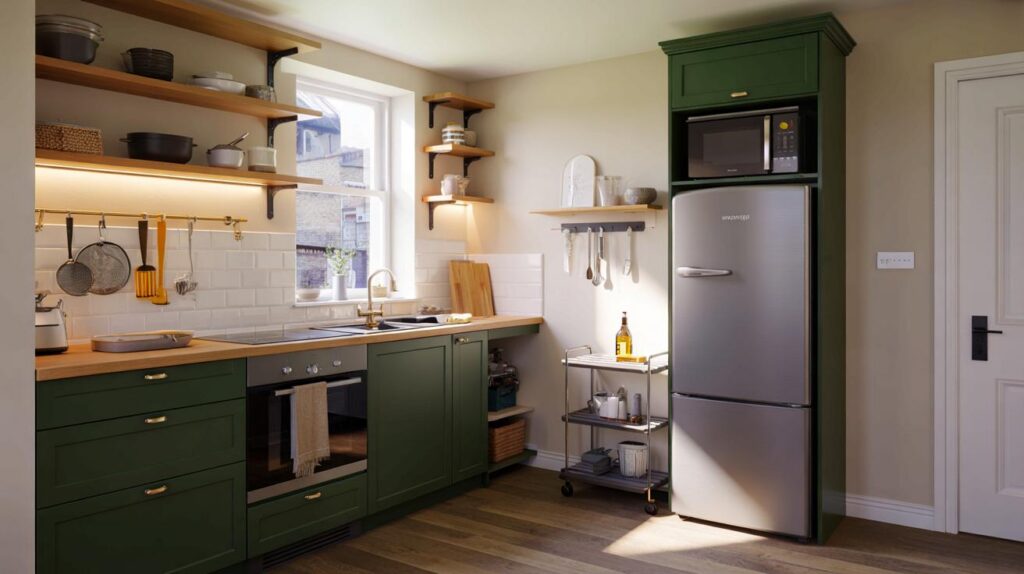
In a country of tight terraces and rented flats, the kitchen often shrinks to a slim corridor between a boiler and a back door. Space is precious, mornings are frantic, and the worktop is never quite clear. The question isn’t “How big is your kitchen?” It’s “How well does it move?”
It’s 7.42am in a South London galley. Toast pops, the kettle chatters, and a sliver of sunlight hits a pile of mixing bowls that never found a home. Someone’s lunchbox is in the fruit bowl. A saucepan, still warm from last night’s pasta, hogs the only decent stretch of worktop like a commuter on a packed train. You slide a chopping board over the sink to gain ten inches and find yourself cooking in a shoebox, yet it feels strangely hopeful. When you shift one thing, the whole room shifts with it. What if the space isn’t the problem?
Use the room’s height, not just its footprint
**Go vertical**. That’s the small-kitchen superpower nobody teaches at school. Walls aren’t just walls; they’re storage waiting to happen. A slim rail above the splashback holds pans, a ladle, the sieve that otherwise eats a drawer. Add a knife strip and under-shelf baskets, and your most-used kit floats, ready to grab. Leave the counter for “now” tasks, push everything else up and off the plane where you chop, pour, and plate. Suddenly, the room breathes.
Picture a Victorian terrace in Leeds with a chimney breast that steals a corner. Jess, who cooks like she means it, screwed a timber batten into the alcove studs and ran 300mm shelves to the ceiling. Baking tins on the top, everyday bowls at shoulder height, trugs for snacks at hip height. She swears the kitchen feels larger, not because it grew, but because her hands don’t search anymore. The wall became a tidy, quiet backdrop rather than a jammed patchwork of stuff.
Why this works is less about capacity and more about sightlines. Clutter at eye level makes a room feel busy; order makes it recede. When vertical storage groups like-with-like and keeps silhouettes simple, your brain stops scanning for where the whisk went. You move in a straight line: reach, use, return. *Small kitchens aren’t a design flaw; they’re a prompt to get clever.* Add one more shelf than you think you need, and leave a little breathing space so the wall doesn’t shout.
Make cupboards behave like well-run shops
Cabinets should work like grocery aisles: face-out, first-in-first-out. Fit risers so plates aren’t stacked to the ceiling, slide-in baskets for packets, and a lazy Susan in the blind corner that usually eats jars whole. Swap round tubs for square, and keep a narrow bin for “decant later” so you’re not decanting mid-dinner. Label the shelf edge, not everything inside. That way, the rule lives in the cupboard, not your head. It’s boringly efficient. You’ll love it.
We’ve all had that moment when a bag of pasta avalanches from the top shelf and ruins your tea. A couple in Glasgow turned that shelf into two half-depth risers, then added a soft-close pull-out for sauces. Their rule: nothing deeper than your forearm unless it pulls out. It changed the way they cook midweek—no more rummage, no repeat buys, no passive-aggressive jars at the back. Let’s be honest: nobody does that every day.
Big traps? Buying bins that are too deep, giving every gadget a shrine, and storing by brand rather than by task. Keep micro-zones: “make a brew” lives together, “morning cereal” lives together, “pasta night” lives together.
“Treat the inside of a cupboard like prime London rent,” says Hannah Dean, a kitchen fitter in Bristol. “If it doesn’t earn its keep weekly, it moves up, out, or on.”
- Use shelf risers to split dead air into usable tiers.
- Install pull-outs under the sink for cleaners and cloths.
- Put a lazy Susan in dead corners; nothing gets lost.
- Label shelf edges for tasks: Brew, Bake, Breakfast.
- Keep one “overflow” basket for batch buys, nothing more.
Flow beats square footage
Think like a café: the path from fridge to hob to sink should feel obvious. Set a 30cm “landing pad” by the fridge for deliveries, a heat-safe pad by the hob for hot pans, and a chopping board that bridges the sink when you need extra counter. If you rent, go sticky: removable hooks for mugs, rail with adhesive pads, and stacking trolleys that roll between the bin and back door. **Clear the sink zone** and you’ll feel as if the room doubled.
Reduce visual noise so your head stays calm when your hands are full. Match containers roughly, keep colours quiet in open storage, and group items by height so lines remain smooth. Push the microwave onto a sturdy wall shelf, lift the toaster on a small riser, and tuck trays into a narrow vertical rack near the oven. One in, one out, no exceptions. **Store like a grocer**, cook like a pro.
When you’re tight on square metres, your habits are the true cabinets. A Sunday ten-minute reset: clear the drying rack, refill tea and coffee jars, corral plastic tubs, wipe the rail. If you skip it, the room will tell you on Tuesday. The trick isn’t perfection; it’s rhythm.
The biggest unlock is editing with mercy. The extra blender jug, the fifth baking tray, the novelty mugs from a hen do fifteen summers ago—these stories don’t vanish if the objects do. Keep the mug you actually reach for at 7am. Everything else can be boxed high or find a new kitchen to love. You’re not chasing Scandinavian showroom vibes; you’re building a small room that lets you cook on a Wednesday without swearing.
Your fridge door is a command centre you haven’t hired yet. Magnetic hooks hold measuring spoons, a shallow magnetic shelf corrals oil and salt above the hob, and a whiteboard squares the shopping list with what’s already in the freezer. Keep a shallow basket on top of the fridge for onions, garlic, and the emergency chocolate you swear is “for guests”. Height you can’t touch is still useful for light, low-risk things.
Lighting is the quiet organiser. Battery under-cabinet strips make the counter feel twice as wide. A brighter bulb over the sink changes your mood at 9pm when the washing-up looks like a mountain. If you can swing it, a single pendant on a warm dimmer softens the room after dinner, when the kitchen turns back into a corner of your life rather than a to-do list.
Renters can still claim corners. Tension rods make instant cleaning caddies under the sink. A slim trolley slots beside the fridge for tins and cling film. Removable rails take spatulas and tongs off the counter without a drill in sight. And if your landlord is twitchy, 3M hooks will keep calm and carry on. Space doesn’t appear; it’s invited.
The British bin situation is real. Food waste, recycling, general bin—three categories before you’ve even boiled an egg. Stackable bins solve the footprint problem, and a small caddy on the counter saves drip walks to the main bin. Keep liners tucked on a hook inside the cupboard door. Mundane, yes. Also the thing that stops Wednesday night from wobbling.
If your kitchen opens to the living area, treat the view like a scene. One handsome tray hosts the kettle, sugar, and mugs. A small plant on the windowsill earns its keep by hiding the washing-up brush. A fabric roman blind softens all the rectangles. You don’t have to fake pretty. You just need a single calm corner that tells your brain, It’s fine.
People worry about appliances. Air fryers are brilliant, but they’re beach balls in a broom cupboard. Give them a home or let them go. The best tool is the one you can reach with wet hands while the onions don’t burn. That’s the test. Keep it close or keep it moving.
There’s a liberating truth under all this: your kitchen isn’t asking to be bigger; it’s asking to be kinder to your day. When your tea things live together and your knives sit exactly where you expect, home starts before the kettle boils. That tiny wobble of pride you feel when a drawer glides and everything fits? It’s not about storage. It’s about time returning to you.
None of this requires a rip-out or a new mortgage. A rail, a riser, a lazy Susan, a light strip—small money, big effect. The joy is cumulative: each little upgrade nudges the next one into place. You’ll find yourself cooking differently, cleaning faster, and inviting friends over on a Thursday just because the room no longer argues with you. And when you walk in after a long day and everything is where it should be, it feels like the house made you a cup of tea first. That’s the goal, really.
| Point clé | Détail | Intérêt pour le lecteur |
|---|---|---|
| Vertical first | Rails, knife strips, high shelves with breathing space | Clears counters, faster reach, calmer sightlines |
| Shop logic | Risers, pull-outs, task-based zones, shallow depths | No rummage, fewer duplicates, smoother weeknights |
| Flow and light | Landing pads, sink bridge board, under-cabinet LEDs | Feels bigger, works quicker, nicer after dark |
FAQ :
- How can I add storage in a rental without drilling?Use adhesive rails and hooks, magnetic knife strips, tension rods under the sink, and a slim rolling trolley. When you move, it all comes off cleanly and comes with you.
- What’s the most space-saving upgrade under £50?A set of shelf risers and one lazy Susan. They turn dead air into tiers and rescue the dark corner, which is where sauces go to be forgotten.
- Where should the air fryer live in a tiny kitchen?If you use it twice a week, give it a low, pull-out shelf near the socket. If not, store it high and swap it in only for batch cooking. Big tools need a rule.
- How do I stop the corner cupboard from becoming a black hole?Add a large lazy Susan or a pair of pull-out trays. Keep only one category there—baking, or dry goods—so your brain isn’t hunting three things at once.
- What’s the quickest habit that changes everything?A two-minute night reset: clear the drying rack and return five items to their zones. It’s small, repeatable, and sets tomorrow up without drama.



Brilliant piece—“vertical first” finally clicked for me. I added a rail and a knife strip last weekend; the worktop actually breathes now. Any tips for keeping open shelves tidy in a rental when you can’t repaint the scuffed wall behind?