
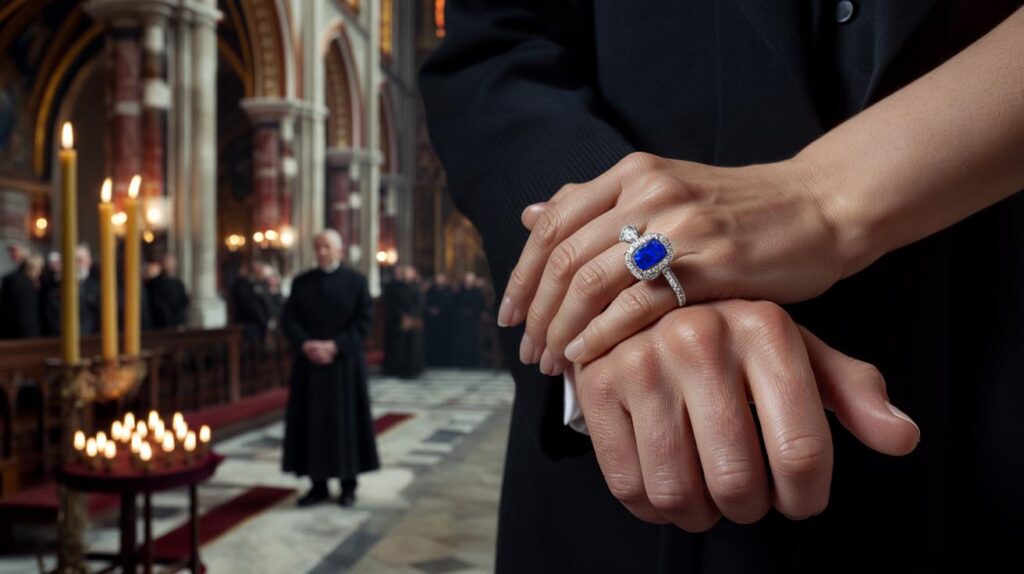
A quiet gesture drew glances at Westminster Cathedral as the Kent family gathered in black across two solemn London days.
Amid hymns and hushed footsteps, Lady Helen Taylor stood close to her father, the Duke of Kent, during a private vigil and the funeral of her mother, Katharine, Duchess of Kent. Observers noticed a discreet tribute on Lady Helen’s right hand. It signalled lineage, love and memory at a moment of national reflection.
A ring that speaks across generations
Lady Helen chose her mother’s engagement ring for both the vigil and the funeral. The move said more than any eulogy. The Duchess and the Duke of Kent became engaged in March 1961. The ring, an oval sapphire flanked by round diamonds and mounted in platinum, has long stood as a symbol of the couple’s union and the Duchess’s understated taste.
The design echoed one owned by Princess Marina, the Duchess’s mother‑in‑law, whose own oval sapphire was also set with diamonds. That visual rhyme matters in royal jewellery. It traces a line through generations, aligning private sentiment with public tradition.
The 1961 oval sapphire, in platinum with round diamond shoulders, returned to the spotlight on Lady Helen’s hand.
The 1961 sapphire and its echoes
Sapphires carry associations with loyalty and constancy. Placing that stone at the centre of a farewell underlined the couple’s 61‑year marriage. It also acknowledged the Duchess’s role as a steady presence within the wider family over decades of service, charity patronage and quiet counsel.
A farewell rooted in faith and protocol
The Duchess died on 4 September at Kensington Palace, aged 92. The family held a private vigil at Westminster Cathedral on Monday 15 September, with the Rite of Reception and Vespers. The Requiem Mass followed on Tuesday 16 September, with Their Majesties the King and Queen and other members of the royal family in attendance.
Her conversion to Catholicism in 1994 shaped the rites. The funeral marked a modern first for a royal Catholic service, and the first royal funeral held at Westminster Cathedral since its opening in 1903. The coffin travelled from Kensington Palace in the Royal Hearse, designed under Queen Elizabeth II, and draped in the Royal Standard.
A modern first: a royal Catholic Requiem at Westminster Cathedral following the Duchess’s 1994 conversion.
From Kensington Palace to Westminster
Departure from the palace began with a piper from the Royal Dragoon Guards, a regiment the Duchess served as Deputy Colonel‑in‑Chief since its formation in 1992. At the Cathedral, a Bearer Party founded by the Royal Dragoon Guards received the coffin. The Duke and Lady Helen walked together, arm‑in‑arm, as the coffin entered the church, a tender moment that captured the day’s intimacy.
Who stood with the duke
The service drew immediate family from across the Kent branches. Ten grandchildren joined their parents to honour the Duchess’s life.
- George Windsor, Earl of St Andrews, with his wife Sylvana Palma Tomaselli and their three children: Edward Windsor, Lord Downpatrick; Lady Marina Windsor; Lady Amelia Windsor.
- Lady Helen Taylor with her husband Timothy Taylor and their four children: Columbus, Cassius, Eloise and Estella.
- Lord Nicholas Windsor with his wife Paola and their sons: Albert, Leopold and Louis.
- Lord Frederick Windsor and Lady Gabriella Kingston attended; Frederick’s wife, Sophie Winkleman, joined them.
- Prince Michael of Kent arrived early; Princess Alexandra came by taxi and used a wheelchair, supported by her children, James and Marina Ogilvy.
Age 92. Sixty‑one years married. Ten grandchildren at the Cathedral pews.
What the sartorial code said
Black dominated the pews, as custom dictates during a period of royal mourning. Lady Helen’s styling followed the code with precision. The single standout was the sapphire ring. Statements in mourning dress tend to lean subtle: a brooch from a parent, a string of pearls, a cufflink with family history. The ring fit that language, placing memory at the centre while keeping the silhouette restrained.
Lady Marina and Lady Amelia Windsor arrived together, both dressed in black, their appearance mirroring the family’s unity. The Duke’s siblings, Prince Michael and Princess Alexandra, set the tone of steady support. Small signals carried weight: linked arms, shared cars, and careful order at the west door.
Moments and milestones at a glance
| Event | Date | Place/Detail |
|---|---|---|
| Engagement | March 1961 | Oval sapphire engagement ring in platinum with diamond shoulders |
| Wedding | June 1961 | York Minster |
| Conversion to Catholicism | 1994 | Shaped funeral rites at Westminster Cathedral |
| Death | 4 September 2025 | Kensington Palace, aged 92 |
| Vigil (Vespers) | 15 September 2025 | Westminster Cathedral |
| Requiem Mass | 16 September 2025 | Westminster Cathedral; King and Queen in attendance |
Faith, family and the route to Frogmore
After the Requiem, plans set the Duchess’s burial at the Royal Burial Ground, Frogmore, Windsor. That resting place gathers multiple generations, tying her story to the wider royal narrative. The route from palace residence to Cathedral and then to Windsor followed precedent, but each stage also reflected her personal journey in faith.
The Prince and Princess of Wales joined relatives in paying respects during the mourning period. The family wore dark clothing and black armbands on duty. Protocol framed the days, yet private grief sat in plain view.
Why a ring matters on a day like this
Jewellery choices at state occasions often distil layers of meaning. Sapphires signal fidelity. Platinum suggests purity and strength. Diamonds flanking the centre stone draw the eye to the piece’s heart. By wearing the ring at both the vigil and the Mass, Lady Helen anchored her mother’s memory at the centre of the farewell, while acknowledging Princess Marina’s earlier chapter through the design echo.
Such heirlooms also provide continuity for younger generations. Grandchildren see how remembrance can be woven into dress. They learn that restraint can communicate as clearly as oratory. They notice that a single piece can carry six decades of marriage, the arc of public service and the bonds that hold a wide family together.
Useful context for readers
Royal mourning has a quiet vocabulary. Pearls appear frequently because they suggest tears. Sapphires and emeralds sometimes surface when they relate directly to a family story. If you follow future services, look for recurring motifs: a regiment’s badge, a brooch linked to a date, or a gemstone that ties back to an engagement. These details rarely happen by accident.
Heirloom rings need care, especially pieces from the early 1960s. Platinum is robust, but claws can loosen. Sapphire hardness resists scratches, yet stones can chip at edges. Families often schedule checks before key events to ensure settings hold under bright lights and long services. Simple measures, such as avoiding ultrasonic cleaners for very old mountings, preserve both metal and stone.
Music and military presence also carry meaning. A lone piper, as heard when the hearse left Kensington Palace, signals respect from a regiment with personal ties. Bearer Parties drawn from associated regiments strengthen that bond, linking service uniforms in the nave to decades of patronage and support.



Beautifully observed. The 1961 oval sapphire felt like a quiet anchor in the service—loyalty, constancy, and memory distilled into one ring. And the echo of Princess Marina’s piece tied it all together. Thank you for catching that detail 🙂
“10 heirs” sounds a bit tabloid—aren’t they ten grandchilren rather than direct heirs? The phrasing muddies the line of succession.