
The last flying Avro Vulcan bomber — the thunderous, delta‑winged XH558 — faces a stark new deadline. Without rapid funding and a permanent home, the aircraft that once rattled tea cups across Britain could slip from public life for good. An urgent appeal is now live. Time is short.
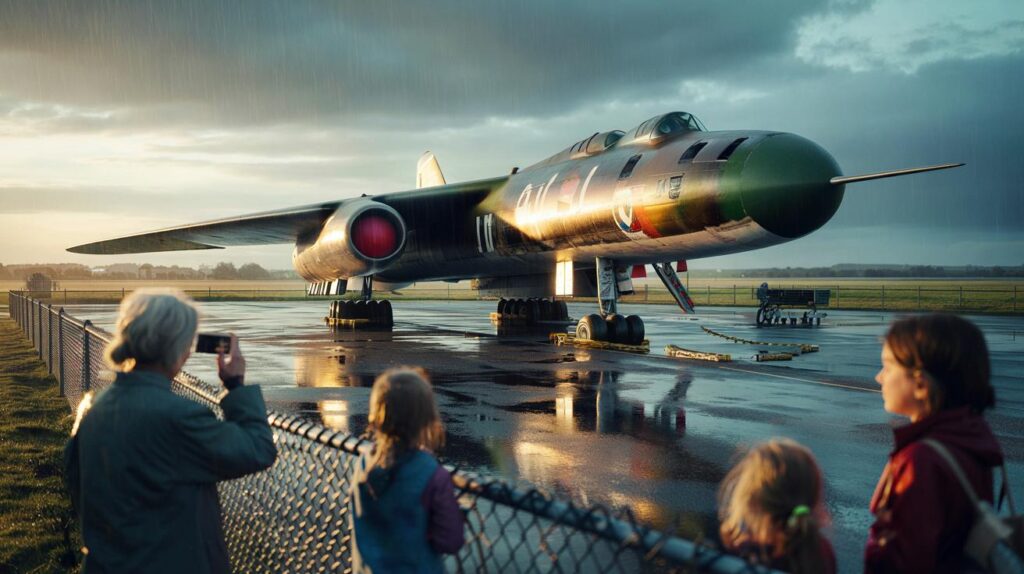
The wind came in across the old airfield like a memory. A handful of visitors pressed their palms to a chain‑link fence, phones lifted, trying to catch the Vulcan’s outline as the light softened to gold. You don’t hear her howl anymore. But even parked and silent, XH558 still fills the sky, all angular grace and heavy history.
One man pointed to the delta wing and told his son about the day this bomber rolled for take‑off, a roar you felt in your ribs. Another woman wiped rain from her screen and whispered, “We can’t lose her.” The aircraft looked almost close enough to touch, yet somehow already receding. Something is about to give.
The knife‑edge moment for Britain’s last flying Vulcan
XH558 is not just a museum piece. Built for the Cold War and returned to flight for a second life on the airshow circuit, she closed her flying career in 2015 as “The Spirit of Great Britain.” Since then, the aircraft has lived a limbo life: celebrated by millions, homeless in practical terms. The closure and reshaping of her former base left the Vulcan exposed to weather, uncertainty and a race against corrosion.
Walk a perimeter at dusk and you’ll see why the clock is ticking. Aluminium hates standing still in damp air. Seals harden. Tyres flat‑spot. Electrical looms don’t like the cold. Volunteers do what they can — desiccant in bays, frequent checks, careful towing — yet an aircraft built to fly always loses a little of itself when fixed in one place. It’s like asking a shark to nap in a rock pool and calling it safe.
That’s the crux of the new appeal: to fund a secure, permanent shelter and a proper public home, with interpretation that matches the aircraft’s significance. The charity behind XH558 says the plan is ready; what’s missing is the money and the paperwork alignment to make it happen fast. No politician wants to be the one on watch when Britain’s last flying Vulcan slips out of reach. Yet that’s exactly where we are.
What needs to happen now — and how the public can move the needle
There’s a practical, step‑by‑step path from risk to safety. First, fund a weatherproof shelter to halt time: controlled environment, secure boundary, monitored access. Next, formalise the site deal so the aircraft isn’t living on borrowed tarmac. Finally, build out the visitor experience that pays its way — guided access to the cockpit, engineering exhibits, and thoughtful storytelling that makes a Cold War machine make sense today. Start with the roof. Future follows.
People ask what difference one donor makes. Plenty. Small monthly gifts stabilise cashflow, corporate partners unlock materials and crews, and social shares pull in the quiet enthusiasts who never step forward until the moment feels urgent. We’ve all had that moment when a childhood noise — a howl in the sky, a rumble underfoot — connects the past to the present in a flash. That spark is fundraising fuel. Let it catch.
Soyons honnêtes : nobody follows every heritage appeal, every week. But this one carries a rare weight. XH558 is the last of her kind to have flown in our lifetimes, the aircraft that made pensioners cry and teenagers look up at the same time. “If not us, who?” goes the old volunteer line, not as a boast but as a shrug.
“We can’t let her fade behind a fence.”
Here’s a quick way to help today:
- Give once or set a small monthly — Gift Aid it if you can.
- Ask your employer about match funding or payroll giving.
- Share the appeal with a personal note and an old photo.
- Offer skills: PR, legal, construction, HVAC, security.
- Write to your local representatives to back the site deal.
A living memory worth the effort
Saving XH558 is bigger than saving an airframe. It’s about protecting the physical sound and shape of a modern British myth — an aircraft that absorbed national fear and showed national audacity. History is often a room of glass cases. This one still breathes. When a Vulcan start‑up rattled windows, you felt a piece of the country’s industrial heartbeat. That’s not nostalgia. That’s connective tissue you can point at and say: we built that, we learned from that, we carried that forward.
There’s also a straight line from today’s STEM skills gap to whether we keep machines like this visible, explorable and explained. Kids don’t fall in love with diagrams; they fall in love with presence. Let them smell hot metal and hydraulic oil. Let them meet the engineers who keep impossible shapes safe. That’s how you turn a photo in a book into the spark that sends someone to college, to an apprenticeship, to a patent.
The appeal is urgent because time is a harsher critic than any accountant. Rivets won’t wait for committee minutes. Nor will public memory. If XH558 vanishes from view, Britain loses both an artefact and a stage where generations meet in open air. Share the link. Nudge a friend. Ask a company to step in with materials or manpower. A bomber built for a dark purpose became, in retirement, a flying bridge. Keeping that bridge standing is on us now.
| Key points | Details | Interest for reader |
|---|---|---|
| Last flying Vulcan at risk | XH558 lacks a permanent, weatherproof home after base changes | Sense of urgency; chance to act before loss becomes permanent |
| Urgent appeal launched | Charity seeks funds, partners and a secure site agreement | Clear ways to help: donate, share, volunteer, corporate support |
| Why it matters | A living piece of Cold War and British engineering heritage | Inspires STEM interest; preserves a rare national story |
FAQ :
- What exactly is XH558?The last Avro Vulcan bomber to fly, retired from air displays in 2015 and preserved for public engagement.
- Why could it “disappear”?Without a funded, permanent home and shelter, public access could end and the aircraft may deteriorate out of view.
- Can the Vulcan ever fly again?No. It’s preserved for ground taxi and exhibition only; airworthiness support and certification are no longer viable.
- How can I help right now?Donate to the official appeal, enable Gift Aid, share the campaign, offer professional skills, and encourage corporate/municipal backing.
- What happens if the funding target isn’t met?Risk escalates: prolonged exposure, mounting costs, and the possibility that public access ends or relocation becomes forced and damaging.



Visited XH558 in 2012—the howl lived in my ribs for days. This isn’t just nostalgia; it’s living engineering that sparks kids into STEM. A weather‑proof shelter and a proper site deal are not luxuries, they’re life support. If the plan’s ready, publish the milestones and let supporters track progress. I’ll set a small monthly (definately Gift Aid) and ping my employer for match funding. Don’t let the last delta fade behind a fence.