
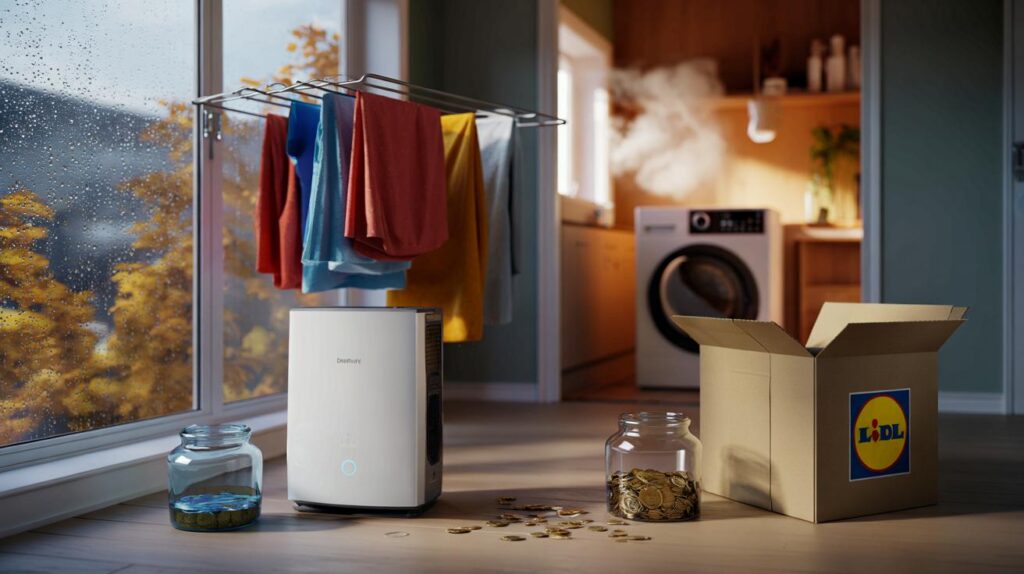
Drying laundry indoors this winter can leave rooms damp, clammy and costly. Households are hunting cheaper ways to keep clothes drying.
Energy bills have inched up again and many families are rethinking how they get washing dry without paying through the nose. A new budget dehumidifier arriving in Lidl’s middle aisle next week aims to turn steamy rooms into cheaper drying zones.
Martin Lewis’ laundry swap that cuts bills
Money-saving guru Martin Lewis has long championed using a dehumidifier to dry clothes instead of relying on a power-hungry tumble dryer. His point is simple. A small appliance sipping a few hundred watts can remove moisture from the air for pennies per hour, while a tumble dryer often gulps two to three kilowatts.
The maths has shifted with the latest cap. From 1 October to 31 December 2025, Ofgem’s typical electricity unit rate sits at an average 26.35p per kWh across Great Britain. Rates vary by region and supplier, and this excludes the daily standing charge.
At an average 26.35p per kWh, a 245W dehumidifier costs about 6.5p per hour to run.
By contrast, a 2kW dryer at the same tariff costs roughly 52.7p per hour. A 3kW machine hits around 79.1p per hour. During pricier months last year, that top end often brushed £1 per hour, which is why the switch still resonates.
Lidl’s Tronic dehumidifier: price, specs and date
Lidl releases a new Tronic Dehumidifier in stores on Thursday 16 October, priced at £74.99. Stock is limited by branch, so early visits may pay off.
- Power draw: 245W (approximate running cost 6.5p per hour at the current average cap)
- Tank capacity: 2.1L with a viewing window
- Moisture removal: up to 10L (manufacturer-stated extraction rate)
- Modes: laundry mode and standard dehumidifying mode
- Safety: full tank warning and overflow protection
- Availability: in-store only, limited quantities from 16 October
£74.99 next Thursday, two programmes including a laundry mode, and up to 10L moisture extraction.
How the running costs stack up
Here is a quick comparison of typical hourly costs at 26.35p per kWh. Figures are indicative and depend on the exact model and settings.
| Appliance | Approx. power | Estimated cost per hour |
|---|---|---|
| Dehumidifier (Lidl Tronic) | 245W | £0.065 |
| Dehumidifier (compact example) | 200W | £0.053 |
| Tumble dryer (lower end) | 2kW | £0.527 |
| Tumble dryer (higher end) | 3kW | £0.791 |
Worked example for a load of washing
Drying a typical load on a heated clothes horse with a dehumidifier running nearby might take 3–5 hours, depending on room temperature and airflow. Using the Lidl unit for four hours at 6.5p per hour adds roughly 26p to your bill. A single hour in a 3kW tumble dryer at the current cap lands near 79p, and two hours would be about £1.58. Families who dry several loads per week could trim several pounds per month by making the switch more often.
How to get the best from a dehumidifier
Placement and routine matter. The aim is to keep relative humidity around 50–60% while moving air over the fabric.
- Dry clothes in one room with the door closed to focus extraction.
- Position the unit close to the clothes horse and keep air paths clear.
- Use laundry mode to boost extraction and airflow.
- Angle a small fan across the clothes for faster evaporation if you have one.
- Empty the tank before each session to avoid auto-stop mid-dry.
- Ventilate briefly after drying to refresh the room and manage condensation elsewhere.
Homes fighting condensation on windows or spots of mould on cold walls may also benefit. Reducing indoor humidity cuts the risk of damp patches, protects plaster and paint, and helps soft furnishings last longer during wet months.
What else lands in the middle aisle
Alongside the dehumidifier on 16 October, Lidl plans seasonal stock including indoor and outdoor plants, thermal clothing for adults and children, and other household staples. These lines tend to rotate quickly. Checking the range online before you set off can save a wasted journey, but you will still need to buy in store.
Who should consider buying
Flat-dwellers without outside space, families who run the dryer daily, and anyone battling condensation stand to gain most. A dehumidifier that costs just a few pence per hour can take the strain off the grid and the wallet. It also doubles as a moisture manager for spare rooms, garages and utility areas where damp smells linger.
What to check before you pay
- Noise and size: make sure the footprint suits your drying room and the hum won’t bother sleepers.
- Drainage: if you dry clothes often, consider whether you can route a hose to a sink to avoid emptying the tank mid-cycle.
- Filters: rinse or replace as advised to keep airflow strong.
- Warranty and returns: keep the receipt and check the store’s policy because stock is limited and replacements can sell out.
The numbers behind that 7p claim
Energy costs come from power times time. The unit’s 245W is 0.245kW. Multiply by the unit rate to get the hourly cost: 0.245 × 26.35p = 6.46p. If your regional rate is higher or lower than the GB average, your figure changes in step. For a 200W model, the same calculation gives about 5.27p per hour. The approach also lets you budget for longer runs. Two hours at 6.46p adds 12.9p. Eight hours adds about 51.7p.
Rule of thumb: each 100W of power draw costs about 2.64p per hour at the current cap.
Extra ways to keep costs down
- Spin your laundry at the highest speed your fabrics allow. Less water in means less time drying.
- Warm the room gently. Air at 18–20°C speeds evaporation compared with a cold utility space.
- Stagger loads so garments have space. Overlapping layers slows drying dramatically.
- Target 50–60% relative humidity. Too dry and wood furniture can crack; too wet and mould thrives.
A quick note on safety and moisture health
Use a level surface and keep cables tidy to avoid trips in a busy drying room. Do not block the air inlet or cover the appliance with fabrics. Empty the tank promptly and wipe seals so stale water does not smell. Households with respiratory issues often find steady humidity control eases symptoms during winter, especially in small bedrooms where windows bead up overnight.
With a £74.99 price tag, a sub-7p hourly running cost and a laundry mode on board, Lidl’s new unit arrives just as radiators fire up and washing lines come down. If you rely on a tumble dryer, even swapping half your cycles for a dehumidifier-and-airer set-up could claw back meaningful cash before Christmas. And if your windows weep each morning, it might just make the whole home feel drier, quicker and cheaper.


