
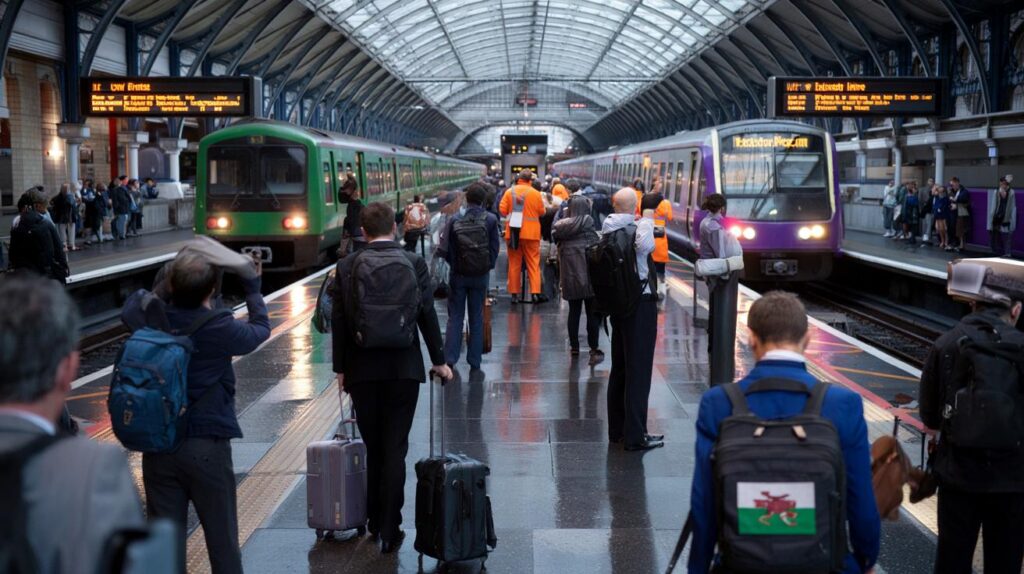
Rush-hour plans unravel for thousands as a fault on the Paddington–Reading main line snarls key routes and leaves Heathrow travellers scrambling.
A power-line problem has halted trains between London Paddington and Reading, cutting the artery that links Wales to the capital and grounding Heathrow’s fastest links. Engineers are on site and warnings stretch to the end of Thursday’s timetable.
What has happened
Great Western Railway has advised passengers not to travel between London Paddington and Reading after a failure of overhead line equipment. The fault has blocked all lines, triggering cancellations and heavy disruption through to the end of the day on Thursday, 18 September.
Overhead line equipment, often shortened to OLE, supplies electricity to trains via wires suspended above the track. When it fails, electric trains cannot draw power and diesel services may be trapped behind stranded trains or blocked by safety cordons, closing the route to all traffic.
Do not attempt to travel between London Paddington and Reading today. All lines are blocked and services are cancelled until close of service.
With so many people affected, rail operators say they cannot provide meaningful replacement buses, coaches or taxis. The network is simply too busy to keep pace with demand by road at short notice.
Who is affected and where
The blockage on the Paddington–Reading corridor hits long‑distance services between South Wales and London, as well as local and airport links. Trains that would normally run into and out of Paddington are being cancelled or turned back short of London. Some trains may run west of Reading but they will not reach the capital while the lines remain blocked.
Routes directly impacted
- All Great Western Railway services to and from London Paddington, including trains from Cardiff, Newport and Swansea.
- Elizabeth line services between Paddington and Reading, and on the Heathrow branches.
- Heathrow Express between London Paddington and Heathrow Terminal 5.
No replacement buses are in operation due to the number of passengers affected and the scale of disruption.
Your options tonight and on Friday
Operators have issued ticket flexibility to help you complete essential journeys or postpone them without additional cost. Expect longer journeys and crowded trains where alternatives exist.
| Option | Thursday 18 September | Friday 19 September | Notes |
|---|---|---|---|
| Use South Western Railway | GWR tickets accepted | GWR tickets accepted for intended journey | Routes include Reading to London Waterloo via Ascot and Staines. Allow extra time. |
| Travel later with the same ticket | Advised if possible | Valid for travel on Friday 19 September | Keep your original ticket. Check service updates before setting off. |
| Elizabeth line / Heathrow Express | Heavily disrupted or cancelled | Check before travel | For Heathrow, consider the Piccadilly line from central London. |
| Alternative operators (e.g., Chiltern Railways) | No confirmed acceptance | No confirmed acceptance | You may need a new ticket. Verify availability and journey times. |
Advice for travellers from Wales
If you are in South Wales and have not started your trip, defer travel to London until Friday if you can. Should trains be running locally, you may be able to reach Reading, then switch to South Western Railway for London Waterloo, but check live running carefully as services can change at short notice.
- From Cardiff, Newport and Swansea: plan for Friday travel where possible; the direct London route remains shut this evening.
- For London airports: Heathrow rail links are disrupted; consider the Piccadilly line for Heathrow or coach options tomorrow.
- For central London: Waterloo is the likely gateway if you can reach the SWR network via Reading or other interchange points.
What causes overhead line failures
OLE faults often stem from damaged contact wire, failed insulators or debris entangled in the equipment. Hot weather can cause wire sag. High winds can dislodge trackside objects. On busy electrified routes, a damaged pantograph on one train can tear the wire and take down the system, forcing a shutdown while crews isolate power and make repairs.
Fixing OLE is meticulous work. Teams must gain access, isolate sections, remove damaged components and re-tension the wire to precise tolerances. Night-time windows are preferred, but tonight’s failure has required an emergency response that will likely continue into the small hours.
How long will it last
GWR expects disruption to persist until the end of Thursday’s service. Knock-on effects may roll into Friday morning as trains and crews end up in the wrong place. Restarting a complex timetable takes time, so early services can still experience delays or short-notice changes even after the wire is repaired.
Disruption is expected until end of day Thursday. Morning services may be impacted by displaced trains and crews.
If you must travel now
- Avoid London Paddington and Reading unless your train is shown as running.
- Consider South Western Railway to or from London Waterloo if you can reach its network, notably the Reading–Waterloo line.
- For Heathrow, use the Piccadilly line from central London to Terminals 2&3, 4 or 5. Allow significant extra time.
- Keep your ticket. Photograph departure boards and any messages that show disruption; they help with claims.
- Taxis are not being arranged by operators due to scale. Do not assume reimbursement for self-booked cabs without prior authority.
- Carry water and a phone charger. Platforms and alternative trains will be crowded.
What you can claim and how to prepare
Delay compensation is available from the operator you were due to travel with. Keep tickets and receipts. Claims usually require either the original ticket or a clear image of it, the intended itinerary, and the actual arrival time (if you travelled). If you abandoned your journey, note that on the claim form and request a refund from the original retailer.
If you need to travel tomorrow instead, today’s GWR tickets remain valid on Friday, 19 September. That flexibility can spare you extra costs and the stress of rebooking. If you switch to South Western Railway tonight, staff should accept GWR tickets; allow extra time as the Reading–Waterloo route has different stopping patterns and lower capacity than the Paddington main line.
Context for Heathrow passengers
With Heathrow Express curtailed and the Elizabeth line impacted, the Tube’s Piccadilly line becomes the most reliable rail option to the airport this evening. Trains run at regular intervals from central London, but journey times are longer than the express services. If you have a late flight, factor in an additional 30 to 45 minutes. If your flight is early on Friday, consider travelling to an airport hotel once Underground services resume in the morning.
Planning for tomorrow
Expect early-morning gaps while depots release trains back to their normal diagrams. Set alerts for your specific trains and check for short-notice platform changes. If you hold a flexible ticket, avoid the first wave of departures to reduce queuing and improve your chances of getting a seat. For meetings in central London, arriving at Waterloo rather than Paddington may add time for the final leg on the Underground; plan a margin of at least 20 minutes for that transfer.



Zero replacement buses for an airport corridor? That’s… bold. If the road network can’t cope, at least arrange staged coaches for overnight. Leaving people to self-book cabs then refusing reimbursement is rediculous.
Can I use my GWR off-peak from Cardiff on SWR via Reading–Waterloo tonite, or only tomorrow? Do barriers at Waterloo actually let you through, or do we need staff to tap us in? Thanks.