
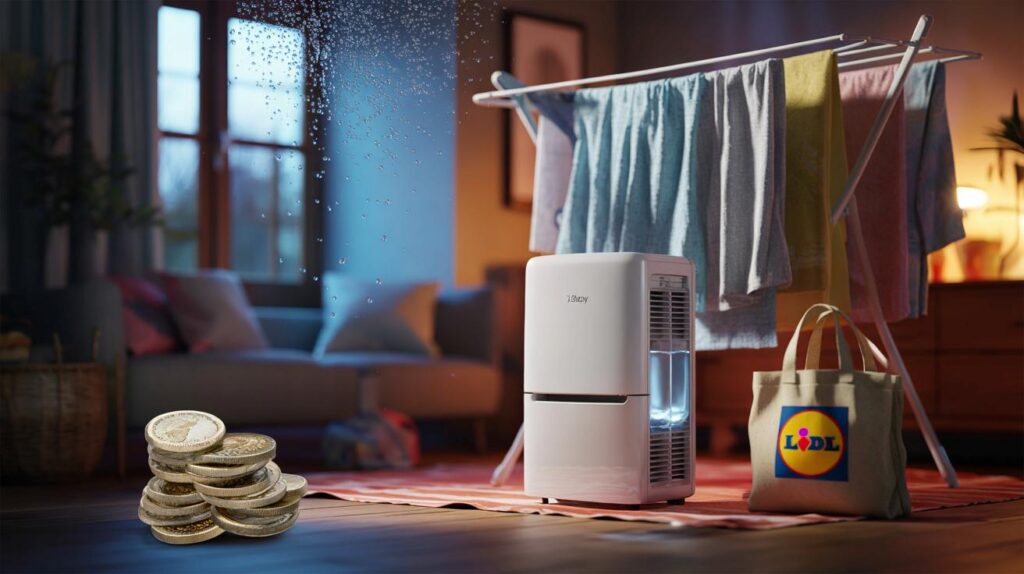
Cold rooms, wet washing and rising tariffs are colliding again. One pocket-friendly gadget could shift your winter routine dramatically.
Budget chain Lidl will put a compact Tronic dehumidifier on sale next week, and consumer champion Martin Lewis has long argued that dehumidifiers can beat tumble dryers on cost. Here are the key details, the sums that matter, and how to decide if it fits your home.
What Lidl is putting on shelves next week
Lidl will release the Tronic Dehumidifier on Thursday 16 October, priced at £74.99. Stock will be limited by store.
On sale Thursday 16 October at £74.99, while stocks last.
The unit is rated at 245W. It offers two programmes, one tuned for laundry drying and one for everyday dehumidifying. It includes a 2.1L tank, an at-a-glance water window, a full-tank warning, and overflow protection. The claimed moisture extraction is up to 10L per day, which reflects lab test conditions and will vary by room temperature and humidity.
Why a dehumidifier can undercut your tumble dryer
Martin Lewis has previously called dehumidifiers a smart swap for drying clothes when bills bite. The logic is simple. Tumble dryers consume a lot of energy in a short burst. A dehumidifier sips power steadily while speeding up air-drying indoors and reducing condensation and mould.
At the current Ofgem cap of 26.35p/kWh, a 245W unit costs roughly 6–7p per hour to run.
Using today’s average price cap, 0.245kW x 26.35p equals about 6.45p per hour. Four hours beside a clothes airer comes to roughly 26p. A typical older condenser dryer can use around 3–4.5kWh per cycle, which is about 79p to £1.19 for a single load. Households with modern heat-pump dryers will be closer to 40p per cycle, so the saving shrinks, but the dehumidifier still reduces damp and musty odours.
The numbers that help you decide
Example running costs at today’s cap
| Appliance or setup | Typical energy use | Cost per hour/cycle | Assumed time | Approx. cost per load |
|---|---|---|---|---|
| Tronic dehumidifier (245W) | 0.245 kW | ~6.45p/hour | 4 hours | ~26p |
| Heated airer (300W) | 0.300 kW | ~7.9p/hour | 6 hours | ~47p |
| Dehumidifier + heated airer | ~0.545 kW | ~14.3p/hour | 3.5 hours | ~50p |
| Tumble dryer, condenser (older) | 3.0 kWh/cycle | ~79p/cycle | 1 cycle | ~79p |
| Tumble dryer, vented (older) | 4.5 kWh/cycle | ~£1.19/cycle | 1 cycle | ~£1.19 |
| Tumble dryer, heat pump (modern) | 1.5 kWh/cycle | ~40p/cycle | 1 cycle | ~40p |
Savings depend on how often you dry clothes, the type of dryer you own, and how long your washing takes to air-dry. A family using an older dryer for 150 winter loads could spend roughly £118 to £178 on electricity. Switching many of those loads to a 245W dehumidifier for about 4 hours per load could land nearer £39. That is a potential saving in the £79–£139 range, with heavier use and thirstier dryers pushing savings towards £200.
Heavy-use households with older dryers could save close to three figures, sometimes more, across the colder months.
Key specs and features at a glance
- Price: £74.99
- Availability: from Thursday 16 October, limited stock per store
- Power draw: 245W
- Programmes: laundry drying, dehumidifying
- Tank: 2.1L with viewing window
- Extraction: up to 10L/day (test conditions; real-world varies)
- Safety: full-tank alert and overflow protection
How to get the most out of a dehumidifier for laundry
Close the room to trap the air you are treating. Position the unit near your clothes airer, but keep a safe gap for airflow. Use the laundry programme if available, or set the target humidity to around 50–55% relative humidity. Aim the outlet towards the garments to keep air circulating.
Empty the tank before each session so extraction does not pause. Clean the filter regularly to maintain airflow. If your home allows, use a drain hose to avoid tank checks during long runs. Avoid draping clothes over the machine. Leave interior doors shut during operation to prevent moisture migrating to colder rooms.
What to expect in real homes
That “up to 10L/day” figure is measured at warm, humid conditions, typically 30°C and 80% relative humidity. British homes in winter sit nearer 16–20°C and 50–70% relative humidity. Extraction will be lower, but still meaningful. The machine releases a small amount of gentle warmth thanks to its compressor, which can help rooms feel less clammy and speed drying.
Damp-prone homes often see side benefits. Less condensation on windows. Fewer musty smells. Reduced risk of mould on external walls and in wardrobes. Clothes tend to feel softer because they dry at lower temperatures than in a tumble dryer, which can help with delicate fabrics.
How it stacks up against other budget fixes
Heated airers are simple and cheap to buy but can take hours and leave moisture in the room. Pairing one with a dehumidifier shortens drying time and prevents condensation. A modern heat-pump tumble dryer is the easiest one-hit solution for busy homes, but it costs far more upfront than £74.99. If you rent or you are on a tight budget, a dehumidifier plus airer often strikes the best balance of cost, control and air quality.
Who will benefit most
Larger households running several weekly loads and anyone battling condensation should see clear gains. Flats with limited ventilation, north-facing rooms and homes that cannot vent a tumble dryer fit the bill. Light users with a new A-rated heat-pump dryer will save less on pure running costs, but may still value better indoor air and gentler drying for woollens and school uniforms.
Price cap context and why your bill differs
The Ofgem energy price cap for 1 October to 31 December 2025 puts the average unit rate at 26.35p per kWh for standard variable tariffs. Your exact rate depends on region and supplier, and the standing charge sits separately. The figures above use the average unit rate only, so treat them as guides rather than guarantees. Metered tariffs, fixed deals and time-of-use plans can shift the picture.
Practical add-ons and pitfalls
Consider a plug-in timer to limit overnight running. Add a cheap digital hygrometer to see real-time humidity. Move the unit between laundry sessions to problem spots such as a bay window or box room. Listen for noise in store if you are sensitive, as sound levels vary widely between models. Keep doors and trickle vents balanced; you want dry, circulated air, not a draught that pulls in damp from elsewhere.
What else arrives in the middle aisle
Lidl is also due to stock seasonal bits on the same date, including indoor and outdoor plants, thermal clothing for all ages and a handful of household items. If you want the dehumidifier, go early; middle-aisle specials often sell through by the weekend, especially at this price point.



At ~6–7p per hour this could finally replace my creaky condenser dryer. £74.99 seems fair if it actually pulls moisture and cuts condensation. Anyone used the laundry mode next to an airer—how long for jeans and towels? Does it auto‑stop when the tank’s full, or can you run a drain hose? I’m in a 2‑bed flat with north‑facing rooms; mould is a pain. Real‑world noise at night would be supre useful.