
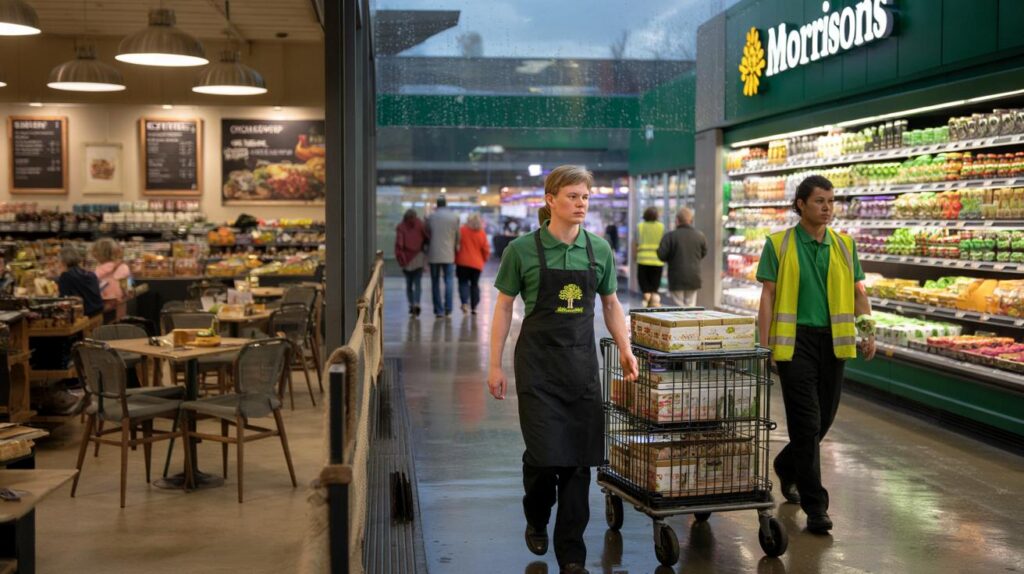
Shoppers face another shake-up as one of Britain’s biggest grocers trims costs and reshapes store services for 2025.
Morrisons will phase out dozens of in‑store cafés and other counters as part of a broad reset aimed at keeping prices sharp and footfall steady. The changes affect communities across England, Scotland and Wales, and come amid intense competition on the high street.
What Morrisons is closing and why
The supermarket is pulling back on space‑hungry, staff‑intensive services and refocusing shops on everyday value, speed and range. A total of 52 cafés are shutting, alongside selected florists, fresh meat and fish counters, a handful of pharmacies and all Market Kitchen formats.
52 cafés, 13 florists, 35 meat counters, 35 fish counters, four pharmacies and all 18 Market Kitchens are slated to close.
The retailer, which started life as an egg and butter stall in 1899 and now runs close to 500 stores, said affected colleagues will be offered redeployment where possible. Rival chains have trodden a similar path, with Sainsbury’s winding down many of its cafés earlier in the year.
Cafés: the biggest change on the shop floor
Cafés have long served as social hubs for parents, pensioners and shift workers. Yet energy costs, staffing pressures and changing shopping habits have squeezed margins. Turning that space over to high‑demand ranges and better‑priced staples is where the chain sees gains.
The closures do not signal retreat across the board. In the latest reported quarter, like‑for‑like sales rose by 3.9 percent, with total sales up 4.2 percent to £3.9 billion. After heavy losses of £1.3 billion and £919 million in the two preceding years, the group posted a pre‑tax profit of £2.1 billion for the year to 27 October 2024.
Sales are growing and profitability has returned, yet non‑core services are being trimmed to defend prices and simplify stores.
Other services set to go
Fresh counters and specialist concessions demand teams, equipment and space. Morrisons is reducing these touchpoints and leaning into packaged alternatives and centralised preparation. Shoppers should expect more shelf space for meal deals, ready‑to‑eat options and private‑label value ranges.
| Service | Sites affected | Status |
|---|---|---|
| Cafés | 52 | Closing in phases |
| Florists | 13 | Closing |
| Meat counters | 35 | Closing |
| Fish counters | 35 | Closing |
| Pharmacies | 4 | Closing |
| Market Kitchens | 18 | All closing |
Where the axe is falling
These are the cafés earmarked for closure. Check local notices for precise dates and replacement services:
- Bradford Thornbury
- Paisley Falside Road
- London Queensbury
- Portsmouth
- Great Park
- Banchory North Deeside Road
- Failsworth Poplar Street
- Blackburn Railway Road
- Leeds Swinnow Road
- London Wood Green
- Kirkham Poulton Street
- Lutterworth Bitteswell Road
- Stirchley
- Leeds Horsforth
- London Erith
- Crowborough
- Bellshill John Street
- Dumbarton Glasgow Road
- East Kilbride Lindsayfield
- East Kilbride Stewartfield
- Glasgow Newlands
- Largs Irvine Road
- Troon Academy Street
- Wishaw Kirk Road
- Newcastle UT Cowgate
- Northampton Kettering Road
- Bromsgrove Buntsford Industrial Park
- Solihull Warwick Road
- Brecon Free Street
- Caernarfon North Road
- Hadleigh
- London Harrow Hatch End
- High Wycombe Temple End
- Leighton Buzzard Lake Street
- London Stratford
- Sidcup Westwood Lane
- Welwyn Garden City Black Fan Road
- Warminster Weymouth Street
- Oxted Station Yard
- Reigate Bell Street
- Borehamwood
- Weybridge Monument Hill
- Bathgate
- Erskine Bridgewater Shopping Centre
- Gorleston Blackwell Road
- Connah’s Quay
- Mansfield Woodhouse
- Elland
- Gloucester Metz Way
- Watford Ascot Road
- Littlehampton Wick
- Helensburgh
How shoppers and staff are affected
Customers will lose a sit‑down spot for a cuppa and a hot meal in these stores. Parents who plan a break mid‑shop and older shoppers who meet friends at the café will feel the change most. Store teams are being offered roles elsewhere in the business, which may mean different hours or departments.
For food‑to‑go, expect more grab‑and‑go chillers and expanded meal deal choices. Where fresh counters vanish, packaged cuts, pre‑trimmed fish and seasonal specials should fill the gap. Prices are likely the driving force behind these swaps, as grocers chase discounter‑level value without sacrificing service too deeply.
The bigger retail picture
Aldi has overtaken Morrisons to become Britain’s fourth‑largest grocer, underscoring fierce competition on price. Supermarkets are trimming lower‑margin operations and investing in core grocery, where shoppers are most sensitive to savings. That said, Morrisons’ latest figures show sales growth and a return to profit, suggesting the strategy is beginning to bed in.
Shoppers have seen similar moves elsewhere as chains streamline cafés and specialist counters. The trend points to leaner stores with faster trips, broader value ranges and more space for everyday staples.
What you can do if your café closes
- Check in‑store posters for last‑day details and any temporary pop‑ups or vending alternatives.
- Ask staff about quiet seating areas that remain available for a short rest during your shop.
- Use loyalty points and app coupons to offset hot‑drink and snack purchases from food‑to‑go fridges.
- If you relied on hot meals, compare the supermarket’s ready‑to‑heat range and meal deals by price per portion.
- Look at neighbouring branches that still operate a café, if travel and accessibility work for you.
Practical angles to consider
Families shopping with children can plan shorter trips and pick up hot drinks at the end, using insulated cups to keep them warm on the way home. Carers accompanying older relatives might prefer quieter times—early mornings midweek—to avoid crowding where seating is limited. If you used the café as a meeting spot, local libraries and community centres often provide low‑cost spaces and refreshments.
There are trade‑offs. Losing a café reduces a social anchor, yet it can free floor area for discounted lines, bulk packs and seasonal value bays. That may help weekly budgets. On the staffing side, redeployment protects experience within the business, which tends to mean quicker tills and better shelf availability.
What to watch in 2025
Expect a phased timetable as stores reconfigure layouts. Look for clearer price messaging, bigger own‑label displays and tweaks to entrance zones where cafés once sat. If sales momentum holds, more stores may pivot in the same direction. If not, selected sites could trial new third‑party concessions or compact seating pods to recapture dwell time without the cost of a full kitchen.



Losing the café at Wood Green will really hurt the social side of shopping for my mum’s group. Please keep some quiet seeting, and be clear on redeployment—will staff be offered roles in nearby stores or have to travel miles? It feels abrupt.