
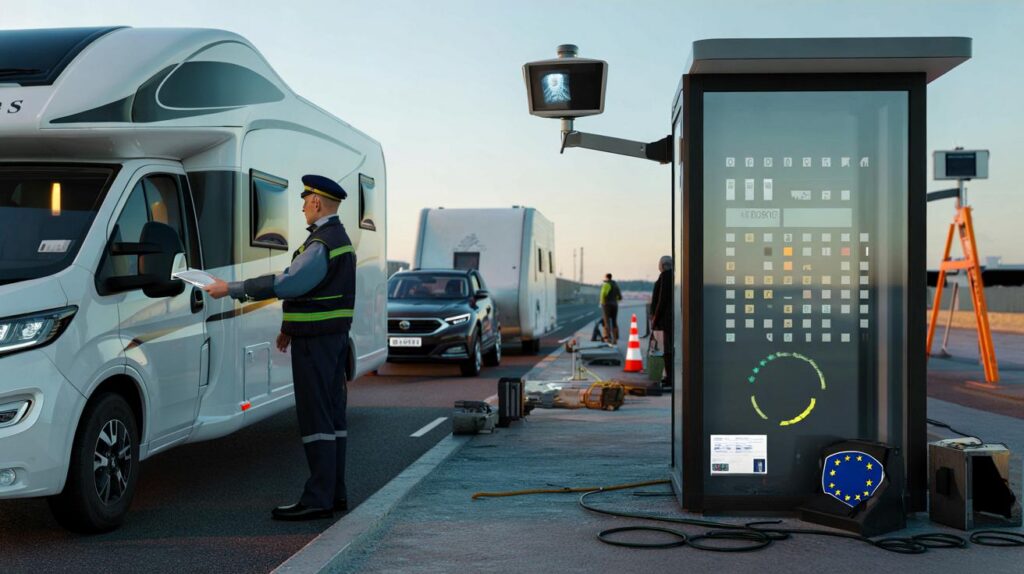
Planning an autumn escape in your motorhome or with a caravan in tow? A fresh border routine could reshape your European road trip.
From 12 October, the European Union will switch on a new Entry/Exit System that changes how British travellers are processed at ports, terminals and land frontiers. The shift affects anyone heading to the Schengen area for up to 90 days in any 180-day period, and it will be phased in over six months. Expect extra checks, biometric enrolment and, at least initially, slower queues for larger vehicles.
What changes on 12 October
The EU Entry/Exit System (EES) replaces manual passport stamping with a digital record of when you enter and leave the Schengen area. For most UK passport holders, the first crossing after 12 October will involve a short biometric enrolment. Border staff will scan your passport, take a quick facial image, and capture fingerprints. The system stores your permitted stay and automatically calculates how much of your 90-day allowance remains.
Ports and terminals will not move at the same speed. European countries will introduce EES gradually over roughly six months, meaning procedures can vary by location until around April 2026. UK juxtaposed controls at Dover, the Eurotunnel terminal in Folkestone and London St Pancras will run the process before you depart the country, while many continental ferry ports and rail hubs will apply it on arrival.
From 12 October, the EU will log your entry and exit digitally. First-time enrolment includes a facial image and fingerprints at the border.
Expect queues at busy pinch points
Initial teething problems are likely. Biometric capture adds steps at the booth, and larger vehicles often use dedicated lanes with fewer kiosks. Operators have been preparing new kiosks and layouts, but early adopters should allow more time around school breaks and peak holiday weekends.
Refusing or failing to complete the process could mean you are turned away. Bring patience, keep documents to hand and follow operator guidance on where motorhomes and towing vehicles should queue.
The 90/180-day rule still applies
EES does not change the limit on visa-free stays: UK passport holders can remain in the Schengen area for up to 90 days in any rolling 180-day window. The system makes this calculation automatic at each crossing, reducing human error but also removing any wriggle room if your arithmetic is off.
- If you spend 60 days in Spain over winter, you have 30 days left for another trip within the same 180-day window.
- A 91st day triggers an overstay, which could lead to fines, entry bans or future visa requirements.
- The 180-day clock is rolling, not fixed by calendar halves. Each day spent in the zone drops out of the count after 180 days.
What motorhome and caravan drivers should do now
Preparation will save you time at the booth and help avoid last-minute refusals. Focus on four areas: documents, timing, vehicle readiness and route planning.
- Passports: check issue and expiry dates. Many Schengen states require at least three months’ validity after your planned departure and do not accept passports older than 10 years at entry.
- Insurance and health: carry proof of motor insurance and a valid GHIC or EHIC. Consider comprehensive travel cover for medical and cancellation costs.
- Vehicle papers: take your V5C logbook or hire paperwork, MOT certificate where relevant, and proof of breakdown cover including onward travel for long vehicles.
- UK identifier: display a UK sticker if your number plate does not already include the UK identifier.
- Route timings: build buffer time into ferry and train bookings. Arrive earlier than usual at Dover, Folkestone and St Pancras while the new checks bed in.
- Lane choice: follow signage for high vehicles and trailers. Keep all passengers ready to present passports together to avoid repeat checks.
- Local rules: check speed limits for vehicles over 3.5 tonnes and any low-emission stickers required for cities in France or Germany.
- Accessories: pack reflective vests, warning triangles and headlamp beam deflectors where required by local law.
Allow extra time at juxtaposed controls in the UK. Larger vehicles may be directed to fewer lanes, which can lengthen queues while EES ramps up.
Key checkpoints and what actually happens
| Where | What changes | What you should do |
|---|---|---|
| Dover ferry terminals | Biometric enrolment at French border booths before departure; slower lanes possible for high vehicles | Arrive early, keep everyone and every passport in the vehicle, windows clear for facial capture |
| Eurotunnel, Folkestone | EES at French controls pre-boarding; kiosk layout adjusted for towing combinations | Follow marshal instructions, prepare to step out briefly if directed by officers |
| Eurostar, St Pancras | Biometrics taken before boarding; platform gates may be busier at peaks | Arrive well within operator’s recommended check-in window |
| Continental ferry ports | Checks on arrival (where no UK juxtaposed controls exist); phased rollout through winter | Carry paper printouts of bookings and insurance to speed verification if systems slow |
Who is affected
EES applies to non-EU, non-Schengen nationals who do not hold a residency permit in a participating country. That includes British holidaymakers and many UK residents with second homes overseas who travel visa-free. If you already hold a residence card for a Schengen country, local procedures differ and you will typically not enrol under EES when using that status.
The rule change also covers drivers and passengers equally. Everyone in the vehicle must present themselves and their passport to be enrolled on the first trip after switch-on.
Where the new rules apply
The system covers the Schengen area and certain associated states, including popular crossings through France, the Netherlands and Spain, as well as non‑EU Schengen members such as Norway and Switzerland. Bulgaria and Romania are also joining the scheme.
Looking ahead: ETIAS follows later
Another change is on the horizon. A separate pre-travel authorisation, known as ETIAS, is planned for the last quarter of 2026. UK citizens will need to secure that approval before travelling once it launches. It is expected to be a quick online application with a modest fee for most adults and multi‑year validity. EES and ETIAS are different: the former logs your border crossings; the latter pre‑screens you before you set off.
Practical examples to help plan your winter escape
If you leave Portsmouth for Spain on 20 October and return on 18 December, you have used 60 days. A New Year skiing trip of up to 30 days in February still fits within your allowance. But if you push to 35 days in February, you would cross into an overstay until some autumn days fall out of the 180‑day window in mid‑April.
Families towing a twin‑axle caravan should assume a little extra time at border booths. Keep the tow vehicle’s fuel receipt and ferry booking handy, as officers sometimes ask for proof of itinerary when lanes back up. If a kiosk struggles to read your passport chip, having a second form of photo ID can help officers verify details faster.
Terms to know, risks to watch
- External Schengen border: the line between Schengen and non‑Schengen territory where EES applies; the UK is outside Schengen.
- Enrolment: your first EES crossing after 12 October, when biometrics are captured and your digital file is created.
- Overstay risk: exceeding 90/180 can lead to fines or a future visa requirement; keep your own count even though EES tracks it.
- Vehicle category: motorhomes over 3.5 tonnes face different speed limits and road charges in some countries; check your weight plate.
For long tours, build a route with flexible stops near ports in case queues eat into driving hours. Night sailings may be less congested during the early months of the rollout. Keep snacks, water and a phone power bank accessible for everyone on board, especially if you’re travelling with children or pets.
Finally, consider a simple diary note: record each day inside the Schengen area. EES will keep the official tally, but your personal log helps you plan future trips confidently—and avoids awkward arithmetic under the gaze of a border officer.



Does the first EES enrolment apply to kids too? Do children need finger prints or just a facial image, and what about those under 12? Planning to use St Pancras—any idea how long the queus might be for families in the early weeks?