
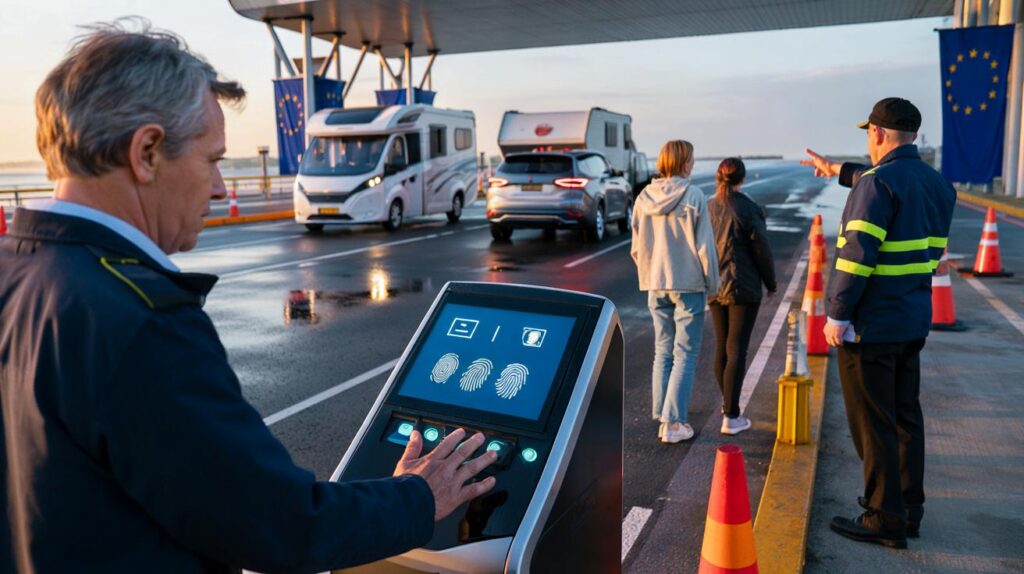
Thousands planning autumn getaways with motorhomes and caravans could meet a new hurdle at Channel crossings as border tech tightens.
Holiday routes to France, Spain and beyond will run under a different set of border rules from 12 October, when the EU launches its new Entry/Exit System. The change affects UK travellers entering the Schengen area, and officials expect a bedding-in period that could slow departures, especially at peak times.
What changes on 12 October
The EU’s Entry/Exit System (EES) replaces manual passport stamping for non‑EU visitors with a biometric check. Your face and four fingerprints will be recorded at first entry, then matched on future trips. The system automatically counts your time in the Schengen zone against the 90 days in any 180‑day allowance.
From 12 October, first‑time EES registration involves fingerprints and a photo, then electronic border records replace passport stamps.
Officials plan a six‑month roll‑out. That means each participating country will bring the system online between October and April, so the process may vary from port to port until spring 2026.
Where and how checks will happen for UK travellers
If you travel via Dover, Folkestone (Eurotunnel) or St Pancras (Eurostar), French border checks take place before departure on UK soil. Operators have installed kiosks and processing points to capture biometrics and confirm travel details.
Motorists towing caravans or driving larger motorhomes should plan extra time to park, register and return to their vehicle. Families and groups will take longer because every eligible traveller needs a first‑time registration.
Allow more time at the border while systems bed in; early journeys could take longer than usual, especially at weekends and school holidays.
Who is affected, and for how long
The rules apply to UK citizens visiting the Schengen area for short stays of up to 90 days in any rolling 180‑day period. That includes those taking motorhomes, campervans or caravans on holiday. The 90/180 rule remains the same, but the counting becomes automatic under EES.
Age and biometric rules
- Facial image captured for most travellers on first entry.
- Fingerprints typically collected from travellers aged 12 and over.
- Subsequent trips should be quicker, as your details are already stored.
How long might it take?
Border agencies expect the first registration to take a few minutes per person. A couple in a motorhome should budget extra time; a family of four could need significantly longer on the first trip after 12 October. Once enrolled, crossings should be closer to normal timings, although busy holiday periods will still stretch capacity.
Because implementation differs by location during the six‑month transition, some ports may move faster than others. Ferry ports that handle high volumes of vehicles towing caravans are preparing for surge periods by opening more kiosks and marshalling space.
Documents and kit: what motorhome and caravan drivers should carry
Border technology will not replace the usual paperwork. UK motorists still need the right travel documents and vehicle equipment for continental roads.
- Passport with at least three months’ validity after your planned exit and issued within the last 10 years.
- Proof of accommodation or itinerary if asked, and funds for your stay.
- V5C logbook for your vehicle, and trailer papers if your caravan is separately registered.
- Valid motor insurance; a physical green card is usually not required within the EU, but check your insurer’s policy for towing and length/weight limits.
- UK identifier on the rear of your vehicle and caravan.
- Safety kit required in many EU countries: warning triangle, high‑visibility vests for passengers, spare bulbs, headlamp beam deflectors, and first‑aid kit.
- Low‑emission zone stickers or registrations where relevant (for example, France’s Crit’Air in certain cities).
The 90/180 rule and how EES tracks your time
Under Schengen rules, UK visitors can spend up to 90 days within any rolling 180‑day window across participating countries. EES calculates this automatically at the border. If you tour France for 65 days with a caravan, then cross to Spain for another 20 days, you have used 85 days in the same window.
The EES will flag travellers who are close to or over the 90‑day allowance, which can lead to refusal of entry or fines for overstays.
Keep a simple diary of entry and exit dates as a cross‑check. If your plan involves multiple hops over a winter, use a Schengen calculator to model your window before you book ferries or trains.
ETIAS is coming later — not this year
Alongside EES, the EU plans to roll out a separate travel authorisation, ETIAS, which will be required for most UK visitors. This is not due to start until the last quarter of 2026, according to current timetables. It will be an online pre‑travel step, similar to systems used elsewhere, and will be valid for multiple trips once granted.
| System | What it does | When it starts | Who it affects |
|---|---|---|---|
| EES | Biometric border entry/exit, replaces passport stamps | 12 October, phased over six months | All non‑EU short‑stay travellers, including UK visitors |
| ETIAS | Pre‑travel authorisation checked at the border | Planned for late 2026 | Most UK visitors to the Schengen area |
What this means for your autumn and winter tours
For many, the main change will be time at the border on the first trip after 12 October. Motorhome and caravan owners should plan an earlier arrival at Dover, Folkestone or St Pancras, especially if travelling with children or older relatives who may need assistance at kiosks.
If you’re booking ferries near half-term or leading into Christmas markets, pick off‑peak sailings where possible. Late‑evening departures often see shorter queues. Build extra time into your driving schedule in case of delays boarding.
Practical planning tips for motorhomes and caravans
- Reserve an early check‑in slot and arrive ahead of the operator’s recommended time.
- Keep passports handy and remove hats or sunglasses for fast facial capture at kiosks.
- Brief teenagers about the fingerprint step so they’re ready when called.
- Park so you can step out safely with all travellers during registration, then return to your lane promptly.
- Carry proof of campsite bookings or a first‑night stop; border agents can ask about your route and accommodation.
- Check toll classifications: larger motorhomes may be charged differently in France and Spain.
- Confirm your breakdown cover includes towing with a caravan and recovery of larger vehicles.
A quick scenario: a two‑week caravan tour after 12 October
Two adults towing a caravan from Kent to Normandy on 20 October arrive at Dover 120 minutes before sailing. They register at an EES kiosk: photos and fingerprints taken, passports scanned, itinerary confirmed. The process adds 15–25 minutes compared with a summer crossing, and the pair board as usual. On their return trip, they face standard exit checks; next time they travel, their biometric data will already be on file, reducing time at the booth.
Risks to watch, and how to avoid them
Overstaying the 90‑day limit brings fines or bans, and EES will make miscounts easier to spot. Build a calendar that totals days actually spent inside Schengen, including the day you arrive and the day you leave. Keep spare time in hand if you winter abroad, and consider splitting longer tours with a UK return to reset your rolling window.
Separate from border checks, remember pet travel rules if you bring a dog or cat. You’ll need an Animal Health Certificate from a UK vet and up‑to‑date microchip and rabies vaccination. Factor in vet appointments when planning departure dates.
What to expect next
Officials say they have worked with French partners to upgrade infrastructure at UK embarkation points. Even so, early weeks after 12 October will be a learning curve for staff and travellers. The picture should stabilise by spring, and ETIAS will follow in late 2026, adding a quick online step before travel rather than a new process at the port.
Plan earlier arrivals, keep documents ready, and treat the first post‑12 October crossing as a test run for smoother trips later in the season.



So we’ll be fingerprinted at Dover even for a quick weekend to Calais? First time only, right?
Thanks for the clear breakdown. We’re towing a small caravan with kids—good tip on arriving earlier and briefing teens for fingerprints. Super helpful.