
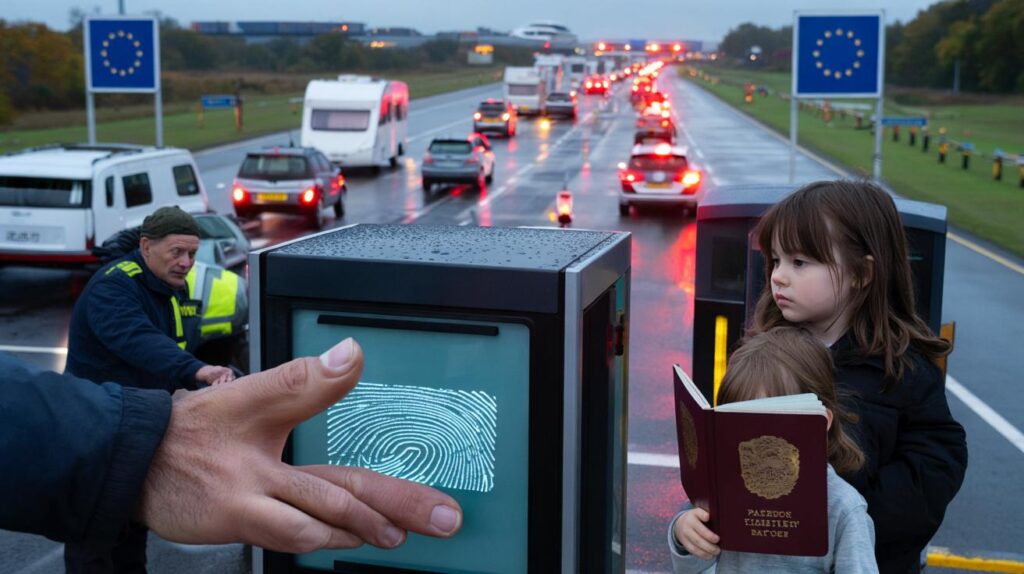
If you tow a caravan or tour in a motorhome, your next continental crossing could feel very different this autumn.
From 12 October, a new EU border system will start reshaping how British travellers are processed before they roll onto ferries or trains. Families heading for France, Spain or beyond in large vehicles will see extra steps at check-in, new biometric scans, and the first signs of a phased overhaul that runs through to spring 2026.
What changes on 12 October
The European Union’s Entry/Exit System (EES) begins on 12 October. It replaces manual passport stamps with a digital record of when and where third-country nationals, including UK citizens, enter and exit the Schengen Area.
On your first trip after the switch-on, each traveller will have a facial image captured and, for anyone aged 12 and over, four fingerprints taken. Border officers will also scan your passport and record your intended length of stay.
First-time enrolment under EES uses biometrics and can take a few minutes per person, so factor in a longer check-in.
Once enrolled, future crossings should be faster because the system recognises you and reuses stored data for up to three years after your last exit. The EES will automatically track the “90 days in any rolling 180 days” limit for short stays.
Who is affected
Any UK resident taking a vehicle into the Schengen Area for a short stay is covered. That includes drivers of motorhomes, campervans and cars towing caravans. Passengers in your vehicle also complete EES checks, including children, although fingerprints are only taken from those aged 12 and above.
If you plan multiple trips this winter—say, a pre-Christmas market tour and a February ski run—the first crossing is the longest. Subsequent crossings should be smoother.
Where the checks happen
On routes with juxtaposed border controls, the EES process takes place in the UK before departure. Elsewhere, you will enrol on arrival in the EU.
| Route | Where EES is completed | What to expect |
|---|---|---|
| Dover–Calais/Dunkirk (ferry) | In Dover | Biometric booths and manual lanes at French controls before boarding |
| Eurotunnel (Folkestone–Calais) | In Folkestone | Checks at French controls pre-boarding alongside vehicle screening |
| Eurostar (St Pancras International) | In London | Station-based kiosks before security and boarding |
| Other ferry routes (e.g., Portsmouth–Caen, Plymouth–Santander) | On arrival in the EU | Processing at the first port reached, which may add to disembarkation time |
How long it could add to your journey
Authorities have redesigned flows and added booths, but first-time enrolment still takes extra time. Border officers suggest two to five minutes per adult, less for children.
A family of four in a car with a caravan could see 15–30 minutes added at peak times, with longer holds if lanes back up.
For group convoys heading to rallies or campsites, staggered arrivals help avoid bunching. Weekends and school holidays remain the busiest periods.
The six-month transition
Member states will phase the system in across ports, tunnels and stations over six months, meaning not every crossing point will operate identical procedures from day one. Expect some variation in lane layout, signage and the mix of kiosks and officer-run desks until April 2026.
Officials advise travellers to build a wider time cushion around departures during the bedding-in period, especially if you need to shepherd kids, pets and tow checks through the same lane.
What motorhome and caravan drivers should do now
Documents and checks
- Passports: ensure each passport has at least three months’ validity after your planned date of exit from the EU, and is less than 10 years old on the day of entry.
- Vehicle papers: carry your V5C logbook or hire paperwork, insurance certificate, and breakdown cover details.
- Towing entitlement: your UK category B licence now permits trailers up to 3,500kg MAM, but local road limits still apply.
- International Driving Permit: only needed in specific cases (e.g., paper licences or certain territories); most UK photocard licences are accepted.
- Kit: warning triangle, high-visibility vests for occupants, headlamp beam adjusters and spare bulbs where required by local law.
Planning your crossing
- Arrive earlier than usual—add 30–60 minutes to your normal allowance for the first trip after 12 October.
- Keep everyone’s passports together and ready at the lane; remove hats and sunglasses for the facial image capture.
- If travelling with pets, manage the Animal Health Certificate process separately to avoid last-minute scrambles.
- Book off-peak sailings where possible; late evening and midweek slots often move faster than Friday afternoons.
How the 90/180 rule will be enforced
The EES will calculate time spent in the Schengen Area automatically. Each entry and exit creates a digital event, replacing the ink stamp. If your stayed days reach 90 within the last 180, you can be refused entry until enough days fall out of the window.
Motorhome owners who like extended touring should map stays carefully. Split long trips with breaks outside Schengen—for instance, in the UK, Ireland or non-Schengen microstates—if you are near the limit.
Looking ahead to ETIAS in late 2026
A separate requirement—the European Travel Information and Authorisation System (ETIAS)—is planned for the last quarter of 2026. This is a pre-travel authorisation for visa-exempt visitors, including UK citizens.
- Application: online, before travel, with passport details and security questions.
- Cost: €7 (about £6) for travellers aged 18 to 70; free for under-18s and over-70s.
- Validity: typically three years or until your passport expires.
ETIAS will not replace EES; you will need both once it launches—ETIAS as a pre-trip authorisation, and EES at the border.
Worked example: a half-term crossing with a caravan
You book a Saturday morning Dover–Calais ferry for 10:00 with two adults and two children (13 and 9), towing a single-axle caravan. You aim to arrive 90 minutes before departure. On arrival at French controls, each adult completes facial capture and fingerprints; the 13-year-old gives facial capture and fingerprints; the 9-year-old completes facial capture only. The whole family’s passports are scanned, and your intended trip length (12 days) is entered. Total EES time: about 12–18 minutes. Traffic adds another 10 minutes. You still board on time.
Extra factors for larger vehicles
Some ports separate caravans and motorhomes into longer lanes. That helps manoeuvrability but can concentrate similar vehicles at the same kiosks. Keep tow mirrors positioned for quick officer sight lines, and leave enough gap to swing the van if directed to a secondary inspection bay.
Weight checks remain unrelated to EES, but roadside enforcement on the continent targets overloaded caravans. Weigh your rig near home and keep axle loads within the plate limits. Overweight penalties can derail a holiday faster than any new border tech.
Country quirks that catch out tourers
- France: Crit’Air vignettes apply in low-emission zones. Order ahead if you plan to drive in city centres.
- Spain: reflective vests must be accessible from the cabin, not in the boot, and two warning triangles may be required for domestic vehicles; one triangle is accepted for foreign vehicles, but check updates before you go.
- Italy: ZTL restricted zones in historic centres carry automatic fines—set your sat-nav to avoid them.
Key takeaways before you roll
12 October marks the switch to biometric border checks for UK travellers entering Schengen, with a six-month bedding-in period and variable port procedures.
Bring spare time at departure, keep documents ready, and plan your 90/180-day stays—your first crossing will be the slowest, the rest should ease.
If your plans involve winter sun or a Christmas market trip, treat October and November as a proving run. Make a checklist for documents and vehicle kit. Run a quick time simulation: add 20 minutes per adult and 5–10 minutes per child to your usual buffer on the first trip, halving that for the second journey.
Finally, think about the benefits once the dust settles. A digital record removes the guesswork from passport stamps, gives you a clear tally of days left for touring, and should shorten queues once everyone has enrolled. Until then, patience and preparation will keep your getaway on track.



45 extra minutes? For a family of four towing, that feels… optimistic.