
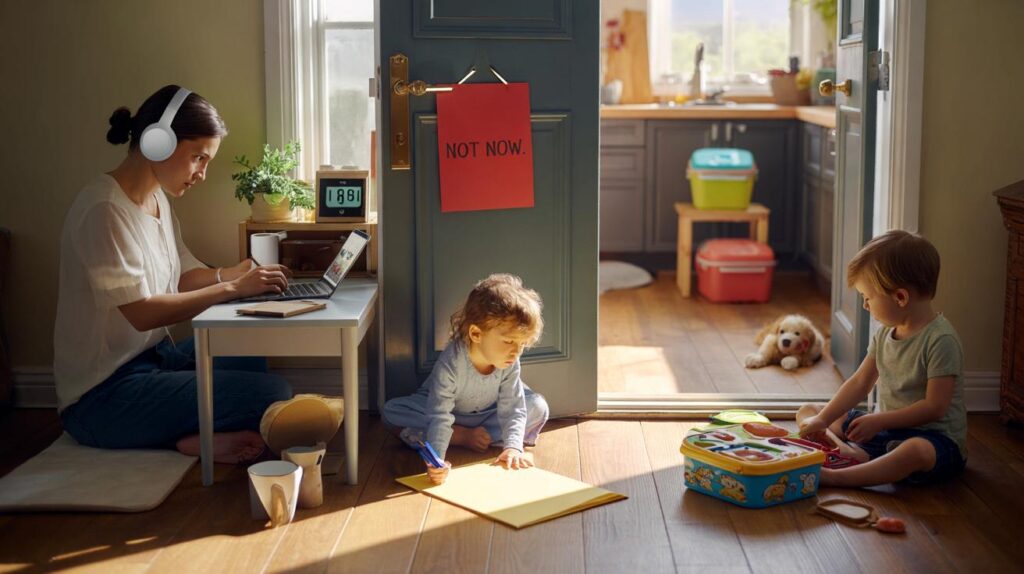
Two tiny toothbrushes in the pot, two lunchboxes waiting, two Slack notifications lighting up like warning flares. That’s the morning rhythm for a mum of two who suddenly found her living room doubling as a meeting room. For months, she tried to be everywhere at once — answering emails with one hand and un-knotting shoelaces with the other. She wasn’t winning. Then she set a single rule that felt almost rude in its clarity. She calls it the “No Double Duty” rule — and it’s the line that stopped the spiral.
The kettle clicked, the dog sneezed, the three-year-old shouted for a banana with the urgency of a fire drill. On her laptop, a video call opened with the cheerful awkwardness of “Can you hear me?” Her nine-year-old’s homework sheet had vanished under a pile of LEGO. She could feel the split-screen inside her brain, two channels competing for the same speaker. We’ve all had that moment when your day feels like a dozen tabs you can’t close. Then she stood up, closed the door, and said out loud: “Mum or worker. Pick one.” It sounded odd. It felt like oxygen.
The rule that changed the room
The rule was brutally simple: never do two jobs at once. The moment she’s working, she’s not parenting; the moment she’s parenting, she’s not working. No mixing, no “just quickly” replies while tying shoelaces, no “just quickly” snack runs mid-email. She created two visible modes for herself and for the kids, like a light switch for the house. When the headphones are on the head, Mum is at work. When the headphones are on the hook, Mum is at home. It wasn’t about clocking more hours. It was about protecting the ones that mattered.
On the first week she tested it, she carved two tight hours after school drop-off for deep work. She told the children the new rule at breakfast and stuck a bright card on her office door: green means “come in”, red means “not now, five minutes”. The nine-year-old scribbled questions on a notepad instead of tapping her shoulder. The three-year-old had a “snack box” and a stack of quiet-time toys, only for red-card moments. Interruptions dropped by half. Her focus stretched long enough to finish the scary task first. By Friday, she wasn’t catching up at midnight. She was on the sofa at 8.30, still awake.
Why did it work? Because switching has a tax. Studies show it can take more than twenty minutes to regain full focus after a context change, even a small one. Each “quick” interruption is a pinhole in your day, leaking attention you never notice until you’re empty. Splitting roles also multiplies hidden tasks: where did I put the scissors, what was I saying on Slack, who’s eaten, who hasn’t? A single rule removes dozens of micro-decisions. It’s a guardrail for the brain. And when children know what the boundary looks like, they often rise to it. Kids like rules when rules feel fair.
How she makes it stick at home
She built rituals. Headphones on. Timer set for 45 minutes. Red card on the door. The nine-year-old got three “golden tickets” a day for true emergencies. The three-year-old got a mini basket of toys and two snacks he could open alone. Every 45 minutes, she popped out for a two-minute check-in — toilet, cuddle, quick reset — then straight back in. Work is work, parenting is parenting, and the handover is sacred. The rule sounds strict, but the tone is warm. She shares the day’s plan on the fridge at breakfast: school, calls, play, dinner. It’s predictable, which calms everyone’s shoulders.
What about days when the plan shreds itself? She writes a “tiny version” of the rule: 20 minutes on, 5 minutes off. If the three-year-old gets clingy, she shifts to floor work — laptop on a low table, headphones still on, red card still up. Let’s be honest: nobody actually does this every day. Some afternoons collapse into cartoons and pasta. That’s not failure; that’s Tuesday. The trick is coming back to the rule the next block, not binning the whole week. She forgives the messy hours, then resets the switch.
“The rule didn’t give me more time,” she told me. “It gave me fewer choices to battle — and that’s what saved my brain.”
When friends asked how to copy it, she shared an easy starter kit:
- Pick one visible signal for “at work” and one for “at home”.
- Set two protected blocks you can defend most days, even short ones.
- Create a child-friendly “not now” plan: snacks, toys, timer, a notepad.
- Make a daily handover moment: headphones off, hug on.
- Keep a “parking lot” note for thoughts that pop up in the wrong mode.
It saved her sanity and her job in the same month. It also made her kinder to herself. When you’re not pretending to be two people at once, you can actually meet your own eyes in the mirror.
Why this matters beyond one kitchen table
The “No Double Duty” rule isn’t a lifestyle flex. It’s a way to make remote work human. You don’t need a big house or paid childcare to test a softer version. You need a signal, a plan for interruptions, and a promise to honour the handover. Bosses often respond well when you explain it with outcomes: two hours without Slack pings equals a report done by noon. Even in open-plan flats, a scarf on a chair can be your red card. You’re allowed to draw a line.
| Key points | Details | Interest for reader |
|---|---|---|
| One rule, many gains | No Double Duty: never work and parent at the same time | Easy to remember, reduces mental load fast |
| Make it visible | Use signals like headphones, door cards, timers, fridge plans | Kids and colleagues understand when you’re “on” |
| Design for interruptions | Snack boxes, quiet kits, “golden tickets”, 45/5 rhythm | Fewer derailments, easier resets after blips |
FAQ :
- What if my kids are very young and can’t read signals?Use colour and rhythm. A red scarf on the chair means “not now”, a green one means “come in”. Pair it with short, predictable blocks and a simple rhyme they can learn. Keep a tactile “busy box” they only see during red time.
- What if my manager expects instant replies?Explain your focus blocks and offer trade-offs: quicker turnarounds, a shared calendar, and a 10-minute mid-morning check-in. Most leaders prefer one solid answer at 10:30 to five scattered replies all morning.
- How do I handle real emergencies?Define emergencies with your children: sick, hurt, fire, doorbell. Give them three “golden tickets” per day they can hand you for urgent needs. If a true emergency hits, flip to parenting mode and log a quick note to resume work later.
- What if my home is too small for a separate office?Create a portable boundary: a folding screen, a specific chair, even a hat. When the hat is on, you’re at work. When it’s off, you’re theirs. Train the family on that cue, and pair it with the timer ritual.
- Where should I start on a chaotic Monday?Start tiny. Pick one 45-minute block. Choose your signal. Set up a snack-and-quiet kit. Tell the family the plan in one sentence. Protect just that block, then celebrate when it’s done. Momentum beats overhaul.



The “No Double Duty” line felt like oxygen—stealing that phrase for my fridge. The red/green card + headphones cue is so simple it hurts. Tried a 45/5 block this morning and actually finished the scary task first. Thank you for making boundaries feel kind, not cold; I honestly feel less frazzeld already.