
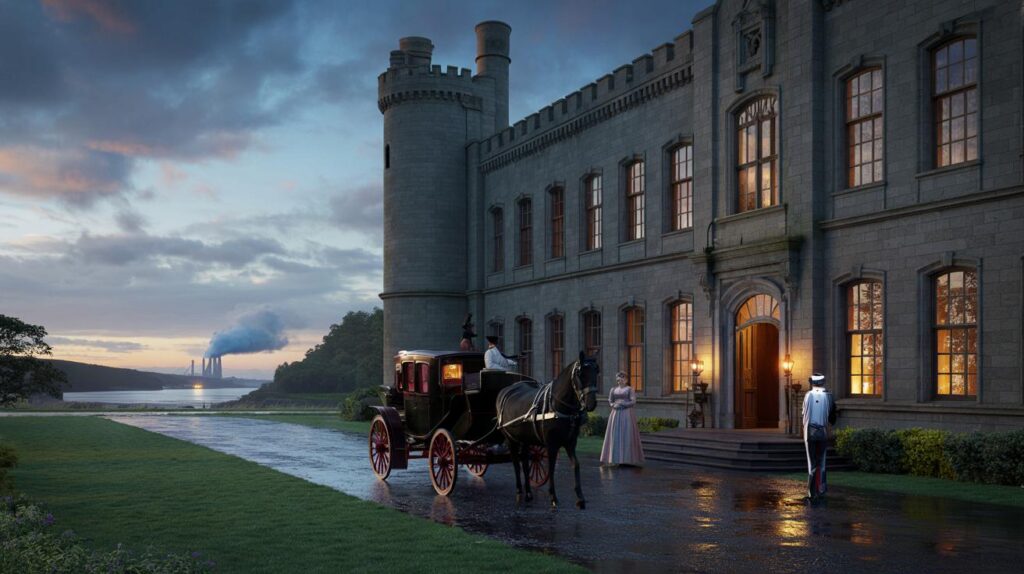
A brooding fortress on Wales’s north coast is preparing for its close‑up, as cameras resurrect a turbulent Victorian world.
The neo‑Norman Penrhyn Castle near Bangor has taken on a fresh role, doubling for the Guinness family seat in a new Netflix period series set against the industrial age’s sweep and strain.
A Welsh stronghold reborn for the small screen
Perched above the Menai Strait, Penrhyn Castle’s crenellations and grand stone interiors were built to look older than they are. Completed in 1840 for the Pennant family, the pile channels medieval swagger through a Victorian lens. For Netflix’s House of Guinness, those qualities have proved invaluable. The production uses Penrhyn as a stand‑in for Ashford Castle, the Guinness family home, evoking privilege, power and the rituals of a dynasty at its zenith.
Penrhyn Castle steps in as Ashford Castle throughout the eight‑part drama, its 1840 neo‑Norman architecture supplying instant period credibility.
The fit is more than visual. Both houses trace their fortunes to the industrial revolution’s windfall. Ashford’s owners modernised a medieval estate; Penrhyn’s were propelled by slate. That shared heritage underscores the series’ central themes of wealth, work and the costs of progress.
Why Dublin had to be reimagined
Although the story unfolds in 1860s Dublin and across the Atlantic in New York, the cameras mostly rolled in north Wales and the north‑west of England. Much of modern Dublin no longer mirrors its 1868 streetscape, so producers fanned out across the Irish Sea, assembling a patchwork of locations with intact period fabric. Manchester and Liverpool supplied dense terraces and civic grandeur. Yorkshire offered mills and cobbles. North Wales provided stately rooms and sweeping grounds to anchor the family narrative.
- Primary urban backdrops: Manchester and Liverpool for 19th‑century street scenes.
- Country house setting: Penrhyn Castle, standing in for Ashford Castle.
- Supplementary period sites: Yorkshire mills, terraces and civic buildings.
- Transatlantic sequences: studio builds and dressed streets evoking 1860s New York.
- Streaming date: eight episodes arrive on Netflix from 25 September.
Producers say the chase for authenticity meant moving more than a typical television shoot, piecing together a convincing Dublin from multiple towns. The goal: visual truth without the constraints of a modern capital’s skyline, traffic and glass.
Inside the Guinness saga
House of Guinness picks up immediately after the death of Sir Benjamin Guinness, the brewer whose drive supercharged the family fortune. The drama tracks the will’s fallout on his four adult children — Arthur, Edward, Anne and Ben — while weaving in characters linked to the brewery’s orbit. The timeline spans Dublin drawing rooms and New York docks, tracing the web between money, politics and reputation.
Created by Steven Knight, known for Peaky Blinders, and starring James Norton, the series leans into questions of legacy: how to preserve a name, when to risk it, and who pays when vision outruns restraint. Expect boardroom manoeuvres alongside domestic tensions, and the murkier compromises that built empires in an age of steam.
Inheritance, ambition and the price of influence drive the plot from Dublin to New York, with the Guinness name as both shield and burden.
Penrhyn Castle’s past and its echoes
Penrhyn’s own story resonates with the series’ preoccupations. The castle rose on profits from slate, quarried at a scale that reshaped the hills above Bethesda. The wealth funded opulent rooms, but the industry also forged hard labour politics, culminating in the long Penrhyn strike at the turn of the 20th century. Today, under National Trust Cymru care, guides explain both splendour and struggle, and how fortunes carved from stone and steel filtered into grand designs.
That duality makes Penrhyn a pointed fit for a drama about dynastic clout. Its great hall, vaulted staircases and richly panelled chambers speak to triumph. Its history hints at the strains beneath the surface. Viewers attuned to those layers may find extra charge in the setting.
What viewers will notice on screen
The production has dressed Penrhyn with period furnishings and textiles to suggest the Guinness family orbit of 1868. Exterior shots lean on the castle’s massed stonework and flanking gardens to signal status within seconds. Interiors emphasise procession: corridors that funnel power, doors that stage negotiations, galleries where alliances are forged with a nod or a glass.
The castle’s geometry — high ceilings, long sightlines, deep thresholds — sells the illusion of 1860s privilege before a word is spoken.
Visual effects help erase modern intrusions and stitch together cities that no longer exist. The result aims for coherence: Dublin’s political theatre, New York’s peril and promise, and a family stronghold that anchors the narrative amid shifting fortunes.
Tourism ripple effect and practicalities
Location shoots tend to leave footprints beyond the screen. Crews book beds, hire carpenters, caterers and drivers, and pay fees that can support conservation work. For visitors, the draw is tangible: to stand where a scene unfolded and to match frames to real stair treads and window bays. Penrhyn’s seasonal opening times, room rotations and the occasional filming closure mean plans benefit from a quick check before travel. Inside, conservation rules apply: steady feet, watch the ropes, respect fragile floors.
| Feature | On‑screen alias | Where to look |
|---|---|---|
| Principal courtyard | Ashford Castle forecourt | Exterior establishing views and carriage arrivals |
| Great hall | Family reception rooms | Political gatherings and pivotal conversations |
| Woodland drives | Approach roads | Scenes of arrivals, departures and tense exchanges |
Film‑induced travel has reshaped itineraries from Cornwall to County Antrim in recent years. Expect fans to map scenes to Penrhyn’s plan, and local businesses to field new questions about coffee spots, parking and the quickest route to the sea.
What this means for Ireland’s story on screen
Shooting an Irish narrative outside Dublin invites debate about authenticity. The team’s answer lies in texture rather than coordinates. By choosing intact Victorian streets and halls, they aim to honour the period’s feeling — soot on the brick, gaslight on glass, the press of crowds — even if the camera is across the water. When the frame cuts back to Penrhyn’s silhouette, the illusion holds because the architecture does the heavy lifting.
Release details and who’s involved
House of Guinness runs for eight episodes and streams on Netflix from 25 September. James Norton leads the cast, with Steven Knight steering the narrative. The story begins in the wake of Sir Benjamin Guinness’s death and follows the forces tugging at Arthur, Edward, Anne and Ben as Dublin and New York pull in different directions.
Eight episodes land on 25 September, charting the Guinness name from drawing room deals to dockside risks.
If you plan a visit ahead of watching, you’ll build a mental map before the credits roll. If you watch first, bring stills and test your eye against the castle’s corridors. Either way, the production turns a Welsh landmark into a lens on Victorian power — and invites you to decide how much stone and story can carry across time.
Curious about context? Look up the Victorian craze for neo‑medieval architecture, which sought moral weight in ancient forms, and compare it with industrial fortunes that paid the bills. Consider how period dramas compress complex legacies into character arcs. Then ask yourself what a camera leaves out: the workers off‑screen, the quiet upkeep of huge estates, and the long afterlife of a family name that still sits on millions of pint glasses.



Penrhyn’s neo‑Norman bones sell the myth better than CGI. Turning a Welsh stronghold into the Guinness family seat feels right given both estates rode industrial fortunes. With Steven Knight steering and James Norton leading, I’m cautiously hyped. Just give us boardroom tension, not only ballroom glamour; show the cost of progress the article hints at. I’ll be there on 25 Sept, pausing to spot those 8 secrets.
If it’s an Irish saga, why not shoot in Dublin? Does texture trump geogrpahy, or is this just budget dressed up as “authenticity”?