
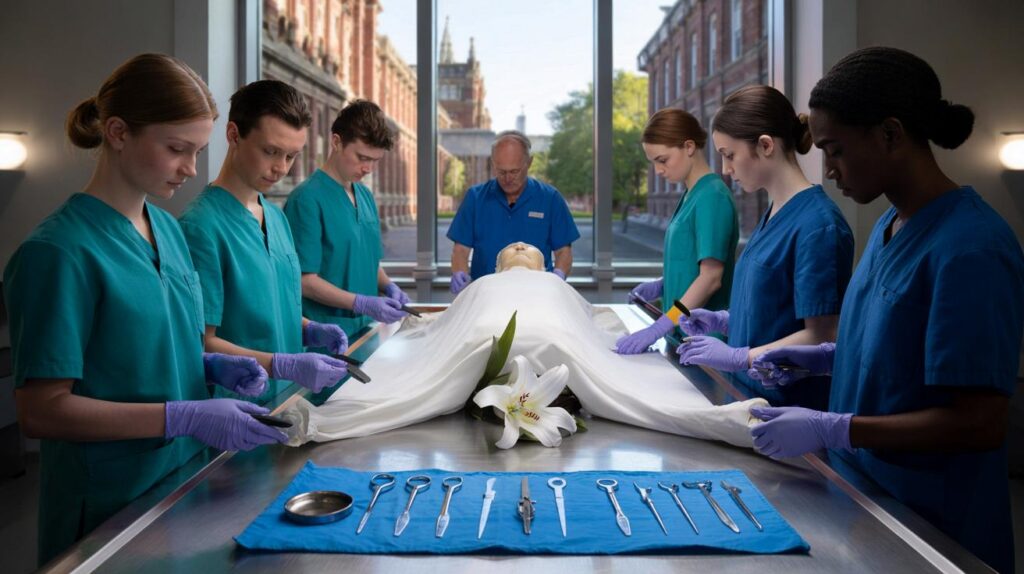
Quiet decisions made years earlier are now reshaping medical training, as the most intimate gift becomes a public service.
Across Northern Ireland, people from every decade of life are weighing a question that feels personal yet civic. They are choosing whether their final act should teach a future doctor’s first lessons. The answer, at Queen’s University Belfast, has already arrived in four figures.
A thousand pledges and a waiting list
Queen’s University Belfast has reopened its Body Donation Programme after a pause during the pandemic and subsequent staffing gaps. Around 1,000 people have already registered to donate their bodies for teaching. A further 250 expressions of interest now sit under review as the university rebuilds its team of specialist technicians.
About 1,000 people have signed donor forms and another 250 are being assessed as the programme restarts.
The medical school teaches anatomy through dissection. Students begin with respectful handling and proceed to systematic study of systems, organs and vessels. Staff say this approach builds the spatial understanding and professional discipline that textbooks and screens cannot replicate.
Why real bodies still matter
Faculty at Queen’s say digital models, augmented reality and high-resolution imaging helped during the programme’s suspension. These tools remain part of the curriculum, yet they concede that no software captures natural variation, texture, fragility or the unpredictable branching of vessels with the same fidelity as a human donor.
Digital anatomy helps, but trainees gain judgement, dexterity and humility by learning from a real person who chose to teach after death.
Prospective students notice. Admissions tutors often hear candidates cite hands-on dissection as a reason to study in Belfast, including applicants from overseas. That choice speaks to a wider culture of learning that places gratitude and care alongside technical skill.
One woman’s decades-old decision
For Virginia Hardy, a 95-year-old from Strangford in Co Down, the decision to donate came long before the recent restart. She signed up more than 30 years ago. Her motive blended kindness with pragmatism. She liked the idea that young clinicians could learn more precisely, and she also felt reassured about practical arrangements at the end of life. Without close family nearby, she wanted clear plans that would spare distant relatives from complicated choices.
Her general practitioner’s appreciation, offered at the time she first registered, stayed with her. Hearing the programme had reopened pleased her and confirmed her view that a final act can carry meaning and utility.
How the programme works
The donation process sits under the Human Tissue Act 2004, which applies in Northern Ireland and places consent at the centre of any decision. Donors must give written permission during their lifetime. Families are informed and often remain closely involved, but the donor’s recorded wishes guide what happens.
Under the Human Tissue Act 2004, a person’s written consent during life governs whether their body can be used for teaching.
When a registered donor dies, their representative contacts the medical school. Specialists assess suitability, because certain conditions can prevent acceptance. If the school can proceed, trained personnel arrange transport and preservation. Teaching usually occurs for up to three years. Afterwards, the university arranges a respectful cremation or burial, often with a memorial event. Families can request ashes.
Who can donate and what to check
- Register while alive and tell your next of kin; keep donor documents with your will and medical notes.
- Some donors cannot be accepted due to cause of death, infection risk, post-mortem requirements or previous major surgery.
- You generally cannot donate your whole body if you have also chosen to donate internal organs for transplant.
- Medical schools typically cover the costs of transport and final cremation or burial linked to the donation period.
- Relatives’ strong objections can complicate arrangements, so early conversations reduce distress and delay.
A bond between campus and community
Queen’s School of Medicine, Dentistry and Biomedical Sciences frames the programme as a partnership. Staff speak of a bond with local people who help in life as patients and, in some cases, after death as donors. That relationship shapes how students behave in theatre, on wards and during family conversations. Knowing that a person, not a model, made their learning possible sets a tone of gratitude that persists into practice.
The restart followed recruitment of new technicians to manage the mortuary and support teaching. The school has already accepted its first donor under the renewed programme. Incoming students arrive with the knowledge that their anatomical training will be richer than during the pandemic years.
Beyond the lab: the skills dissection builds
Working with a donor strengthens more than anatomical knowledge. Students learn careful instrument handling, respectful teamwork, note-taking under time pressure, and the discipline of pausing before cutting. They see how bodies differ from diagrams: arteries split in unexpected places, nerves take unusual routes, and scar tissue tells stories of past illness.
That realism feeds into safer clinical decisions later. A junior doctor who has seen how tissues behave can anticipate bleeding, avoid fragile structures and manage risk with a steadier hand.
Technology’s limits and its place
Virtual anatomy offers speed and repeatability. It lets students zoom, rotate and label with a tap. Yet it flattens unpredictability and cannot reproduce the resistance and give of living tissues. At Queen’s, the future looks hybrid. Students will keep the speed of digital revision while anchoring their understanding in the generosity of donors who chose to teach the hard parts of anatomy that screens gloss over.
If you are weighing the decision
People consider body donation for many reasons: a wish to help, a belief in practical benefit, or a desire to simplify costs and arrangements for family. If you are thinking about it, speak with relatives now. Write down your wishes. Ask your GP about the paperwork medical schools require. Keep contact details for the university that would receive your donation.
Think about the balance between organ donation and body donation. If your priority is to help a transplant recipient, whole-body donation may not be possible. If your focus is teaching, body donation could be the right path. Some people decide on organ donation first, with a fall-back to body donation if transplantation cannot occur; policies vary by institution, so check before you commit.
Practical scenarios to consider
Plan for timing and distance. If death occurs far from Belfast, transport may take longer and could affect suitability. If a coroner orders a post-mortem, the school may not accept the body. If you live alone, nominate someone who can notify the university promptly. These small steps help your decision take effect when it matters.
A clear plan, shared early, turns a private wish into a final lesson that trains the clinicians who will care for all of us.
For many in Northern Ireland, that lesson already has a number attached: 1,000 committed donors, 250 more preparing to follow, and a generation of students ready to learn from the people who chose to keep teaching after their last day.



Incredible to see 1,000 people pledged—thank you to every donor and family. This is how safer surgeons are made, with humility and skill taught side by side.
How do they handle cases where relatives object even if consent was given? Under the Human Tissue Act, does the donor’s recorded wish override family vetoes in practice?