
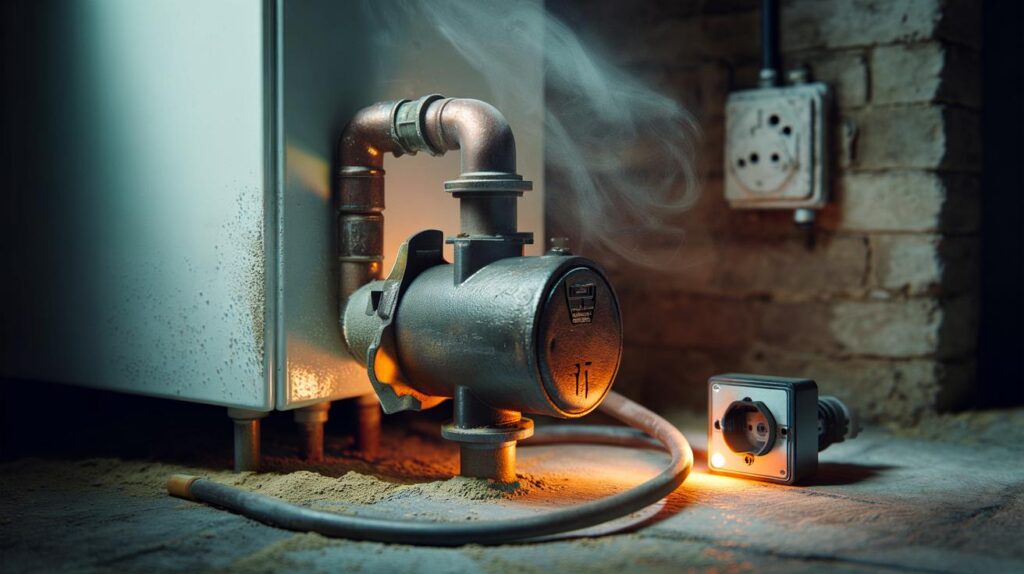
There’s a small bronze lump near your boiler that never gets a second glance. It whirs through the night, sips electricity through the day, and no one remembers when it was last touched. **Your boiler room could be burning £150–£250 a year on a single forgotten motor.**
At six in the morning, the kitchen is cold and the kettle is louder than it needs to be. Down below, the basement has that metallic tang of pipes and dust, and a soft, persistent hum, like a distant fridge that never clicks off. I follow the sound to a scuffed circulation pump the colour of old coins, its casing warm, the cable brittle where it bends, the speed switch set to “III” as if someone decided “max” was the safe choice and never looked back.
I plug in a little energy monitor and the numbers jump, settle, and hold. The figure is small in the moment — 82 watts — but it feels heavy when you multiply it by hours, days, months, winters. The meter blinked like a warning.
The quiet device that never sleeps
There’s a trick to these hidden loads: they don’t shout. A circulation pump lives in that in-between space — not quite an appliance, not quite a building service — and that’s why it escapes attention. It hums along whether you’re home or not, often wired to run with the boiler or even on a permanent feed, and the difference between an efficient unit and a hungry one is hard to feel with your fingertips.
Old UK homes are full of them. If yours says Grundfos UPS or Wilo Gold on a badge that has lost its shine, you might be looking at a 60–100 watt motor running for much of the heating season. I met Leanne in Leeds who thought the boiler was the only energy culprit; her pump was drawing 70 watts, 24/7, because it had been left on the highest speed years ago. Over a year, that’s roughly 613 kWh. At 27–30p per kWh, it sneaks towards £170–£185 without a single light being switched on.
Why so thirsty? Many older pumps use fixed-speed induction motors. They don’t modulate, they just spin, pushing water around the loop whether radiators need it or not. Flow is brute-forced, not tailored, so the pump wastes energy and can even make the boiler short-cycle. Newer ECM (electronically commutated) pumps vary their speed, track system resistance, and match output to demand. **A modern ECM pump can cut that consumption by 60–80% right away.** The physics doesn’t change; the control does.
How to spot it, test it, and tame the load
Start simple. Find the pump on the pipework near your boiler and read the nameplate: brand, model, speed settings, rated watts. Then measure real use with a plug-in energy monitor or a clamp meter on the feed, and watch it across a normal heating cycle. Note the kWh, not just the watts. **Start by reading the wattage on the nameplate, then measure the real draw — facts beat guesses.** Once you have a day’s data, multiply by 365 and by your tariff to see the yearly cost. It’s sobering, and empowering.
Don’t jump to “max speed equals warmer house”. It often means noisy pipes, wasted power, and poor radiator balance. Try the lowest speed that still gets rooms warm, then check radiators are hot top-to-bottom and balance lockshield valves to even out flow. We’ve all had that moment when a small tweak turns the whole system calmer. Let’s be honest: nobody actually does that every day. So make one careful pass, write down the settings, and leave the system to prove itself for a week.
If the numbers still sting, replacement is the clean move. Look for an A-rated ECM pump with auto-adapt modes — common choices are well-known, and fit straight onto many existing flanges. A heating engineer can swap one in about an hour, and you’ll feel the difference in the silence as much as the bill.
“We replaced an 85W three-speed with an ECM that idles at 7–12W in a typical home. The payback was under two winters, and the kettle stopped competing with the basement hum.” — Martin H., heating engineer, Kent
- Target draw after upgrade: 5–25W in steady heating, 30–40W at peak flow.
- Look for auto-adapt or proportional pressure modes, not fixed-speed.
- Add a dirt filter or clean the existing one to protect the new impeller.
- Balance radiators after the swap to lock in comfort and savings.
What’s really going on when a pump eats your power
The pump isn’t just an electricity cost; it’s a signpost. When water rushes too fast, radiators can’t shed heat efficiently, the boiler short-cycles, and fuel use creeps up while rooms feel oddly uneven. When water creeps too slowly, the boiler runs longer, and you chase warmth with the thermostat. Hidden in that small motor is the rhythm of the whole system, the timing of heat moving from flame to space, the quiet choreography that keeps a home steady.
So the win is twofold: cut the watts and smooth the flow. That might mean moving from an old three-speed box to a variable-speed ECM, setting the curve once, and letting it think for itself. It might mean a ten-minute balance and a fresh look at the delta-T between flow and return. *It’s a small fix that quietly resets the rhythm of your home.* And it’s the kind of fix neighbours talk about when they compare bills in the spring.
The small upgrade with outsized impact
This is not about shaming old kit. It’s about noticing the stuff the house hides well. If a 70–100 watt always-on load becomes 10–20 watts most of the time, the saving is the size you can actually see in a quarterly statement, not just feel in your conscience. And the comfort often improves too — less whine in the pipes, fewer hot-and-cold swings, less fighting with the thermostat.
Once you’ve looked at the pump, you start noticing other 24/7 passengers: the garage fridge that’s older than your teenager, the router-plus-switch stack, the towel rail left in summer. A single baseload audit transforms how a home breathes. You don’t need to turn into an energy bore, or stand over the boiler with a stopwatch. You just need one quiet afternoon, a plug-in meter, and a small willingness to change a setting that no one has touched since the last World Cup.
Some upgrades feel like a chore you’ll never finish. This one feels oddly satisfying. The result is tidy numbers and warmer rooms, a little more silence in the evenings, and the calm sense that you’ve fixed something fundamental. **If your pump is hot to the touch and humming all day, it’s costing you money every hour.** The fix is within reach, and it doesn’t ask you to be perfect. Just curious.
| Key points | Details | Interest for reader |
|---|---|---|
| Old pumps can cost £150–£250/year | 60–100W continuous draw adds up to 525–876 kWh/year at typical UK tariffs | Clear money saved for a small change |
| Measure before you change | Use a plug-in meter or clamp, track kWh over a day, and calculate yearly impact | Confidence to act based on your own data |
| ECM pumps slash the load | Variable-speed, auto-adapt units often run at 5–25W in normal heating | Fast payback, quieter system, better comfort |
FAQ :
- How do I tell if my pump is “old” or inefficient?Check the model badge: three-speed units without “ECM”, “Alpha”, “Yonos”, or A-rating are likely older. A warm casing, audible hum, and a fixed speed switch are clues.
- How many watts should a good modern pump use?Expect 5–25W in steady operation on a typical radiator system, rising briefly to 30–40W at peak. Old fixed-speed pumps are often 60–100W regardless of demand.
- Can I replace it myself?Swapping a pump involves isolating valves, draining a little water, and testing for leaks. Many homeowners hire a heating engineer; it’s usually a quick job with the right spanners and washers.
- Will a smart thermostat fix a power-hungry pump?Not directly. Smart controls manage boiler firing and schedules, which helps, but the pump’s motor efficiency and speed control determine its own electrical draw.
- What if I have a combi boiler or a heat pump?Combies still use a circulation pump for central heating. Heat pumps rely on careful flow rates, so an ECM pump and good balancing are essential for efficiency and quiet running.



Is there any reason to keep a three‑speed pump on “III”? I always assumed faster = warmer, but your note about short‑cycling has me rethinking. If I drop to “I” and balance the radiatprs, what signs tell me it’s too low—slow heat-up, big delta‑T, boiler locking out? Any risks to older valves when ajusting?