
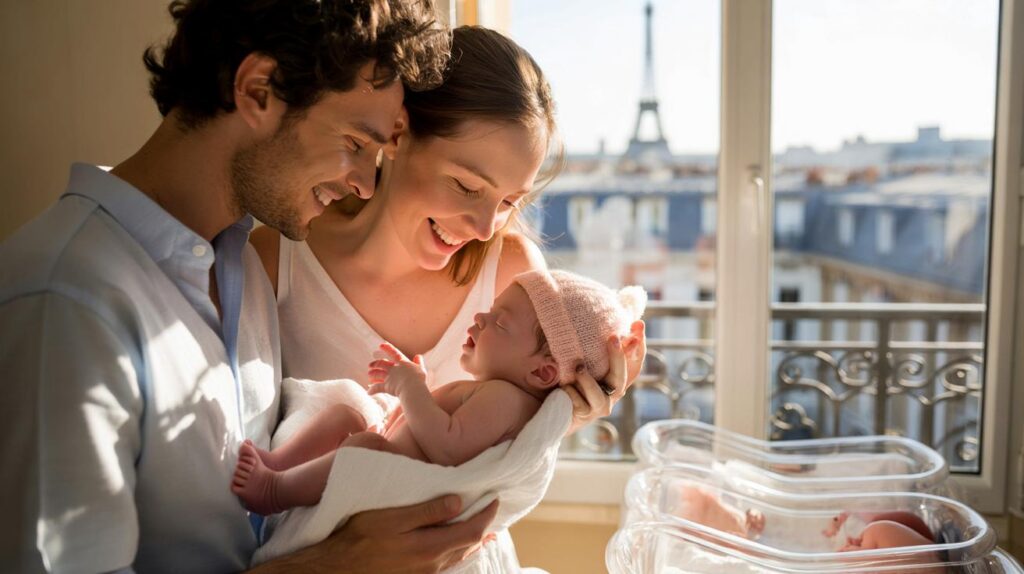
Across Europe, a short, sun-bright girls’ name keeps edging past fresh fads, winning over grandparents and social-first parents alike.
In France, Léna has turned quiet momentum into a durable lead. Fresh registry data for 2025 shows the name holding a prized place in the national charts while newer stars swirl around it. The appeal looks simple on the surface, yet the numbers tell a broader story about how families choose names that travel well, feel modern and carry light in their meaning.
The name lighting up the charts
Léna is no passing trend. By 2025, nearly 74,000 women in France answer to it, and the name accounts for around one in every 130 births. That footprint cements its position among the most given girls’ names of the past quarter-century, placing it 12th since 2000 and 14th in the current year’s Top 20. In a field crowded with crisp, vowel-led choices, this two-syllable favourite continues to cut through.
Nearly 74,000 bearers in France and about 1 in 130 newborn girls named Léna in 2025: a compact name with a big footprint.
| Indicator | Figure | Notes |
|---|---|---|
| Current national rank (2025) | 14th | Just behind Lina and ahead of Inaya |
| Share of births (2025) | ~1 in 130 | Consistent presence across many regions |
| Since 2000 | 12th most given | Strong over a 25-year window |
| Total bearers in France | ~74,000 | Measured across living generations |
From Greek roots to global reach
The name’s glow begins with meaning. Léna traces back to the Greek hêlê, associated with the brightness of the sun. It links historically to Helen/Helena and, by extension, to Elena across southern and eastern Europe. In Brittany and other Celtic-influenced corners of France, it also appears as a friendly short form of Elena. The result is a name that feels local and international at once, easy to spell and easy to say in many languages.
Meaning anchored in “brightness of the sun” gives Léna an optimistic charge that parents instinctively recognise.
Its brief shape adds to the charm. Two syllables, an open final “a”, and soft consonants place it squarely in the modern sweet spot. That simplicity helps in school registers, on forms and in global inboxes, which matters for a generation likely to study or work across borders.
A rise three decades in the making
Before the late 1980s, Léna barely registered, with fewer than 50 baby girls receiving it each year in France. Then the charts shifted. Parents leaned towards sleek names that feel light, international and quick to pronounce. Léna fit that mould and climbed steadily through the 1990s and 2000s. By 2025, it stands shoulder to shoulder with the elite, just behind Lina and ahead of Inaya.
Why this rhythm of growth? Partly phonetics: the “-a” ending harmonises with a pan-European taste that includes Emma, Mila, Alba and Giulia. Partly portability: Léna looks familiar to speakers of French, German and Italian, and still makes sense without the accent in English-language contexts. Families also value a name that reads bright but not showy, timeless but not dated.
Variants and the friendly rival
Léna hosts a small family of variants—Lehna, Leina and Lenna share the sound while tweaking the look. Its close cousin Elena has surged as well, now solidly placed in France’s national Top 50. Elena draws strength from its Mediterranean cadence and long historical runway via Helen of Troy, which lends classical appeal without feeling dusty.
Across francophone regions, patterns diverge. In Switzerland and Wallonia, Léna still holds firm. In Quebec, parents lean increasingly towards Elena, a choice that sidesteps the accent while staying faithful to the root. Both routes keep the sunlit meaning in view; the difference lies in typography, regional taste and the documents children will use as they grow.
Léna or Elena? Same sunny origin, two scripts, and a shared promise of easy cross-border use.
Diacritics and day-to-day life
The accent on Léna is standard in French records. Abroad, the mark can disappear on forms or platforms that limit special characters. That rarely alters pronunciation in France but may shift it elsewhere. Some families register Léna officially and use “Lena” where systems force plain text. Others choose Elena from the start for complete uniformity across languages. Neither route forfeits the radiance behind the name.
What parents say they want
Conversations with expectant parents point to a similar checklist: clarity, warmth and range. Léna scores well on each.
- Short and clear: teachers, doctors and teammates say it the first time.
- Positive imagery: “sunlight” signals warmth without feeling ornate.
- Global friendliness: the name travels easily in Europe and beyond.
- Style match: pairs neatly with minimalist surnames and lyrical ones.
- Low risk of spelling traps: the accent is the only wrinkle, and it’s manageable.
Character impressions people attach to the name
Characterology—an interpretive field rather than science—often links Léna with dynamism, courage, curiosity and independence, wrapped in an easy charisma. Many parents hear that list and simply recognise a bright, forward-leaning image consistent with the name’s etymology. Whether or not families buy into name psychology, the associations tend to be upbeat and modern.
Thinking of choosing Léna? A quick road‑test
Before committing, run a practical check. It helps you picture how the name will live day to day, in France and elsewhere.
- Say it with your surname at normal speed; listen for awkward echoes or tongue-twisters.
- Write it with and without the accent; check how it appears on typical digital forms.
- Scan initials and monograms; avoid unintended words.
- Try a playground test: can a five-year-old classmate pronounce it easily?
- Consider future travel or study abroad; decide whether Léna or Elena fits your path.
- Think about nicknames you like or dislike; set boundaries early if needed.
- If you care about rarity, look at local rankings; Léna sits high nationally, which may mean classmates share it.
Names that sit well beside Léna
If you are pairing siblings or looking for middle names, balance rhythm and style rather than matching endings too closely.
- Balanced middles: Léna Claire; Léna Sophie; Léna Maëlle.
- Siblings with similar weight: Léna and Alba; Léna and Romy; Léna and Noa.
- Siblings with a classic tilt: Léna and Émile; Léna and Arthur; Léna and Elise.
Why the trend matters beyond the name itself
The rise of Léna mirrors a broader European turn towards compact, melodic names that adapt across languages. Families move more, study abroad more and work across borders more. Names that cross administrative systems and social circles with minimal friction gain an edge. Léna, with its sunny root and crisp form, shows how a choice can feel personal yet fit a global moment.
For those weighing Léna against Elena, think less in terms of winners and more about context. If you expect to keep the accent on official papers and daily apps, Léna offers a distinctly French stamp. If you prefer uniformity in international settings, Elena smooths the path while preserving the meaning you value. Either way, the data from 2025 signals a durable favourite that has earned its place among France’s top picks.



Great breakdown! We chose Léna in 2022 for exactly these reasons—short, sunny, and easy across languages. The note about the accent dropping on some platforms is spot on; we use Léna on official docs and Lena on airline apps, no drama. Also loved the sibling pairing ideas; Léna & Romy is adorable. Thanks for the clear data and the little history lesson 🙂