
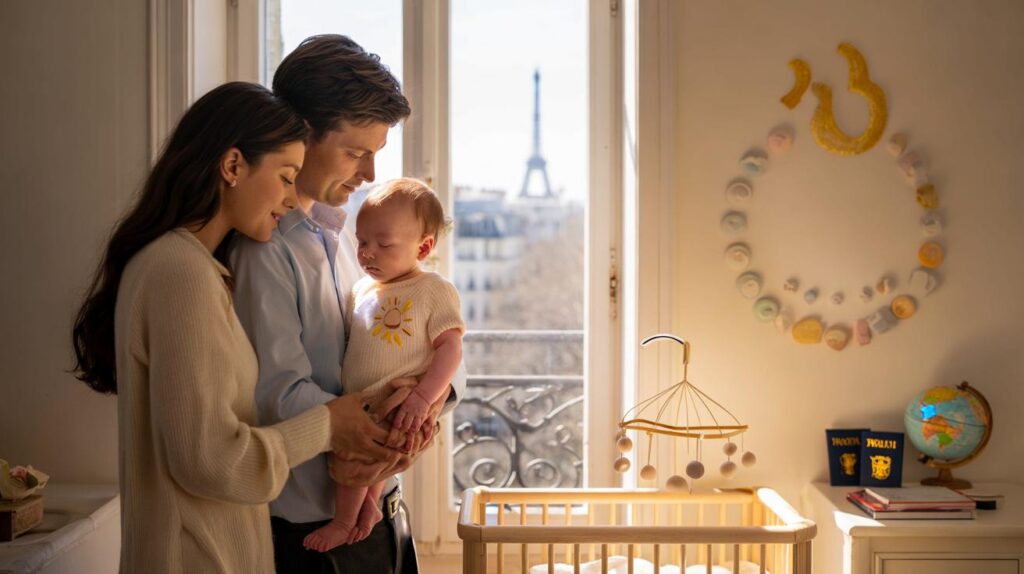
You think baby names come and go. But one sunny syllable keeps cutting through the noise, from Paris to Perth.
Fresh 2025 figures point to a bright, brief French choice capturing parents’ hearts, even as Alba, Romy and Giulia climb the charts.
The figures that put Léna on the map
Léna now stands as one of France’s most bankable girl names of the century. Since 2000, it ranks 12th by cumulative use. In 2025 alone, it sits in 14th place nationwide—slotted just behind Lina and ahead of Inaya—showing both depth over time and current pull. Nearly 74,000 French women bear the name today, and roughly one in 130 newborn girls receives it each year.
74,000 bearers. About 1 in 130 births in 2025. Twelfth most given since 2000, 14th in this year’s national table.
How the curve climbed since the 1980s
Four decades ago, Léna barely registered—fewer than 50 baby girls a year received it in France. The surge began as the fashion for short, vowel-led names took hold in the late 20th century. By the 2000s, Léna tracked upwards with a clean sound and simple spelling, a combination that travelled well across borders. Its appeal never hinged on one celebrity or one TV moment; rather, it rode a broader shift towards concise, melodic names ending in “a”.
Where the name comes from and why it resonates
Rooted in the Greek hêlê, Léna carries the meaning “brightness of the sun”. The name connects internationally via the Helen/Helena family, yet it has also developed its own identity in the Francophone world. In Brittany, it often appears as a diminutive of Elena. Those connections give the name cultural depth while keeping it light on the tongue.
Meaning matters: Léna channels “sunshine” in both sound and story, giving parents a positive, portable choice.
Phonetically, the two syllables land softly and end openly, which helps across languages. Many parents now want a name that a nursery teacher in Lyon, a GP in London and a colleague in Lisbon will pronounce without stress. Léna ticks that box, while still feeling distinctly European and unmistakably feminine.
- Origin: Greek hêlê, linked to Helen/Helena.
- Style: short, two syllables, ends in “a”.
- Vibe: warm, upbeat, confident; sunny imagery.
- Current status: 14th in France (2025), 12th since 2000 by cumulative count.
- Typical rivals: Lina, Inaya, Alba, Romy, Giulia; longer cousin Elena rising fast.
Rivals, variants and the global picture
Léna presents several close variants—Lehna, Leina and Lenna—alongside the international rivals Lena and Elena. The variant Elena has made notable gains, now in France’s Top 50, buoyed by its Mediterranean feel and literary pedigree via Helen of Troy. In Switzerland and French-speaking Belgium (Wallonia), Léna remains resilient. In Quebec, though, Elena now edges ahead.
| Form | Accent | Roots | Pronunciation guide | Perception |
|---|---|---|---|---|
| Léna | Yes (é) | Greek hêlê; linked to Helen | leh-nah (stress on first syllable) | Distinctly French, bright, modern |
| Lena | No | Germanic/Slavic/Scandinavian usage | lee-nah or leh-nah (varies by country) | Global, flexible, pan-European |
| Elena | No | Greek/Latin; Helen family | eh-leh-nah or eh-lay-nah | Mediterranean, classic, rising |
What parents say they want in 2025
Parents report three priorities: portability, positivity and brevity. Léna fits the pattern. It travels on school registers and HR databases, radiates cheerful meaning and keeps paperwork clean. It also pairs neatly with a spectrum of surnames—hard consonants gain a melodic counterpoint, while softer surnames keep the flow.
Spelling, accents and the admin you’ll actually face
In France, the accent aigu is standard and appears on official documents. Outside French systems, the accent may vanish on forms or airline bookings. That is not a deal-breaker, but it creates two lived versions—Léna and Lena—particularly in English-language environments. If you plan an international life, you may want to agree a default for travel and digital profiles.
- Passports and tickets: check how carriers render diacritics; “Lena” may appear on boarding passes.
- School systems: teachers often accept both forms; supply the preferred spelling early.
- Email handles: reserve both lena.surname and léna.surname to avoid confusion.
- Voice assistants: test pronunciation on your devices; adjust phonetic hints if available.
The sound that sells: why short “a” names keep winning
Names ending in “a” create a clear opening vowel and an unforced cadence. They feel friendly, easy to call across a playground and hard to misspell. Léna slots neatly alongside Mila, Ava and Alma, yet holds a French signature through the accent. That balance—recognisable but not generic—helps it hold its chart position against fresh arrivals.
The five-year outlook
Expect Léna to remain a core pick in France while ceding a little ground to Elena in regions where diacritics can be a hassle. Its share—around one in 130 births—may drift slightly as Alba, Romy and Giulia continue to break through. But the name’s long run since 2000 suggests remarkable staying power, especially in urban areas that favour short, internationally friendly choices.
Steady, not spiky: Léna looks set for durable popularity rather than a volatile boom-and-bust cycle.
Practical pairing: middle names and siblings
For a middle name, balance the brightness with either a crisp consonant or a longer classic. Léna Charlotte, Léna Camille, Léna Joséphine and Léna Beatrice each bring a different rhythm. For siblings, consider complementary shapes—Malo, Nino, Sacha, Alba, Inès or Romy—to keep the compact, continental feel.
What to weigh before you commit
Think about everyday use. Will family members pronounce the accent? Do you want the name to mirror a heritage language? Are you comfortable with two parallel spellings in digital life? If you can answer yes, Léna gives you warmth, clarity and reach without feeling overexposed.
For parents comparing close options, run a quick “life test”: say the full name over the phone; write it in block capitals; imagine it on a CV; ask a stranger to spell it back. Léna usually passes cleanly on all four counts. That, together with its sunny meaning and proven chart strength, explains why 74,000 families have already said yes—and why thousands more may follow this year.



Defintely my 2025 favorite—bright, brief, and not too cutesy. Great pick.