
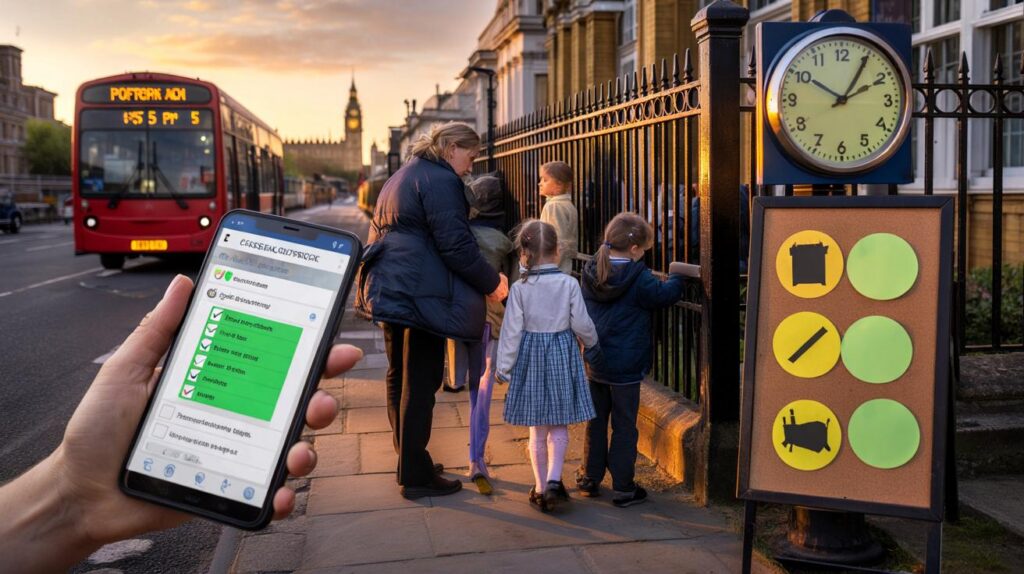
Longer days, fewer school runs, and a fresh row over childcare: families sense a shift that could reshape weekdays.
Parents across the country are watching a fast-growing campaign that promises a three-day weekend, a later pick-up, and a fierce policy fight. The idea has leapt from chat groups to Westminster’s agenda in a matter of weeks.
What has changed this week
A national petition calling for a four-day school week has cleared the 100,000-signature bar, propelling it towards a House of Commons debate. By mid-October, the tally stood at 123,112 and rising. The proposal is simple on paper: keep total teaching time by adding an hour to each school day, then drop one day from the week.
Campaigners argue the model could relieve pressure on families and stem teacher burnout. Ministers have pushed back, citing attendance, learning time, and the knock-on cost of extra childcare. The debate now moves from playground talk to parliamentary timetabling.
The numbers behind the surge
- 123,112 signatures recorded in mid-October, passing the debate threshold of 100,000.
- Petition aims to add one hour to each teaching day and cut Fridays, creating a four-day week.
- Deadline for signatures: 4 December 2025.
- In the United States, around 2,100 public schools across 26 states use some form of a four-day week.
- Typical full-time teachers in the UK work about 52 hours a week during term time.
More than 100,000 signatures forces the issue onto Parliament’s docket, with a Commons debate now in play.
What a four-day week could look like
The petition’s version keeps learning hours intact by stretching each school day. That means a later finish four days a week and Fridays off. Families would save one morning rush and one afternoon pick-up, but would face a longer after-school stretch on the remaining days. Clubs, wraparound care and transport would all need tweaks.
How the 32h30 rule bites
Government policy sets a minimum expectation for state-funded, mainstream schools: a school week of 32 hours and 30 minutes. Any four-day model must still hit that total.
To meet 32 hours 30 minutes across four days, schools would need to extend each day by roughly 1 hour 38 minutes.
In practice, the typical day would exceed eight hours. That creates practical questions: when do clubs fit, how long is lunch, and who pays for an extended day’s heating, supervision and transport?
Where the government stands
Officials have issued a firm response. Ministers say they have no plans to reduce the school week to four days. They stress regular attendance for learning, well-being and safeguarding, and point to parental work patterns that rely on a predictable five-day school routine. The department also notes that most schools already meet the minimum weekly hours, and expects the rest to align.
Ministers warn that shorter weeks could push parents to find extra childcare, reduce hours, or leave work, with wider economic costs.
Teachers, workload and retention
The four-day idea intersects with a staffing problem that refuses to fade. Leavers outnumber joiners in key subjects, and OECD data has flagged retention as a growing concern. Nearly one in ten qualified teachers left the profession in 2022–23. Advocates say a four-day pattern, or at least greater flexibility, could put a brake on departures.
Unions have pressed for measures that cut the grind rather than the learning: staggered start and finish times, remote planning time for theory-heavy subjects, and trust-based workload policies. The question for MPs is whether a structural change to the timetable delivers better results than targeted workload reforms.
What MPs will weigh up in a debate
- Learning outcomes: can longer days maintain concentration, especially for younger pupils and those with SEND?
- Attendance and safeguarding: will a free Friday improve or harm attendance patterns across the week?
- Childcare capacity: can providers fill a new Friday gap without pushing up costs?
- Teacher retention: does a compact week reduce attrition, or does a longer day negate gains?
- Transport and costs: how do bus contracts, utilities and staffing shift under a compressed schedule?
- Equity: do disadvantaged pupils lose access to school meals, enrichment and safe spaces on a day off?
Key dates and the wider petition backdrop
Petitions passing 100,000 signatures are considered for Commons time. If the committee agrees, MPs will get a date to debate. The four-day week petition remains open until 4 December 2025, so the tally could grow further, strengthening the political signal.
Campaign momentum mirrors another parental push. MPs have already scheduled a debate on term-time holiday fines for Monday 27 October 2025, after that petition sailed past 100,000 signatures and topped 180,000. Parents behind that drive want up to 10 fine-free absence days per year. Both petitions tap the same fault line: control over the family calendar.
What a typical day might look like
| Model | Weekly hours | Daily length | Indicative finish | Friday |
|---|---|---|---|---|
| Current five-day | 32h30 | ~6h30 | ~15:30 | Open |
| Proposed four-day | 32h30 | ~8h08 | ~17:08 | Closed |
These timings are illustrative and will vary by school, break structure and local transport. A later finish may push bedtimes and mealtimes, especially in winter, so families would need to adapt routines.
Parents’ practical questions
Childcare and costs
One fewer school day reshapes childcare demand. Some families would avoid wraparound care on the fifth day and save money. Others would need a new full-day place on Friday, which could erase any savings. Local provision differs widely, so a uniform rule may produce uneven outcomes.
After-school clubs and enrichment
Sports, music and tutoring often sit after the bell. A longer school day could squeeze these into tighter slots or push them later. Schools might bring certain activities inside the extended day, but that requires staffing and budget.
Learning and attention spans
Older pupils may cope with longer lessons, especially in exam years where double periods can help. Younger children tire earlier, so schools would need more breaks, movement and varied tasks to keep learning effective. SEND provision would need careful planning around sensory load and therapies.
If your area pilots a four-day week
- Map your week: identify which activities move to Monday–Thursday and which shift to Friday.
- Talk to your employer early: ask about compressed hours, remote Fridays, or a slight shift in start and finish times.
- Check childcare capacity now: Friday places may sell out quickly if demand spikes.
- Budget for winter: later finishes mean more time travelling in the dark; factor in transport and safety arrangements.
- Build a rest plan: a free day helps only if evenings stay manageable; keep homework and screen time balanced.
What schools would need to plan
Timetables must protect core subjects while spacing breaks to preserve attention. Staff rotas would need fresh cover patterns for pastoral and safeguarding duties late in the day. Meal service windows might widen. Transport contracts could shift pick-up times. Governors would want to test attendance and attainment data term by term, with a clear route to reverse course if outcomes dip.
Useful context for the debate
The four-day model is not one-size-fits-all in the United States. Rural districts often adopted it to cut long bus routes and costs; urban outcomes vary. Evidence suggests attendance can hold steady, but effects on attainment depend on how schools use the extra time within longer days. Any UK move would need robust evaluation, proper funding for trials, and clear protections for vulnerable pupils.
Families want fewer battles with the clock. Whether policy shifts depends on the data—and on Friday childcare.



Back it! If we keep total hours and give families a real Friday breather, that’s a win. Teacher burnout is real; a compact week could help retention and focus. Later pick-ups align better with work for many of us. Let’s pilot, measure, and scale what works 🙂