
You tell yourself you’ll start after tea. Then after the next song. Then when the kettle cools down. The washing up glares, the inbox sulks, the laundry morphs into an upholstered landmark. You’re not lazy; you’re stuck in the doorway of doing. At home, that doorway feels especially tight, because no one is watching and nothing is urgent until it is. What if the doorway could be widened by a tiny, almost laughable move?
The mug is warm in your hands. Outside, a delivery van coughs and leaves. Inside, the list in your head keeps blinking like a faulty sign: clean the sink, reply to the landlord, change the sheet that never seems to dry in time. You open a new tab, then another, and somehow end up watching a man in Hokkaido fillet a salmon you’ll never eat. We’ve all had that moment when the smallest task inflates to the size of a full renovation. Then you remember a line you read once about a Japanese habit that begins with a single minute. You set your phone for sixty seconds, absurdly short, almost mocking. The timer starts, and your hand moves before your brain can object. Sixty seconds.
The small-start secret your future self will thank you for
Procrastination at home rarely looks dramatic. It’s quiet, mostly invisible, and strangely heavy. Work is a mountain until it becomes a pebble. The Japanese answer to that mountain is modest: the 60‑second Kaizen rule. Do the thing for one minute. Not thirty. Not five. Just sixty seconds of a single, concrete action. It’s a gentle trick that turns “I should” into “I’ve started”, and that shift is where momentum lives.
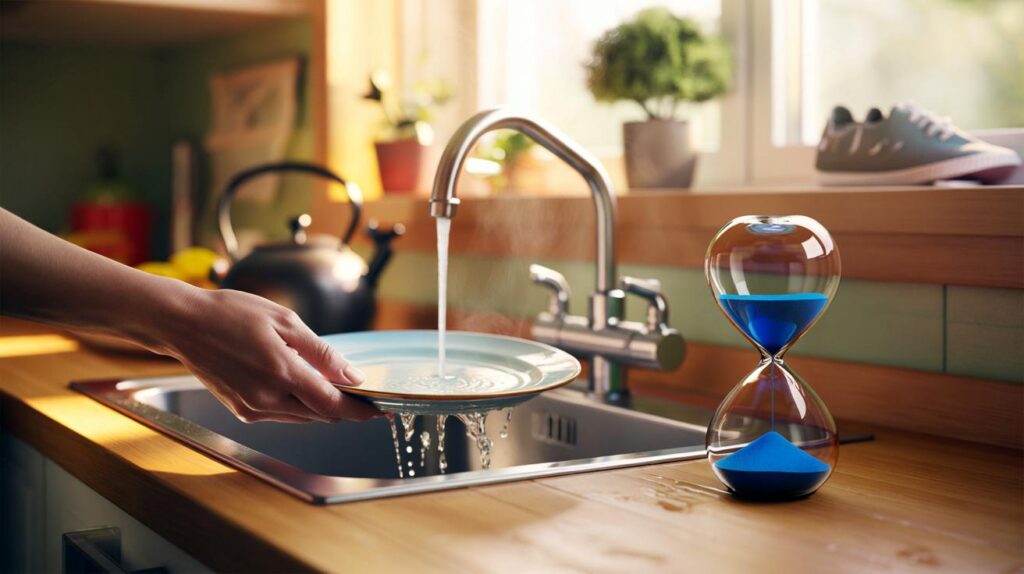
Picture a sink full of plates after a long day. One London reader tried the one‑minute rule at 7.42pm on a Tuesday: timer on, tap running, sponge in hand. One plate, one fork, a quick swish of the pan, timer off. Oddly, they kept going for another two minutes, then stopped. No grand victory speech, no chore chart, just a small win that didn’t wake the inner rebel. Next day, same minute, same motion. By Thursday, the sink no longer felt like a glare. It felt like a nudge.
There’s simple psychology at work. Big, fuzzy tasks trigger threat signals because your brain can’t see the edges, so it stalls. A tiny, defined step lowers that internal alarm and reduces cognitive load. You’re not choosing between “clean kitchen” and “scroll phone”; you’re choosing between “wipe the hob for sixty seconds” and “scroll”. That reframes the start as safe and finite. Momentum is rewarded by a drip of dopamine, and your mind learns a new loop: I start, it’s fine, I can stop. Starting stops being a cliff and becomes a kerb.
How to use the Japanese 60‑second rule at home, today
Pick a task that’s been nagging and choose the first micro‑movement that belongs to it. Set a one‑minute timer. Do only that movement until the beep. Examples: place three plates into the rack, open your laptop and type the subject line, fold the bath towels only, carry two books back to the shelf. Name the action out loud. “For one minute, I will wipe the table.” Then start. Name the first physical movement, not the outcome. It’s your one‑minute truce with your brain.
A few gentle guardrails help. Stop when the timer goes, even if you want to carry on, because stopping teaches safety. If you continue, it’s a bonus, not a rule. Keep it physical; “research new boiler” becomes “open notes app and list three questions”. Keep it specific; “sort bedroom” becomes “pair socks for one minute”. Let’s be honest: nobody really does this every day. You’ll miss. That’s fine. The trick works because it forgives, not because it’s perfect. If you fall off, pick a new minute later and start again.
There’s a quiet pride that arrives with tiny consistency. You’re not trying to impress anyone or overhaul yourself by Monday. You’re just making a start so small that resistance doesn’t notice until it’s too late.
“I didn’t clean the kitchen. I just turned on the tap for a minute, and the rest happened almost by accident.”
- One‑minute scripts to steal:
- Kitchen: “Rinse cutlery only.”
- Admin: “Open inbox and star one message.”
- Laundry: “Fold ten items or stop at the timer.”
- Fitness: “Put trainers on and walk to the doorstep.”
- Writing: “Type the date and a single sentence.”
What changes when you start tiny
Home gets lighter when tasks stop feeling like verdicts. One minute creates a foothold where there wasn’t one, and a foothold is enough to change your route through a room. You begin to respect the start as a skill of its own. Some minutes stay small. Some bloom into half an hour because the friction has melted. You don’t have to decide which. The point is that you did not stay stuck in the doorway.
People sometimes ask if one minute is a gimmick. It’s more of a lens. Shrinking the start reframes the chore as a move you already know how to make. The minute brings you into contact with the task, and contact creates clarity: this cloth is too dry, that email needs a screenshot, those socks are not a pair. Clarity tamps down dread. And dread is what kept you parked on the sofa in the first place.
There’s a cultural grace to this as well. In Japan, kaizen speaks to continuous, humane improvement—small, respectful steps that compound. At home, that looks like rinsing the mug now, not building a new personality. It looks like a quick reset of the hallway instead of a perfect hallway. You’re borrowing a tradition of gentle precision and letting it breathe in your flat. If you want one more cheat code, here it is: Stop after one minute on purpose once a week, even when you’re in flow. That single act keeps the tool kind.
Consider the days ahead as a series of doorways rather than walls. A minute to open the first one, and then see what’s behind it. Maybe you stop. Maybe your shoulders lower and you carry on without bargaining. Maybe you message a friend with your favourite one‑minute script, and they send one back you hadn’t thought of. It’s not about conquering yourself. It’s about befriending the part of you that hates the cliff‑edge feeling, and quietly removing the cliff. The minute is modest, almost shy. It’s also how rooms, mornings, and moods begin to turn.
| Key points | Details | Interest for reader |
|---|---|---|
| The 60‑second Kaizen rule | Do a single, physical action for one minute, then stop | Removes dread, creates instant momentum |
| Make the start tiny and specific | Name the first movement: rinse cutlery, open email, pair socks | Gives a clear, doable way to begin any task at home |
| Protect the stop | Stopping at the beep teaches safety; continuing is optional | Builds trust with yourself, avoids burnout or boom‑bust cycles |
FAQ :
- What exactly is the Japanese 1‑minute rule?It’s a kaizen‑style habit: choose a tiny, concrete action and do it for sixty seconds at a set moment. Then stop.
- Is this the same as the Pomodoro Technique?Not quite. Pomodoro uses longer 25‑minute blocks. The one‑minute rule is about defeating the initial resistance with an almost comically small start.
- Will this work for admin as well as cleaning?Yes. Translate vague tasks into micro‑moves: open the bill, type the subject line, snap a photo of the meter.
- What if I stop after one minute and feel guilty?That’s the training doing its job. Stopping reduces dread next time. Many days you’ll naturally carry on once the barrier is gone.
- Can it help if I struggle with focus?It can soften the “start” friction by lowering stakes and narrowing attention. For clinical concerns, speak with a professional for tailored strategies.



Tried the 60‑second Kaizen rule while the kettle boiled and wow, it broke my ‘doorway of doing’ instantly 🙂 Rinsed cutlery, then somehow cleared half the sink. Tiny start, big momentum—bookmarked!