
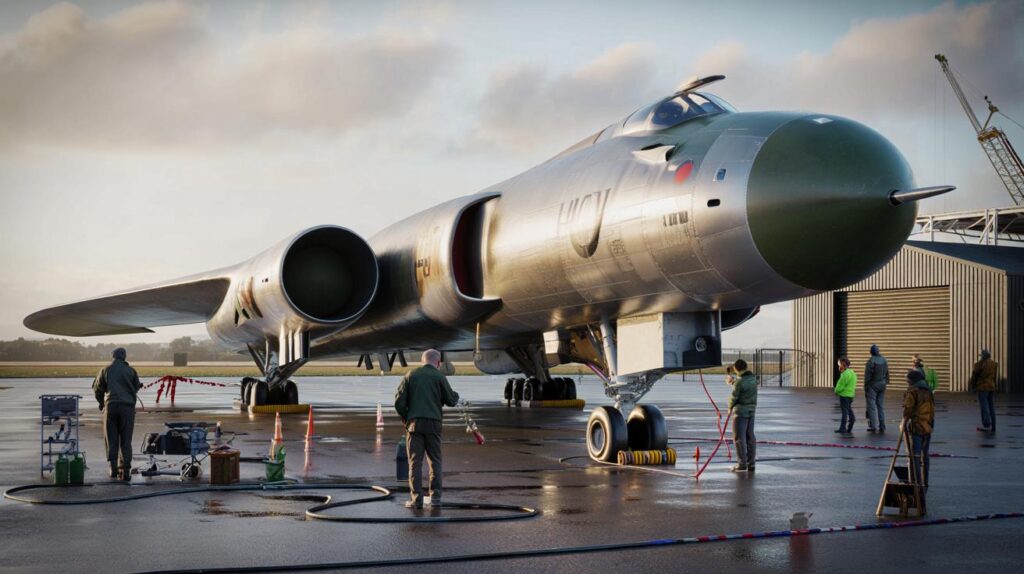
A hulking delta-wing icon rests in South Yorkshire as supporters juggle hope, red tape and rising bills this autumn.
A new public appeal seeks to secure the future of Avro Vulcan XH558 at Doncaster Sheffield Airport, as the charity that safeguards the aircraft wrestles with mounting costs and an uncertain timetable for a long‑planned visitor centre.
What is at stake
Vulcan to the Sky Trust, the charity behind XH558, has warned that finances now sit under heavy strain. The aircraft holds unique status. It flew for the Royal Air Force during the Cold War, retired from service in 1993, and returned to the skies for a much‑celebrated final season in 2015. No other Vulcan can fly. None carries the same combination of history, condition and public attachment.
Only one: XH558 is the last Vulcan to fly and a keystone of Britain’s Cold War story. Losing momentum now risks losing access for good.
The aircraft currently lives at Doncaster Sheffield Airport. The airport shut in 2022, a decision that triggered deep uncertainty for XH558. A plan to remove the aircraft has since been reversed. Doncaster City Council has indicated support for the bomber to remain at the site for the long term, while a potential reopening of the airport proceeds through a separate process.
From runway favourite to grounded icon
After the final flight in 2015, the trust ran briskly attended fast‑taxi demonstrations and tours. That activity stopped after 2017 as the aircraft moved hangar and compliance requirements tightened. Costs rose while income fell. The charity has kept XH558 indoors and intact, yet prolonged inactivity risks corrosion, systems decay and skills attrition if teams cannot work to a regular schedule.
The plan for a new home
The trust wants to build The Vulcan Experience, a permanent visitor centre with XH558 as its centrepiece. The vision includes a walk‑through of the Vulcan’s cramped interior, an interactive briefing on the RAF’s V‑Force, and a gallery that examines aviation’s environmental impact and future fuels. Education sits at the heart of the plan, with hands‑on activities aimed at inspiring engineers, technicians and pilots of tomorrow.
FlyDoncaster Ltd, the company seeking to manage a reopened airport, has identified a potential plot for the centre. That location keeps XH558 near a runway, close to rail links and the M18. The trust says this would allow safe, year‑round access and a professional conservation environment.
- Inside the cockpit: guided access to the pilot and navigator stations
- Cold War briefing zone: V‑Force missions, deterrence and rapid‑reaction alerts
- Engineering hub: live demonstrations of maintenance, materials and inspection techniques
- Climate gallery: aviation emissions, efficiency gains, sustainable fuel research
- Schools programme: curriculum‑linked STEM workshops and career pathways
Interim funding now unlocks the build later: bridge the gap, stabilise the project, and keep XH558 accessible in Doncaster.
Who pays and why now
The trust draws support from donations, grants, retail, experiences and partnerships. Since 2017, recurrent costs such as hangarage, insurance, compliance and security pressed hard, while popular public ground runs ceased. The new appeal seeks breathing space. The charity argues that a modest bridge of funding would carry the project to the next phase, where the visitor centre can start to generate sustainable income.
The team has not asked to return XH558 to flight. Instead, it prioritises preservation, safe public access and educational value. That approach aligns with current regulatory reality and avoids the spiralling expense of airworthiness on a unique, elderly airframe.
Why people care
For many families, XH558 represents a living link to grandparents’ service, to British aerospace ingenuity and to a complex period of history. The aircraft’s thunderous howl drew millions during its final years in the air. On the ground today, its presence still prompts the same mix of awe and reflection.
Teachers, apprentices and industry partners view the project as a practical pipeline: an opportunity to bring aerodynamics, structures, electrics and systems to life. A well‑equipped centre can host school visits, mentor young volunteers and spotlight local careers in maintenance, manufacturing and airport operations.
Doncaster’s airport question
Airport closure in 2022 forced hard choices. The plan to remove the bomber has been set aside. Doncaster City Council supports the aircraft staying on site. FlyDoncaster’s outline envisions a revived airport, with the Vulcan as a cultural anchor and an education asset. Even if the airport’s timetable shifts, the trust says the identified land can still host the new centre, subject to permissions and funding.
| Year | Milestone |
|---|---|
| 1960 | XH558 enters RAF service |
| 1993 | Vulcan retires from RAF operational use |
| 2015 | Final flights; aircraft becomes a ground exhibit |
| 2017 | Move of hangar; public fast‑taxi runs halt |
| 2022 | Doncaster Sheffield Airport closes; future uncertain |
| 2025 | Urgent appeal launched to protect XH558 and progress the centre |
What you can do now
Supporters can give one‑off or regular donations, pledge corporate sponsorship, or provide skilled volunteer time. Gift‑in‑kind services—fabrication, tooling, inspection, electronics and environmental monitoring—help control costs. Local residents can register interest for school visits and community projects, which strengthens the case for grants tied to education and heritage.
Every month without funds raises the risk of deterioration that later costs more to reverse.
Preservation risks and practicalities
A cold, damp hangar accelerates corrosion inside wings, control surfaces and wheel wells. Engineers mitigate that with desiccant packs, humidity control, periodic borescope inspections and fluid cycling. Tyres, seals and hoses age even when static; they need turning, pressure checks and replacement on a schedule. Avionics and electrical looms benefit from careful energisation, not neglect.
Insurance, safety compliance and security add non‑negotiable costs. Trained volunteers can reduce labour pressure, but the charity still needs professional oversight and specialist inspections. A dedicated centre with environmental controls would slow decay, allow safer access and protect the aircraft from avoidable damage.
The bigger picture
The RAF’s V‑Force—Vulcan, Victor and Valiant—formed the backbone of Britain’s strategic deterrent during the tense early decades of the Cold War. The Vulcan’s delta wing enabled high‑altitude performance, later adapted for low‑level penetration when tactics changed. XH558 embodies that evolution. Presenting it alongside honest context about deterrence, geopolitics and ethics matters for students who only know this era from textbooks.
The proposed centre also promises room to examine aviation’s climate footprint with clarity. Visitors can weigh trade‑offs between efficiency gains, sustainable aviation fuel, electrification and hydrogen, and the practical constraints of long‑haul flight. Linking the Vulcan’s gas‑guzzling past to cleaner‑flight research gives young engineers a real‑world problem set to tackle.
What happens if funding stalls
Without interim support, the charity may need to scale back access, defer preventive maintenance or mothball activity that keeps the aircraft healthy. Each step makes revival harder later. With timely backing, the trust can stabilise costs, keep public engagement alive and move closer to breaking ground on a permanent home that secures XH558 for future generations.



Count me in—XH558 is a living classroom. I’ll chip in, but could you publish a simple monthly cost breakdown (hangar, insurance, compliance, etc.) so donors see where every pound goes?
I love the vision, but why should the public keep covering gaps while landowners and councils delay? Show an independent audit and a hard stop date for this “bridge” funding, otherwise I’m sceptical.