
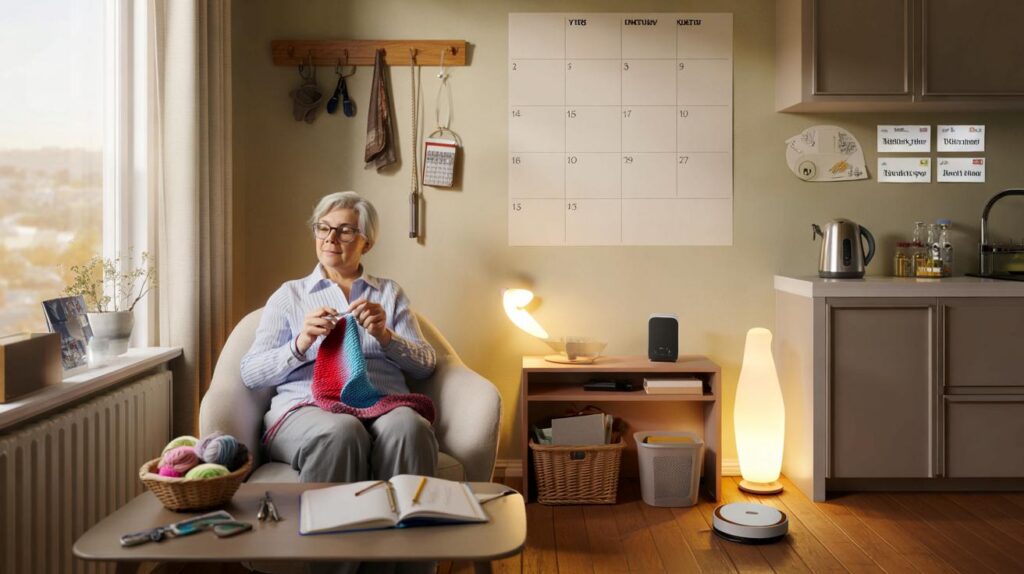
The kettle clicks off, a gentle puff of steam fogging the little kitchen window. Margaret wipes a spot on the counter she doesn’t remember making, then reaches for the sticky note stuck to the bread bin. Another reminder. Another list. The radio burbles, the post lands with a thud, and the morning slides away in tiny decisions — where did she put the keys, did she take the afternoon tablets, when did the bins go out this week?
Across town, a sketchbook waits on a coffee table, untouched. A half-knitted scarf slumps in a basket. The house is warm and kind, yet it tugs at her sleeve with a hundred whispering tasks. We’ve all had that moment when the day was meant for pleasure, yet got swallowed by “just five minutes” of tidying. Margaret sits, sighs, and looks at the clock.
What if the home could give time back?
Make the house do the thinking
There’s a quiet trick to feeling organised without living by a stopwatch: let the home carry the memory. Not everything — just the bits that slip. Put cues where your eyes already land. Place the morning tablets next to the kettle, not in a cupboard. Hang the dog lead on a hook by the door. Set a simple voice reminder at 9 a.m. and 9 p.m., so you don’t have to hold the time in your head.
Think of it like adding rails to a path you already walk. A robot vacuum that runs while you read the paper. A standing order for lightbulbs every six months. A basket under the letterbox for post, with a mini bin for junk. Every tiny nudge removes a decision and gives back a minute. Minutes become an afternoon. An afternoon becomes a class, a book, a garden.
Ruth, 72, did three small changes: a “landing tray” by the front door, labels on shelves she often forgot, and a plug-in timer for lamps at dusk. She noticed something odd by week two — less rummaging, less backtracking. No big overhaul. Just friction removed. Her knitting came out for the first time since Christmas. She laughed that she’d been tripping over the same invisible bumps for years. Now the floor felt smooth.
Practical moves you can set up in an afternoon
Start with a single room. Put a shallow tray near where you enter and call it the landing zone. Keys, glasses, wallet, hearing aids — all in one place, every time. Put a small dish in that tray for coins and a pen. On the wall above, hang a large calendar with big squares and a thick marker. If you use a smart speaker, set a routine: “Good morning” to read the day’s appointments and weather. Make it visible.
Next, pick one chore that steals time and shrink it. For laundry, add a second hamper in the bathroom for delicates so sorting happens as you go. For cooking, keep a “staple shelf” eye-level: tins of soup, tuna, beans, and your favourite herb blend. Batch-cook two trays of veg while the oven is hot. Freeze flat in labelled bags. Let’s be honest: nobody really does that every single day. And that’s fine — once a week beats “meant to” forever.
Small tech helps when it’s quiet and kind. A smart plug can switch the hall lamp on at sunset so you never walk into a dark home. A shared digital calendar with a family member can ping when a GP appointment is due. Automate the boring. Keep choices soft and reversible, with an off switch you can find.
Common traps? Buying too many containers before you know what needs a home. Installing five new apps and forgetting the passwords. Tidying sentimental piles when you’re tired. Go gently. Tackle a “five-item tidy” — pick up five things and give them a true place. Stop there. If labels help, make them big, black-on-white. Test the label with your glasses off. If you need a reminder, put it where your eyes naturally go, not where it looks neat.
When energy dips, aim for resets instead of renovations. A 10-minute reset after the evening news: clear surfaces, prep vitamins for tomorrow, put charging cables back in the tray. Make a “Sunday sweep” list on a card by the kettle: bins, laundry start, medication box refill. Keep it short. Keep it real. The goal isn’t a perfect home; it’s a kinder one.
There’s a saying from occupational therapists that sticks:
“If it isn’t easy, it won’t happen on a Tuesday.”
Use that as a filter for every system you set. If it feels fiddly today, it won’t survive next month.
- Quick wins: stick-on hooks by the door, a pill organiser with morning/evening lids, and a “library bag” that lives by the chair for returns.
- Five-minute rule: if it takes less than five minutes, do it before sitting down.
- One-touch rule: when you pick something up, try to put it in its final place, not halfway.
- Keep duplicates: a spare pair of readers in the kitchen and the hallway tray.
- Low-tech first: paper calendar plus a fridge magnet pointing to today.
Trade chores for hobbies
Strip back the friction and your day expands. A home that holds the routine frees your hands for joy. Start small, measure relief, and repeat what works. If batch-cooking gives you a Tuesday afternoon to paint, that’s a win. If a voice reminder reduces the “Did I take it?” loop, keep it. If the robot vacuum gets stuck on a fringe, roll the rug and move on.
You can make space without throwing your life in a skip bag. Move the hobby forward, closer to where you sit — guitar on a stand, sketchbook open, yarn in a bowl by the lamp. Put the first step in your path so it calls you. And if a system slips, smile and reset. Routines are meant to be helpful, not heroic.
One quiet change often unlocks another. A brighter bulb makes the corner inviting, the chair gets used, the book gets finished. The tiny hinges of the day swing open, and a little more light gets in. Imagine what your week looks like when the house runs in the background and you get to star in the foreground.
| Key points | Details | Interest for reader |
|---|---|---|
| Externalise memory | Place cues where you look, not where they “should” go; use simple voice reminders | Fewer forgotten tasks, more mental space for hobbies |
| Design easy defaults | Landing zone by the door, labelled shelves, Sunday sweep card | Less searching and backtracking, smoother days |
| Smart, gentle tech | Smart plugs, robot vacuum, shared calendar; always with off switches | Automated chores without fuss, safer evenings and saved time |
FAQ :
- What’s the very first step if I feel overwhelmed?Pick one doorway and create a landing zone: tray, hook, calendar. Stop after that. Win the entrance, then move inward.
- Do I need a smart speaker to stay organised?No. A big paper calendar, a kitchen timer, and a simple pill box cover most needs. Add tech only if it reduces steps.
- What if I try a system and it doesn’t stick?Treat it like a jacket that doesn’t fit. Change the cut, not yourself. Move the cue into your line of sight and try again.
- Any budget-friendly ideas that work fast?Stick-on hooks, bold labels, a spare charger in the landing tray, and a robot vacuum on sale can shift a week’s rhythm.
- How do I keep family involved without nagging?Share a calendar and one clear rule: keys and post go in the tray. Ask them to set the lamp routine and refill the label tape. Teamwork, calm tone.



Thank you for the “home carries the memory” line — it clicked. I put a shallow tray by the door and a big wall calender above it, and the rummaging dropped immediately. The “Tuesday” rule is such a good filter; anything fiddly gets cut. Any favorite pill organizers that open easily for arthritic hands?
Robot vacuums always get stuck on my rug fringe or the door strip. How is that saving time if I’m constantly rescuing it? Any hacks beyond “pick up everything first” or should I ditch it?