
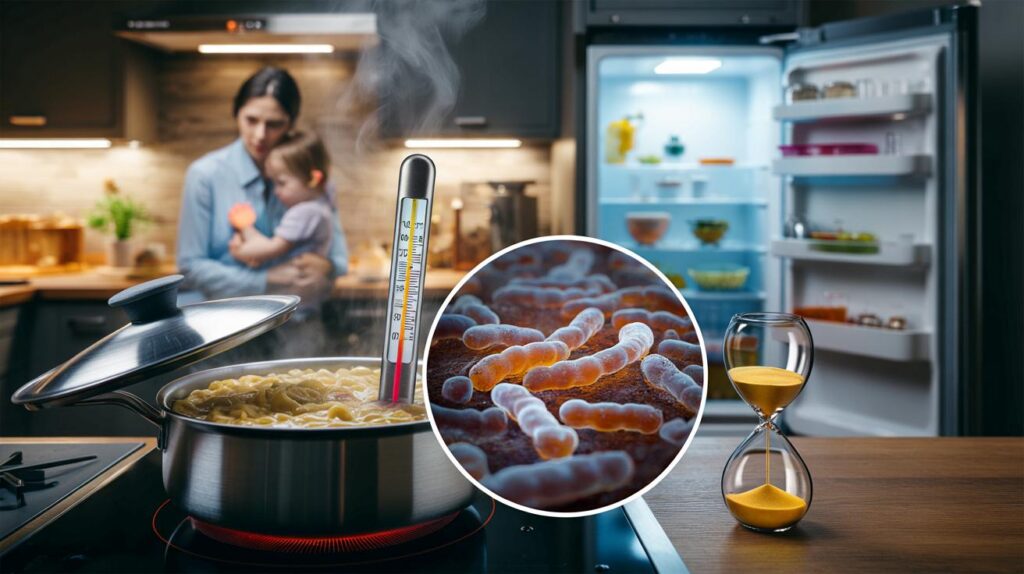
After a hearty supper, many of us hover over the washing-up while pans steam on the hob, thinking nothing of it.
That pause feels harmless. Yet the clock starts the moment a casserole leaves the heat. Warm leftovers on the counter create perfect conditions for bacterial growth, and that cosy ritual can end with a night of cramps, or worse.
Why so many people still wait
Old myths about heat and the fridge
Plenty of households still believe a warm dish will wreck the fridge, steam up the shelves, or taint nearby food. Modern appliances manage occasional warm items without complaint, especially if you store food in shallow, covered containers and keep good airflow. The real risk sits on the worktop, not inside the fridge.
People also fear flavour loss or soggy textures. A tight lid traps steam and condensation; a short vent before chilling solves that. Energy worries surface too. Yet a brief cooling period inside the fridge costs pennies. A bout of food poisoning costs far more in time, comfort, and sometimes wages.
Comforting habits, modern kitchens
Family tips pass down for decades, often from cooler, draughtier homes. Today’s kitchens run warm, especially with ovens on and guests chatting. A stew can linger in the danger zone for hours. Tradition collides with microbiology, and microbes usually win.
What really happens while food cools
The danger zone and runaway growth
Cooked food drops from steaming hot through a risk range where bacteria multiply fast. That range typically spans 8–63°C. As the core temperature falls, organisms that survived cooking or arrived after serving start to grow. Some strains can double every 20–30 minutes; in two hours, a small population can swell dozens of times over.
Time at room temperature drives risk. The hazard is exposure, not the last traces of heat.
Large pots cool slowly. A deep chilli may still be warm inside long after the surface feels safe. Meanwhile, microbes find protein, moisture, and warmth—everything they need to surge.
How contamination actually creeps in
Home kitchens teem with harmless and harmful microbes from hands, utensils, chopping boards, and air movement. Serving spoons touch plates, guests talk over dishes, lids go on and off. Each touch raises odds of contamination. The longer food sits out, the higher that chance climbs, and the more time any contaminants have to multiply.
The health risks you can’t see
The culprits and the foods they love
Common offenders include Salmonella, Listeria, Escherichia coli, Staphylococcus aureus, and Bacillus cereus. They favour protein-rich dishes, creamy sauces, cooked rice, pasta, and meats. Bacillus cereus is notorious in day-old rice; its heat-resistant spores can survive cooking, then thrive as rice cools slowly.
Once established, populations can reach infectious doses in a short window, especially after large meals with repeated serving.
Symptoms and who faces the biggest hit
Foodborne illness often brings nausea, stomach cramps, vomiting, diarrhoea, headache, and sometimes fever. Young children, older adults, pregnant women, and people with weakened immunity face higher risks, including dehydration and complications that may require medical care.
Should you refrigerate while still warm
What science and regulators advise
Food safety guidance points to a clear rule: aim to get cooked food out of the danger zone quickly. Do not leave cooked dishes at room temperature for more than two hours. If the room is hot, the safe window shrinks. Modern fridges can handle food that is warm, provided you use shallow containers and do not block vents.
Target a fridge temperature of 0–5°c and put leftovers in within two hours of cooking.
The fridge’s brief effort to cool a warm container poses less risk than letting food sit on the counter gathering bacteria. Space items out so cold air circulates. If the dish is very hot, speed the cooling first.
Practical ways to cool food fast
Steps that cut risk without killing flavour
- Transfer into shallow containers no deeper than 5 cm to cool the centre quickly.
- Split big batches into smaller portions before you sit down to eat.
- Vent the lid for a few minutes to release steam, then cover and chill.
- Stir thick dishes while they cool to disperse heat trapped inside.
- Use an ice-water bath for bulky pots: set the pan in a sink of cold water, stir, then refrigerate.
- Place containers on different shelves rather than stacking, to keep air moving.
Large, shallow containers slash cooling time. Depth is the enemy when you need rapid chill.
Mistakes to bin from your routine
- Leaving a pot to “rest” on the switched-off hob for the evening.
- Sealing a steamy dish tightly with film straight away; trapped vapour condenses into warm moisture.
- Repeatedly moving the same dish in and out of the fridge; portion what you need into a clean bowl.
- Judging safety by smell or look; many pathogens give no warning signs.
Numbers that make the case
What a two-hour wait can mean
Consider a pan of rice or a creamy pasta bake. Start with 100 bacterial cells after serving. With a doubling time of 20 minutes, 120 minutes brings six doublings: that is 6,400 cells. Add another hour and you approach half a million. You cannot see or smell those numbers, but your gut will notice.
A digital probe thermometer helps. Aim to drop food from 63°C to below 5°C as briskly as you can. The shallower the dish, the faster the fall. Mark containers with the date and use leftovers within two to three days. If in doubt, throw it out.
Extra guidance for tricky foods
Rice, soups, and slow-cooked dishes
Cooked rice: move it into shallow trays immediately, cool quickly, and refrigerate. Reheat until piping hot all the way through, then serve once. Soups and stews: remove bones or large joints, spread into shallow containers, and stir during the cool-down. Slow-cooker meals: once done, transfer out of the warm pot; do not leave on “keep warm” for hours on end.
Reheating targets matter. Bring leftovers to at least 70°C for two minutes, or until visibly steaming throughout. Only reheat once. Frequent reheats degrade taste and raise risk.
Planning that keeps everyone safer
Simple tweaks before you plate up
- Lay out clean containers before you serve, so portioning is quick.
- Assign one serving spoon per dish to cut cross-contamination.
- Clear and cover leftovers before dessert; your future self will thank you.
- Keep a “first in, first out” shelf where older leftovers sit front and centre.
Concerned about energy? A modern fridge re-stabilises quickly. The health risk from a counter-top cool-down far outweighs the small extra chill a warm dish needs. Good organisation also reduces waste, because labelled, visible leftovers get eaten on time.
Useful add-ons for cautious cooks
Tools, checks, and a quick risk test
A cheap probe thermometer, a stack of 1–2 litre shallow boxes, and a marker pen change the game. Use the probe to check internal temperatures. If a thick dish stays above 20°C after an hour, move to an ice bath for ten minutes, stir, then refrigerate. When guests linger, portion and chill half the dish before you bring seconds to the table.
A simple rule helps when you hesitate: if the food sat out beyond two hours, or tasted warm after you opened the fridge later, do not risk it. Your fridge should sit between 0 and 5°C; check with a fridge thermometer and adjust the dial if needed. These small steps protect families, save sick days, and keep those hard-cooked meals enjoyable the next day.



I’ve been leaving pasta out for 3 hours and never got sick. Is this a bit alarmist? Fridges can definately handle a warm pan, right? Not trying to be snarky—just wondering what the real‑world risk looks like versus the lab numbers if you reheat properly the next day.