
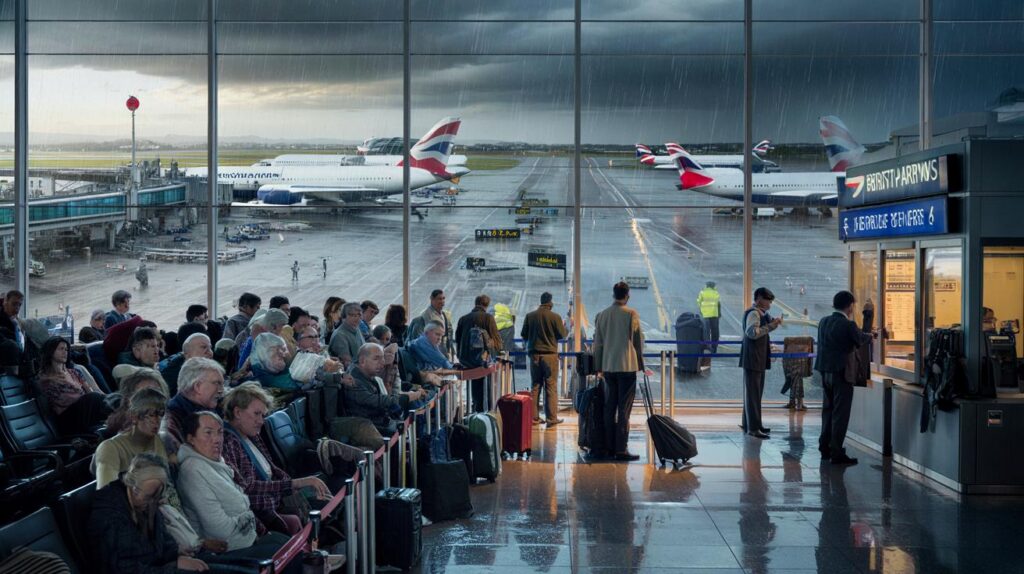
Rain lashed runways, crosswinds climbed, and visibility sank. Departure boards flickered as plans unravelled and tempers frayed across Britain.
What began as a fast-moving weather front has become a nationwide travel headache, with the UK’s busiest hub under pressure and passengers scrambling for options.
Heathrow hit by wave of cancellations
London Heathrow has cut movements and thinned schedules after crews reported wind gusts, heavy rain, and low cloud. British Airways cancelled more than sixty services, equating to around eight percent of its daily programme, to keep operations safe and manageable. The airline trimmed short-haul rotations and paused several European and domestic departures to reduce airborne holding and runway congestion.
More than 60 British Airways flights were cancelled at Heathrow, roughly 8% of the day’s programme.
Routes linking London with Edinburgh, Newcastle and Glasgow took a notable hit. Services to continental hubs, including Vienna, Luxembourg, Budapest, Copenhagen, Geneva, Oslo, Stuttgart and Nice, also saw cancellations or rolling delays. Aircraft and crews ended up out of position, which tightened capacity just as demand for rebooking surged.
Inside terminals, queues built at ticket desks while the airline redirected customers to digital channels. Hold times lengthened as call centres handled reissues, refunds and overnight arrangements. Local hotels near the airport filled quickly, pushing some travellers towards coach transfers or late trains to reach beds further afield.
Industry estimates suggest 10,000–12,000 travellers may be displaced across the network today.
Routes worst affected
The following city pairs saw repeated cancellations or extended delays, based on today’s operational picture and airline advisories.
| Route | Status today | Typical delay | Plan B |
|---|---|---|---|
| London–Edinburgh | Multiple cancellations | 90–240 minutes | LNER rail from King’s Cross; consider London City services |
| London–Glasgow | Reduced frequency | 60–180 minutes | Avanti West Coast from Euston; limited same-day availability |
| London–Newcastle | Several flights axed | 90–210 minutes | LNER rail; look at Leeds or Teesside connections |
| London–Vienna | Cancellations and late departures | 120–300 minutes | Connect via Frankfurt, Zurich or Amsterdam if seats exist |
| London–Budapest | Reduced options | 120–240 minutes | Indirect via Munich or Warsaw; watch minimum connection times |
| London–Copenhagen | Knock-on delays | 60–180 minutes | Rebook from Gatwick or Manchester if feasible |
Pressure spreads beyond London
Delays also hit flights to and from Gatwick, Manchester and Birmingham as aircraft rotations slipped. British Airways and partner carriers trimmed late turns to protect the evening wave. Around five percent of the day’s BA services were delayed, according to internal tallies shared with passengers, with several departures pushed by multiple hours.
Low-visibility procedures and gust limits reduce runway throughput, forcing airlines to cut flights to keep the network stable.
Why the weather paralyses flight operations
Air traffic control increases separation between aircraft when cloud lowers and visibility drops. That decision reduces landing rates and quickly creates a queue. Crosswinds near or above certified limits mean crews cannot safely take off or land. Strong headwinds also slow inbound flights, which distorts schedules, crew duty windows and stand availability. Once a hub falls behind, recovery takes time.
Runway capacity and recovery
Heathrow normally runs a tight operation with little slack. When weather erodes capacity, airlines cancel short sectors first because they recover quickest when conditions improve. That approach also frees aircraft for longer routes with fewer alternatives. The trade-off is painful for domestic and near-Europe travellers who rely on frequency.
What passengers can do now
Speed matters. Seats on the next workable flight vanish quickly when an entire bank is cancelled. Use the app or website to rebook before joining queues at the airport. If you must speak to an agent, try overseas call centres or social channels while you wait in line.
- Check all nearby airports: Gatwick, Stansted, Luton and London City may hold last-minute seats.
- Use rail for domestic routes: LNER, Avanti West Coast and TransPennine can be faster door to door today.
- For Europe, consider coaches or high-speed rail via Paris, Brussels or Amsterdam if flight inventory is tight.
- Keep all receipts for meals, hotels and local transport. You will need them to claim later.
- If your trip purpose has passed, request a refund instead of rebooking to avoid sunk costs.
Your rights under UK261
UK261 mirrors EU261 and sets clear obligations. Weather is classed as an extraordinary circumstance, so cash compensation for cancellations usually does not apply. Your rights still do.
Duty of care applies: meals, reasonable refreshments, a hotel if overnight, and transport to and from that hotel.
You can choose rerouting at the earliest opportunity, rerouting at a later date, or a full refund for the unused journey. If the airline’s next flight is far away, you may request rerouting on another carrier where reasonable. Claims require booking references, boarding passes where issued, and itemised receipts for expenses.
Where the bottlenecks are
Hotel capacity near Heathrow is tight after evening waves cancel. Travellers should widen their search to Slough, Uxbridge, Hounslow and central London areas on the Piccadilly line and Elizabeth line. Surge pricing affects taxis during weather events, so the train can be cheaper and faster.
Aircraft and crew positioning will remain the pinch point through tomorrow morning. Early departures depend on where planes and crews ended their day. Expect a staggered restart, with some first waves cancelled to rebuild resilience.
What to expect in the next 48 hours
Forecasts suggest bands of rain and gusty winds easing in phases rather than clearing at once. That pattern favours gradual recovery. Short-haul networks should stabilise first, followed by long-haul rotations as aircraft return to base. Residual delays will linger on routes that lost multiple rotations today.
Travellers with connections should add wider buffers. Two hours may not be enough when stands are tight and buses replace airbridges. If you must connect to cruises, events or fixed tours, contact operators as soon as possible to protect your booking.
Practical add-ons that can save your trip
Travel insurance with delay benefits can cover meals and accommodation when weather shuts down airports. Some premium credit cards provide similar cover if the ticket was purchased on the card. Section 75 protection may help if a package provider fails to deliver contracted services.
Consider mixed-mode itineraries. A same-day rail hop to Edinburgh or Newcastle, then a next-morning flight from there to mainland Europe, can beat waiting for a single direct seat from Heathrow. For families, splitting across two flights increases chances of movement; agree a meeting point at arrival.
Act fast, keep paperwork, and stay flexible—these three steps shorten disruption and improve outcomes.
For now, British Airways continues to rebook, refund and provide care, while airports meter movements to match the weather. As the skies steady, capacity will return, but the knock-on effect will take time to flush through the system.



Can BA reroute me on another carrier if the next seat is days away? Under UK261, do I have to accept a voucher or can I take a full refund? My flight to Copenhagen was canclled and the app keeps looping.
Stuck at Heathrow, starring in my own weather docudrama. Anyone got a spare power outlet and a morale boost? 🙂