
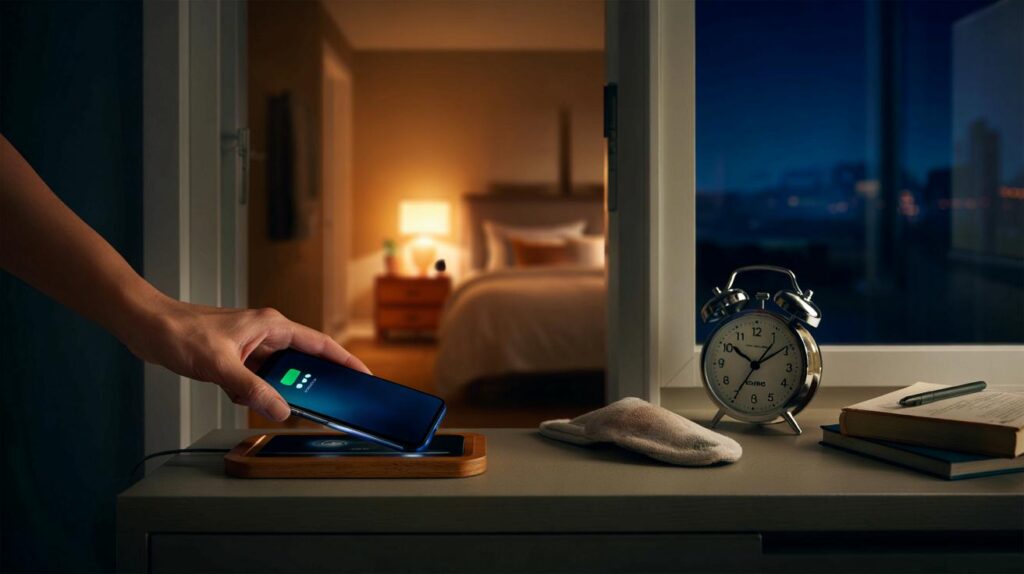
You want a clear answer, not vague advice. If you aim to be asleep by 11 pm, the science points to one clean cut-off: switch your phone off at 9:30 pm. That’s the moment your evening biology, your brain’s light sensors and your willpower all still line up. It sounds painfully early. It’s also the hour that gives sleep a fair chance.
I watched a carriage of strangers on the 21:42 home, faces lit electric blue. Thumbs flicked. Shoulders hunched. No one looked quite ready to stop. The woman opposite had “just one more” reel looping; the man by the door scrolled markets like a pilot watching weather. Outside, the sky was gone. Inside, midday glowed from palm-sized suns.
My screen buzzed in my pocket. It felt like a dare. I thought of the body clock tucked behind my eyes, quietly keeping score every minute past nine. The lights of the phone and the lights of the street were not the same. Timing matters.
The science of the switch-off hour
Here’s the blunt headline: if your target bedtime is 11 pm, the science-backed switch-off is **9:30 pm**. That window gives your circadian system room to lift melatonin, the hormone that whispers “bedtime” to the brain. It also trims cognitive arousal, because attention needs a runway, not a parachute.
We’ve all had that moment when you look up, your neck clicks, and it’s somehow midnight. Researchers have shown that bright, blue-leaning light in the late evening delays melatonin and pushes sleepiness back. Aligning your cut-off ~90 minutes before lights-out reduces that shift. For many of us, that lands precisely at 9:30 pm.
Why not 10 pm? There’s more at play than photons. Your feed fires novelty, reward and social tension, all of which keep the prefrontal cortex switched on. A 9:30 pm stop leaves enough “downshift” for the nervous system, not just the eyes. Think of it as the **90-minute rule**: one hour for biology to recalibrate, and half an hour for your mind to wander into sleep.
How to actually hit 9:30 pm
Set a “last light” alarm for 9:25 pm and treat it like a flight. Flip the phone to Airplane or full Shutdown, not just a lazy lock. Place the charger outside the bedroom. Dim lamps to warm tones by 9 pm. If you need a tech bridge, run greyscale from 8 pm and Do Not Disturb from 9 pm. Then do something slow and analog: stretch, wash, a real page or a pen-and-paper brain-dump.
Make it frictionless. Put your book on the pillow, your slippers by the bed, your charger in the hallway. Tell someone you live with that you’re trying this, so the social scaffolding holds. If you slip, reset the next night without drama. Let’s be honest: nobody really does that every day. Progress is boring and uneven, and that’s still progress.
“Treat sleep like sunrise: it shows up on time when nothing blocks the horizon.”
- 9:25 pm: Alarm named “Last Light”.
- 9:30 pm: Phone off, charger in another room.
- 9:35 pm: Lights warm and low; simple wind-down ritual.
- 10:15 pm: In bed with paper pages or calm audio, not a screen.
- 11:00 pm: Lights out. No phone cameo. No exceptions.
What if your life isn’t 9:30-friendly?
Some nights you’ll be on call, parenting, or working late. Rather than abandon the idea, anchor the principle: aim for a 90-minute phone-free glide-path before sleep, whatever the clock says. Night owls can shift the window later. Early birds can go earlier. If your routine varies, protect two constants—no phone in bed, and one non-negotiable “last light” moment. *Small consistent cues teach your body what time it is faster than heroic one-offs.* Build your own version: a kettle at 9:28 pm, a lamp click at 9:31 pm, a note by the door that says “tomorrow will still be there.” The point isn’t puritanism. It’s margin. Margin for melatonin. Margin for quiet. Margin for the you that exists when the world stops shouting.
| Point clé | Détail | Intérêt pour le lecteur |
|---|---|---|
| Switch-off at 9:30 pm | For an 11 pm bedtime, cut the phone 90 minutes earlier | A clear, simple target that fits body-clock timing |
| Light and arousal both matter | Blue light delays melatonin; scrolling keeps the mind “on” | Explains why filters alone don’t fix bedtime |
| Make it a ritual | Alarm, shutdown, charger away, warm lights, paper wind-down | Turns a hard rule into an easy habit |
FAQ :
- What if I need my phone as an alarm?Use a cheap bedside alarm and charge your phone in another room. If that’s not possible, at least enable Airplane Mode and place it out of reach.
- Do blue-light filters and Night Shift solve the problem?They help with brightness and wavelength, but the mind stays engaged. Filters are a seatbelt, not a parachute.
- Is it the light or the content that keeps me awake?Both. Short-wavelength light delays melatonin; novelty and social triggers raise arousal. That’s why the 90-minute window targets the pair.
- What if I work night shifts?Shift the rule with your schedule: cut the phone 90 minutes before your planned sleep, use bright light during work, and blackout cues on your way home.
- How long before I notice a change?Many people feel a difference within three to five nights. Deeper benefits—more stable sleep timing—often show up over two to three weeks.



Merci pour la règle des 90 minutes — je coupe à 21h30 dès ce soir. On verra si mon cerveau arrête de me jouer des tours 🙂
21h30, vraiment ? Entre les devoirs des enfants, les msgs du boulot et le seul moment calme à 22h, cest un peu irrealiste. Des astuces concrètes pour les parents, autre que « discipline » ? Je veux bien essayer mais le réel mord.