
Door signs promise a tiny forcefield: a few words to make someone think twice. Some do. Some are just wallpaper for the determined. Burglars read them like traffic lights, and the difference between red and amber is stranger than you’d think.
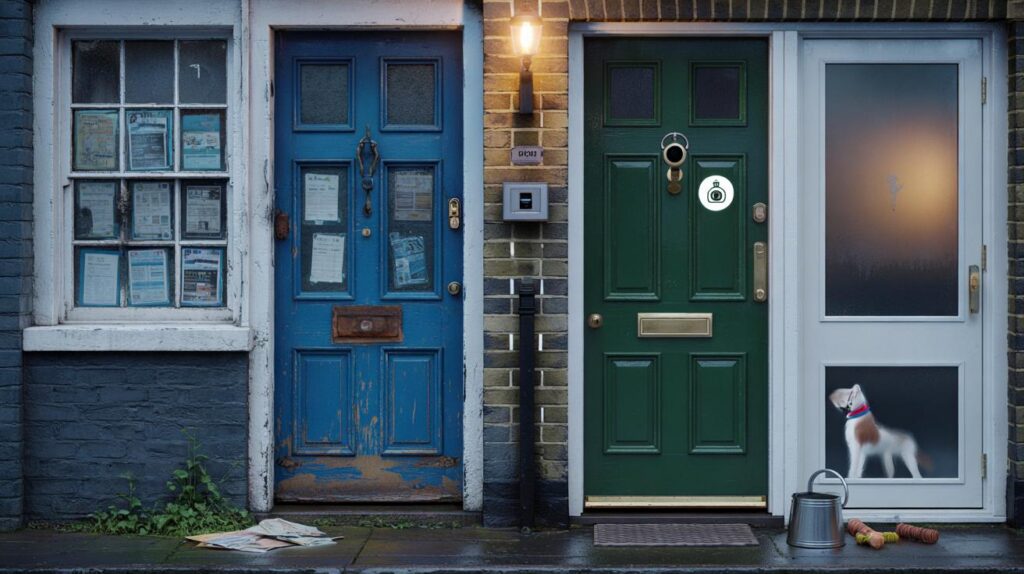
It’s a wet Tuesday on a London terrace and the street is a collage of stickers. “CCTV in operation.” “No cold callers.” “Beware of the dog.” A delivery driver glances up, a hooded teenager glances back, and the front doors become little billboards of risk and bluff. I walk slowly and count them, the credible and the not. *I hear a TV behind frosted glass and a quiet dog coughs once.* A security decal peels at the edge and flaps in the wind like a lie. One house makes me feel watched without knowing why. Another feels almost abandoned. The difference isn’t the font.
What burglars actually read at your door
Former offenders describe a quick mental maths: risk, time, noise. Signs speed that up. They’re scanning for proof you care, and proof you’ll react, not just words. **A sign lands when it pairs with a cue that can’t be faked at a glance.** Think lens reflections, wires, a bell push that glows, a dog bowl by the step. That split second decides whether your letterbox becomes a rehearsal or a hard pass.
Research backs the gut feel. In a UNC Charlotte survey, most burglars said alarms made them move on, and visible cameras shifted routes. A Met officer told me the same pattern on the ground: streets with active Neighbourhood Watch boards and doorbell cams see fewer “walk-up” attempts. Picture two identical semis. One has a generic “24hr CCTV” plaque, no camera in sight. Next door shows a real doorbell cam, a branded alarm hexagon, and a modest “Monitored alarm” tag. Guess which porch gets tested first.
Some signs scream bluff. The all-caps, clip-art “CCTV 24/7” plate on a flimsy screw. “No cash kept on premises” at a family home. “No cold callers” reads like a wish, not a threat. What works tends to be specific and anchored: a known alarm brand sticker on the glass, a smart doorbell icon near the bell, a dog warning where you can hear or see evidence of a dog. **Credibility is the currency.** Empty signals are like dummy cameras without cables—useful only to the person who bought them.
How to design a sign that actually deters
Treat the sign as an arrow, not a shield. Pair it with a visible device or trace: a doorbell camera in frame, an alarm box high on the brick, a small window contact in sight. Keep the words short and specific. In the UK, alarm company logos punch above their size, and “Monitored and recorded” lands harder than “Smile, you’re on camera.” Position at eye level near the handle, not ankle height near the skirting of your life.
Avoid the collage. Too many stickers looks like noise, and noise reads as panic. Rotate out sun-bleached decals and fix peeling corners, because wear equals bluff. If you use a “Beware of the dog” sign, back it with the sound, the bowl, the bed. We’ve all had that moment when you hesitate at a door because something feels attended to. Let’s be honest: no one really does that every day. So set it up to look “always on” even when you’re not.
The cleanest line is simple: signal investment, not fear. One good sign plus one visible device beats five vague warnings.
“Burglars don’t read your grammar, they read your habits,” an ex-offender told me. “A neat porch with one real camera is worse for me than a wall of shouty stickers.”
- Use one or two credible signs, not a gallery
- Place at eye level, near the handle or bell
- Pair with visible hardware: bell cam, alarm box, sensor
- Keep wording specific: monitored, recording, response
- Refresh anything faded or peeling within a season
Beyond the sticker: a layered mindset
Signs are the first whisper, not the whole conversation. The real deterrent is a cluster of small cues: lived-in timings on lights, a car sometimes in the drive, bins not left out for days, a curtain that moves at odd hours. A sign succeeds when it fits into that pattern of attention. **Your front door becomes a story about time, reaction, and likelihood.** The sticker is just chapter one. Think layers: one credible sign, one visible device, one habit that creates uncertainty. A burglar wants certainty. Your job is to make them doubt, fast, and walk on with a shrug.
| Key points | Details | Interest for reader |
|---|---|---|
| Credibility over volume | One specific, branded sign paired with visible hardware beats multiple generic warnings | Spend less, get more deterrence |
| Placement and proof | Eye-level signs near the handle or bell, backed by a doorbell cam or alarm box | Small adjustments that change behaviour |
| Layered cues matter | Signs work best alongside lived-in signals and responsive routines | Practical habits that feel doable |
FAQ :
- Do “Beware of the dog” signs actually work?They can, when the house offers dog cues: sound, bowl, toys. Without those, many burglars treat the sign as theatre.
- Are fake CCTV stickers worth it?They sometimes slow the naive, but experienced offenders look for lenses, reflections, and cables. Pair any sticker with a real device for impact.
- What about “No cold callers” signs?They’re great for doorstep peace, less so for deterrence. They don’t imply monitoring or response, which is what offenders fear.
- Where should I place a deterrent sign?At eye level near the handle or bell, not low on the panel. The message should be unavoidable in the approach path.
- What wording lands best?Short and specific beats cute: “Monitored alarm,” “24/7 recording,” “Audio and video.” Skip jokes or novelty phrasing that dilutes the threat.



Great piece—clear and practical. Credibility over volume defnitely lands.
Is there any data on false positives? Do “Beware of the dog” signs scare off delivery folks more than burglars?