
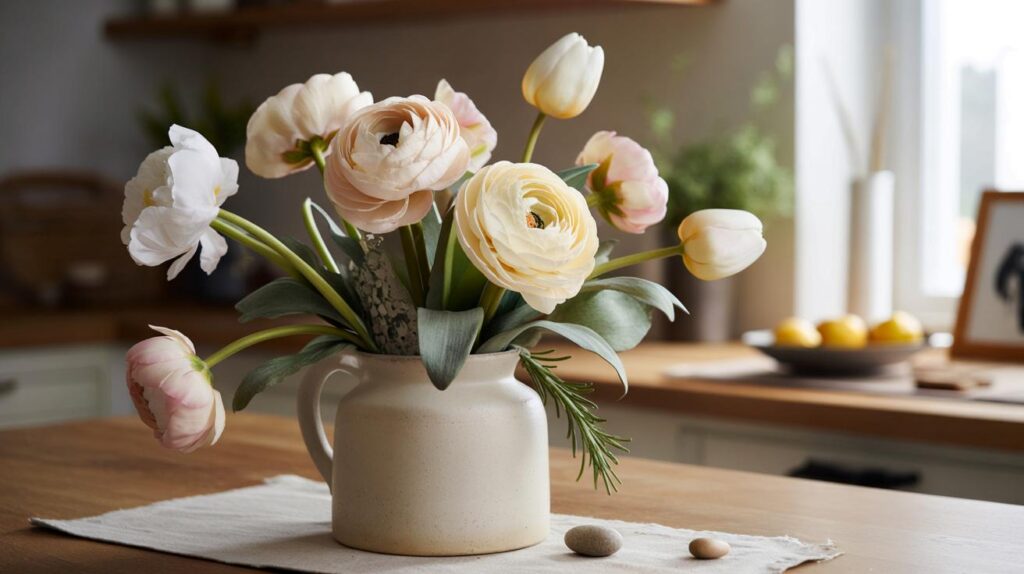
There’s a fine line between chic and cheap with faux flowers. One looks like a quiet, elegant secret; the other like a budget costume under bright lights. The difference is never just the price of the stems. It’s the way they’re chosen, shaped, and placed in a room that already has a pulse.
I was standing in a friend’s London kitchen, the kind with a radio murmuring and a bowl of lemons pretending to be artistic. A vase of pale ranunculus caught the morning, soft and milky, and I reached to lift them out for a fresh cut. The stems held firm. No give. No weight shift. The leaves felt like new raincoats.
I laughed, a little stunned, and then leaned closer. Imperfect petals. A kinked stem. A shadow that looked… true. *I had been fooled in daylight by a still life.*
That afternoon I went down the rabbit hole. Why did those fakes look more alive than last week’s real bouquet? The answer wasn’t one thing. It was a handful of ordinary, almost invisible choices. And one small trick I wasn’t expecting.
The eye knows, but it can be tricked
The human eye hunts for clues: weight, irregular edges, and the messy poetry of real growth. Perfect symmetry is a tell. So is a shiny leaf with no vein. The secret, oddly, is to let things look a touch wrong.
We’ve all had that moment when a display feels “off” and we can’t say why. It’s usually because everything sits at the same height, facing forward like a school photo. Tilt a bloom, turn one away, and the scene breathes. **If it looks perfect, it looks fake.**
On TikTok and Pinterest you see it in the scroll. The faux arrangements that stop your thumb have looseness. A stem leans, a head dips, and there’s a small gap that feels like oxygen between flowers. Your brain reads that gap as life, not a shop window.
The styling moves that make them chic
Start with the vessel. Opaque beats glass nine times out of ten. A ceramic jug, a matte stoneware cylinder, even a silver tankard gives instant gravitas. It hides stems and wires, and suddenly your flowers feel anchored to the table, not floating in mid-air. **Light, vessel, and scale do more than any price tag.**
Then move to the stems. Trim them to the right height—no blooms jammed under a rim. Gently bend the wired stems so they arc and dip like real growth. Think in odd numbers, and give each bloom its own pocket of space. Let one sit a little taller. Let one look away.
Materials matter. “Real-touch” varieties in foam or latex often trump shiny polyester, especially for tulips, peonies, and magnolia. Silk can be gorgeous for roses and hydrangea if the petals have a matte, slightly frayed edge. Off-white reads better than stark white. And colour isn’t uniform in nature—look for a blurred gradient on petals and a soft, slightly bruised green on leaves.
The tweaks nobody tells you about
Create weight. Put a layer of small stones, marbles, or florist’s chicken wire inside the vase. It stabilises the stems and makes your hand feel resistance when you move them. Your brain notices the heft without knowing why. The whole thing reads as “real object,” not prop.
Now the water debate. If the stems are plastic-coated with no exposed wire, a shallow pour can look convincing. If not, skip it and go opaque. Fake water resin can be brilliant but it’s permanent, so commit with a classic mix you’ll keep. Let’s be honest: nobody actually does that every day.
Dust kills the illusion, so a quick hairdryer on cool or a soft paintbrush works wonders once a week. A gentle waft of eucalyptus or rose water on the vase (not the petals) whispers “fresh.” And mix in a sprig of real foliage now and then—rosemary from the windowsill or a clipped branch from a weekend walk—because the tiniest bit of true life lifts the whole thing.
From “nice” to “who did your flowers?”
Think like a florist, act like a stylist. Plan a loose silhouette—one hero bloom, two supporting players, and filler you almost don’t notice. Turn the vase as you work. Step back. Then pull one stem out and reinsert it at an angle so the arrangement looks like it grew into place rather than landed there.
Common trip-ups? Too many identical stems crowding together. Overly glossy leaves that catch the light like patent shoes. Stems all the same length, creating a flat top. It happens to everyone, and that’s alright. Swap one bloom for buds, or add a branch with a knuckle in it for contrast, and the whole picture changes.
Room context matters. Place faux blooms where you’d naturally see cut flowers: kitchen table, entry console, bedside. Avoid spots that scream “no water ever,” like a steamy bathroom shelf or a sun-baked window ledge at noon. A shadow nearby—a framed picture, a lamp—helps the eye read depth.
“You’re not copying nature; you’re imitating the feeling of nature,” a London stylist told me. “Asymmetry, a pause, and one small flaw. That’s the cheat code.”
- Choose matte petals and leaves with visible veining.
- Use an opaque vessel for easy wins and hidden mechanics.
- Vary stem heights; tilt at least one head away from the viewer.
- Introduce negative space so blooms aren’t shoulder to shoulder.
- Refresh the scene with seasonal branches or herbs from real life.
So where does that leave your home?
The lesson is reassuring: the most convincing faux florals don’t shout. They blend into the rhythm of your room, then surprise you when a guest reaches to sniff a tulip that won’t wilt. **Less bouquet, more breath.**
Switch arrangements with the seasons—fat peonies in late spring, meadowy cosmos in summer, moody hellebores when the light thins. Keep colours a touch muted and vessels honest. A jug you love beats a vase that tries too hard.
And remember the real secret. The magic isn’t in the flowers. It’s in the way your hand edits, adjusts, and gives permission for imperfection. That small, human touch is the difference between plastic and poetry.
| Point clé | Détail | Intérêt pour le lecteur |
|---|---|---|
| Vase opaque | Ceramic, stoneware, or metal hides stems and adds weight | Instantly more believable and refined display |
| Asymmetry | Odd numbers, varied heights, one bloom facing away | Signals natural growth and fights the “shop window” look |
| Material choice | Real-touch foam/latex for tulips and peonies; matte silk for roses | Max realism where it shows most: petals and edges |
FAQ :
- Should I put water in a vase with fake flowers?If stems are plastic-coated and sealed, a shallow pour can look convincing. If wires are exposed, go for an opaque vessel or use clear resin “fake water.”
- How do I clean faux flowers without damage?A soft paintbrush or microfibre cloth for dust, then a cool hairdryer to finish. No harsh sprays on petals.
- Can I mix real and artificial stems?Yes, and it’s a brilliant cheat. Add fresh greenery or branches for scent and movement, and keep the faux as the steady base.
- How do I stop them looking shiny?Choose matte finishes and visible veining. A light mist of mattifying spray on leaves (tested on a hidden spot) can knock back glare.
- What’s the best room for faux flowers?Places you naturally style: dining table centre, hallway console, bedroom side table. Avoid harsh direct sun that highlights seams.



Brilliant piece. The “opaque vessel over glass” tip blew my mind, and the idea of tilting one bloom away instantly killed that showroom stiffness. I tried odd numbers + a little negative space and it’s definitly more natural. Also, off‑white over stark white is such a quiet win. Thank you!