
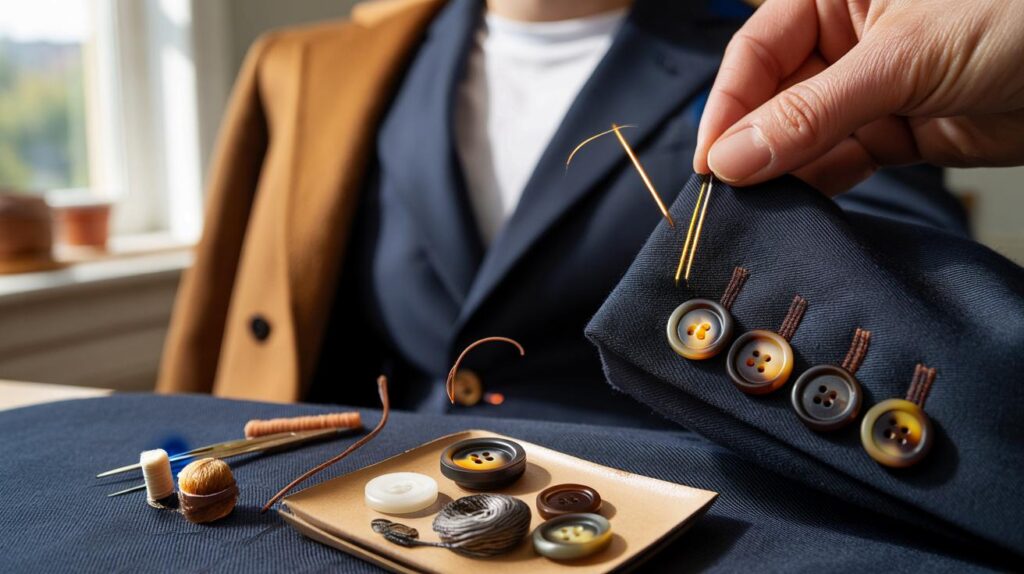
The woman on the Jubilee line wore a navy blazer you’ve seen a thousand times. Boxy fit, clean lapel, sleeves pushed just so. Next to her, a man in near-identical navy: straight-leg trousers, white tee, same moodboard of “quiet luxury”. Yet only one of them looked expensive. It wasn’t the cut. It wasn’t the logo—there wasn’t one. It was the tiny discs catching the carriage light: rich, horn-look buttons on one jacket versus flat, plasticky ones on the other. We’ve all had that moment where two outfits feel worlds apart, for reasons you can’t name. Here’s the name.
The swap: trade basic plastic buttons for grown‑up ones
The simplest way to make almost any outfit look pricier is this: **swap the buttons**. That’s it. Replace shiny, injection-moulded plastic with natural or refined buttons—corozo, horn-look, matte metal, mother-of-pearl, thick resin with depth. The difference is immediate. A blazer reads tailored, a cardigan looks heirloom, a high-street coat suddenly suggests Savile Row. Buttons sit where eyes land: centre front, cuffs, waist. They frame movement and catch light. Upgrade those little anchors and the whole piece tells a different story.
I once watched a stylist do it on set: £69 high-street blazer, swapped with four horn-look buttons from a haberdashery, stitched in under ten minutes. The jacket photographed like a designer piece. No retouching, no belt trick, no filters. Search “button swap” on social feeds and you’ll see the same gasp-inducing before-and-afters. A drapey trench with dull discs becomes a film noir coat after twenty minutes and £8 of new hardware. Small parts, big perception shift. It’s oddly thrilling to watch.
There’s a reason it works. Shiny plastic can look thin and bright, reflecting light in a way that screams mass production. Better buttons have **weight**, subtle texture, and a more nuanced sheen. They sit flatter. They clack, not click. And because buttons are repeated—three on a cuff, six down a placket—the signal compounds. Humans read repetition as intent. When the details look considered, the mind fills in the rest: fabric must be better, cut must be sharper, owner must be someone who knows. Perception stacks before you’ve even said hello.
How to do it: fast, neat, affordable
Start with your most-worn piece: a navy blazer, camel coat, black cardigan, denim jacket. Take it to natural light and snap a photo. Then choose replacements in the same size: 24L or 26L for blazers, 18L–22L for shirts, 40L for coats. Go for horn-look, corozo (nut-based and beautifully matte), mother-of-pearl for shirts, or brushed metal for utility pieces. Keep the colour story calm—tortoiseshell on navy, dark horn on charcoal, tonal brown on camel. Stitch with strong polyester thread, create a tiny thread shank so the fabric doesn’t pucker, and knot cleanly on the inside. *It’s almost unfairly simple.*
A few pitfalls trip people up. Don’t pick buttons that are too glossy; it reads cheap on camera and in daylight. Avoid gold that looks brassy or orange. Match hardware families where you can—cool metals with cool jewellery, warm with warm. Let’s be honest: nobody replaces every button the minute they buy something. Do one hero piece this weekend and see how it changes your rotation. If sewing isn’t your thing, a alterations shop will do a full coat for the price of a couple of coffees.
Mind the finishing touches. Choose thread that either vanishes (tonal) or looks purposeful (contrasting, but not shouty). Double-check buttonhole orientation so logos face upright. Consider swapping the inside spare button too—consistency calms the eye. **Weight matters.** A slightly heavier button helps a placket sit straight and keeps a cuff drape clean.
Change the buttons, change the story.
- Best for: blazers, coats, cardigans, shirt cuffs, denim jackets.
- Materials to try: horn-look, corozo, smoke mother-of-pearl, matte metal.
- At-home time: 10–25 minutes per garment.
- Cost: roughly £3–£12 for a full set, depending on material and size.
Why it fools the eye—and where to take it next
Luxury is a sum of signals. Fabric helps, fit helps more, but details seal the deal. Buttons sit at the exact points where hands fidget and eyes pause. They’re the handshake of a jacket. Upgrade them and you anchor colour, echo metal tones, and add texture where the body moves. The result reads “considered” even if the piece is from last year’s mid-season sale. The camera doesn’t argue; neither does the mirror. Suddenly your everyday jeans-and-blazer outfit looks like someone thought about it.
| Point clé | Détail | Intérêt pour le lecteur |
|---|---|---|
| Swap plastic for quality buttons | Corozo, horn-look, mother-of-pearl, matte metal | Instant upgrade without buying new clothes |
| Match tone and size | Keep sizes consistent; align warm/cool metals | Looks cohesive and quietly expensive |
| Finish like a pro | Thread shank, neat knots, tonal or purposeful thread | Cleaner drape and longer-lasting result |
FAQ :
- Does this work for men’s and women’s clothing?Yes. Blazers, coats, shirts, cardigans and denim jackets all benefit. Focus on classic colours and subtle textures for a uni-sex, polished feel.
- How do I find the right button size?Measure the old one across in millimetres or “ligne” (L). Common sizes: 18–22L for shirts, 24–26L for blazers, 36–40L for coats. Match like-for-like to avoid loose buttonholes.
- Will it damage my garment?No, if you sew through the original holes and keep stitches tidy. A tiny thread shank stops pulling and protects the fabric.
- What if I can’t sew?Many dry cleaners and alteration shops will swap a full set in under a day. It’s a low-cost job and they’ll match the thread for you.
- Which colours look most expensive?Tonal and muted options. Tortoiseshell on navy or camel, smoke mother-of-pearl on white, dark horn on charcoal. **Keep it consistent** with your belt buckle and watch.



Mind blown—such a small change for a big “quiet luxury” upgrade. I swapped to dark horn-look buttons on my navy blazer tonight and it instantly read smarter. The weight/clack thing is real. Thanks for the sizing tip (24L!). My commute outfit just levelled up 🙂