
There’s a room in the house that works hardest and smells the strangest: the laundry room. It swings from steamy to stale, collects damp socks like souvenirs, and somehow traps odours that no candle can mask. The good news? Freshness isn’t a mystery. It’s a few tiny habits that fit between the spin cycles.
I walked into a small terrace house in Leeds on a Tuesday morning, the kind where walls remember the weather. The laundry room sat off the kitchen: window cracked, washer blinking, a heap of towels draped like a surrendered flag. The air had that sour-linen tang that creeps up on you, part detergent, part damp. The owner laughed, embarrassed, and pointed to a shelf of sprays that had done nothing. Three minutes later, the room smelled like nothing at all. The fix took three minutes.
What’s really making that laundry-room smell?
Odour builds when water lingers. Not just puddles — invisible damp in towels, film on the door seal, humid corners where air doesn’t move. A laundry room is a spa for microbes, fed by warmth, soap residue and forgotten socks. You smell “musty”, but what you’re sensing is a chemical whisper that comes from a thriving little ecosystem. It isn’t dramatic. It’s slow and stubborn.
Think of Maya, a renter in a new-build flat in Manchester. Her washer looked pristine, but the rubber gasket was cloudy, and the drain filter lurked behind a fiddly panel. She used generous scoops of detergent and softener because “clean should smell clean”. Within weeks, a sweet-sour note hovered in the hallway. When she switched to smaller doses and cracked the washer door after cycles, the smell faded. One tiny change — air — did more than the fancy sprays.
The logic is simple: moisture plus residue equals odour. When humidity in a small room sits above roughly 60%, water doesn’t evaporate; it clings. That leaves a damp buffet on seals, hoses and the drain trap. Add too much soap, and you get extra film that never rinses fully. Bacteria and mould don’t need much. They love the quiet, closed spaces right after you slam the door on a finished wash. Open that door, reduce the residue, and you break the chain.
Simple steps that work with real life
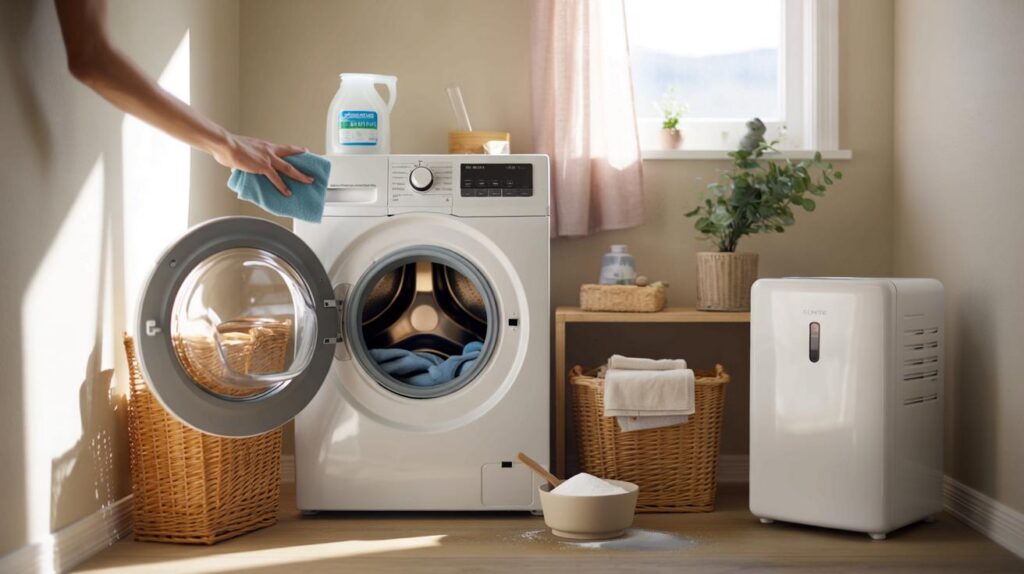
Build a daily “three-minute reset” that runs on autopilot. After the last load, pop the washer door and detergent drawer open a thumb’s width. Wipe the gasket and inner glass with a dry microfibre. Toss any damp lint and give the floor a quick once-over. If you’ve got a vent, set it to trickle for an hour; if not, place a small moisture absorber on the shelf. Once a week, sprinkle bicarbonate of soda in the empty drum and run a hot rinse. **Airflow beats perfume.**
Most odours come from well-meaning mistakes. Overfilling the drum traps pockets of wet. Big glugs of softener leave a waxy coat that smells nice at first, then turns swampy. Leaving clean laundry in the machine “just for a minute” invites that grey, wet-cardboard note. We’ve all had that moment when a load sits overnight and greets you like a gym bag. Let’s be honest: no one really does that every day. Pick one habit you’ll actually keep, and start there.
When you tweak the basics, the room changes fast. Switch to high-efficiency detergent and measure it — small scoop, not guesswork — because **detergent doesn’t equal clean**. Wash towels hot every few cycles to reset them, and swap closed plastic hampers for breathable baskets. Keep a cheap digital hygrometer on the shelf; if you see 65% humidity, crack a window or run a compact dehumidifier for an hour. *Some days, the room just needs a breath.*
“Freshness is physics before fragrance,” says a veteran appliance tech in Leeds. “Dry the machine. Move the air. Then everything else starts behaving.”
- Leave washer door and drawer ajar after each cycle.
- Wipe gasket and glass dry; clear the drain filter monthly.
- Measure detergent; skip softener on towels; use a hot reset wash monthly.
- Swap sealed hampers for ventilated ones; rotate damp items quickly.
- Track humidity; use a window, vent, or small dehumidifier.
A little routine, big difference
There’s a quiet joy when a room smells like nothing. Not meadow. Not citrus. Just clean air, ready for the next busy day. You start to notice how the door seal stays clear, and the laundry comes out fresher with fewer products. A modest ritual — that **three-minute reset** — frees your future self from the “ugh, what’s that?” moment. Share the tasks if you live with others: one person cracks the door, another wipes the glass, someone checks the filter on Sundays. Small habits spread when they’re easy and visible. If a friend complains about their laundry-room stink, send them the simplest part to try first. Freshness becomes a team sport when it’s this light.
| Key points | Details | Interest for reader |
|---|---|---|
| Ventilate and dry | Door and drawer ajar; wipe gasket; short vent or dehumidifier use | Stops odour at the source with seconds of effort |
| Use less, clean smarter | Measure detergent; skip softener on towels; monthly hot reset | Better smell, softer towels, longer machine life |
| Design the routine | “Three-minute reset”; breathable hampers; humidity check | Simple, repeatable habits that fit busy days |
FAQ :
- Should I leave my washing machine door open all the time?Leave it ajar after each wash until the drum and seal are dry. If the room is humid, keep it slightly open between loads to keep air moving.
- Does vinegar get rid of laundry-room odour?White vinegar can help cut residue in an empty hot cycle and on seals. Use sparingly and never mix with bleach. It’s a tool, not a daily crutch.
- How often should I clean the drain pump filter?Check monthly if you do frequent washes or have pets. Every two to three months is fine for light use. Place a tray underneath — it can release a bit of water.
- Is a dehumidifier worth it for a small flat?For windowless laundry nooks, a compact unit run for an hour after washing works wonders. Aim to keep humidity near or below 60%.
- Can I add essential oils to my wash for freshness?A few drops on dryer balls or a cloth in the dryer is safer than in the detergent drawer. Fragrance should follow dryness, not hide damp.



Tried the three-minute reset last night and wow—my laundry room finally smells like nothing. Who knew using less detergent would actually work? Thanks for the practical tips! 🙂