
An island where October still feels like late summer, the afternoons hit 26C, and the rush of August feels like a rumour. British retirees quietly settle in for a month, then three, tempted by calm seas, small-town smiles and bills that don’t make your eyes water. The surprising bit? It’s much closer, and simpler, than you think.
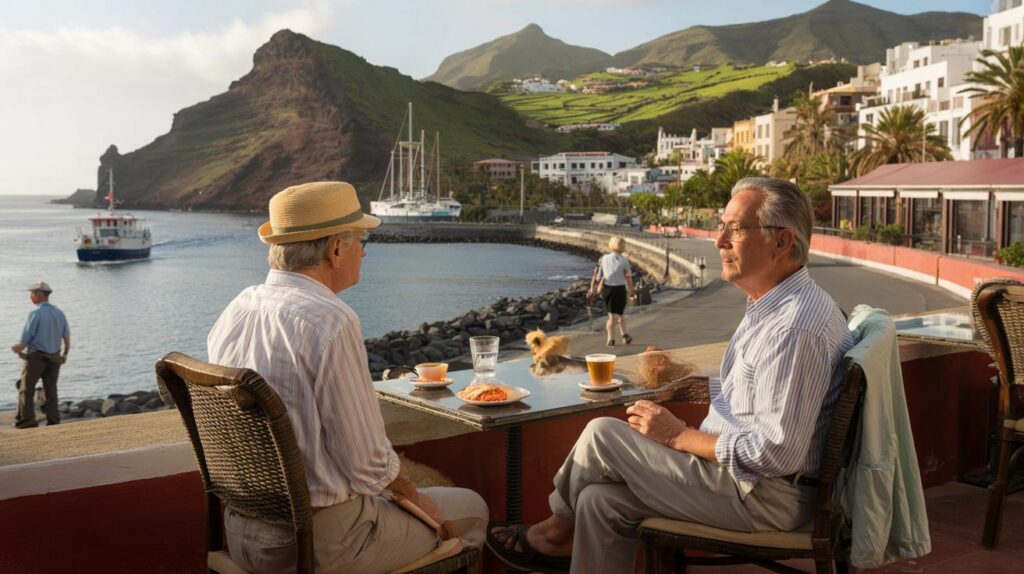
The ferry’s horn rolls across San Sebastián de La Gomera as the last light turns the harbour honey-gold. On the promenade, two couples in linen and sandals trade book recommendations, the sort of gentle chat that only happens when no one’s in a hurry. A waiter carries cortados with a nod that says “you again?”, and a dog flops under a table with a sigh.
It’s the middle of October. The sea is warm enough for a lazy swim, the air sits at 26C, and the town behaves like it has all the time in the world. A retired nurse from Leeds tells me she came for a fortnight and stayed six weeks. Another man says he came to “see if my knees liked the hills” and hasn’t stopped smiling since. The island keeps a quiet secret.
La Gomera: the Canary Island that dodges the crowds
La Gomera is Tenerife’s shy neighbour, a green bowl of ravines, terraces and tiny beaches that somehow avoids the big-resort noise. In October the days are warm without being fierce, the evenings cool enough for a light cardigan, and the trade winds tidy the sky to an impossible blue. You get the perks of the Canaries—sunny days, steady weather, safe swimming—without the bingo megaphones.
Valle Gran Rey, on the west coast, is where you’ll see the classic sunsets and a slow parade of older walkers returning from the cliffs with salt in their hair. Hermigua and Agulo, up on the north, feel like secret villages from a film, with banana leaves rustling and the sea winking beyond the fields. In the centre, Garajonay National Park holds a cool laurel forest, all moss and birdsong, like someone turned down the volume on life. **It still reaches 26C on the coast here in October, and the sea can feel like a warm bath.**
I met Dennis and Moira, both recently retired from Kent, outside a bakery in Hermigua. They rent a one-bedroom flat with a balcony big enough for pot plants and a view they keep trying to describe to friends (“It’s like Devon, if the hills were bigger and the sea warmer”). Their days are gentle: a swim at Playa de la Caleta when the sun’s high, an island bus to Agulo for lunch, a slow shop at a corner store, and a WhatsApp chat with the grandkids before bed. When Moira needed a check-up, the clinic in San Sebastián saw her quickly, and a neighbour translated the new words. “We felt looked after,” she said, “even though we’re the outsiders.”
What makes La Gomera work for British retirees
The island is small enough to learn by heart, and varied enough to keep you interested for months. Warmth sits on the south—Playa de Santiago is a favourite—while the north stays fresher and greener, so you can choose your microclimate like you’d pick a seat in a café. The buses are regular between the key towns, ferries to Tenerife run several times a day, and flights to Tenerife South from the UK are an easy four to five hours. **You get sunshine, Spanish healthcare standards, and a kinder cost of living than the British seaside.**
The quiet is real, not brochure spin. La Gomera has fewer hotels than its big sisters, so October doesn’t suddenly clog. You’ll meet German walkers, a handful of French couples, and a tidy number of Brits who prefer a view to a queue. It’s Spain through a slower lens: tapa plates clink, fishermen chat at the harbour wall, and the woman at the post office already knows you want stamps for the kids. *We’ve all had that moment when a place feels like it recognises you.*
You also get practical wins. For short stays, British citizens can spend up to 90 days in any 180-day period across the Schengen area. Longer stays are possible with the right Spanish visa—many retirees use a non-lucrative residence route—and access to care can be arranged via the UK S1 form once resident, or private cover before that. The island has a small hospital in the capital and clinics in the main towns, plus pharmacies where the staff are kind and direct. Let’s be honest: nobody really does that every day.
How to test the dream (without uprooting your life)
Start with a one-month trial between late September and November. Fly to Tenerife South, stroll to the ferry bus, and sail across to San Sebastián in under an hour. Pick two bases to compare: perhaps Valle Gran Rey for sunsets and beach walks, then Hermigua for green valleys and cool nights. Book a simple apartment near a flat path, because hills are part of the deal here. Pack solid walking shoes, a hat you like, and the one jumper you actually wear.
Don’t try to see the whole island in a week. Give each village time to breathe. If steps worry your knees, choose Playa de Santiago or La Playa in Valle Gran Rey where pavements run level by the shore; ask hosts about lift access before you book. Get a local SIM or pocket Wi‑Fi for video calls, and bring paper copies of your GHIC card, passport and any meds list in English and Spanish. Buses are good, taxis are reasonable for short hops, and the ferry crew will take your bags like you’re family. If heat is a concern, head to the laurel forest after lunch and go slow.
You’ll decide faster if each day has a simple rhythm: swim, shop, stroll, rest. **Give yourself permission to do less.**
“I thought we’d be bored,” says Anne, 68, from Bristol. “Turns out I was just tired. After a week of sea air, I felt ten years lighter.”
- Best bases for a first stay: San Sebastián (easy everything), Valle Gran Rey (sunsets), Playa de Santiago (flat and friendly), Hermigua (green and cool).
- Weather shorthand: coast 25–27C by day in October; sea often 23–24C; evenings a light layer.
- Paperwork to prep: passport, GHIC for short stays, travel insurance; for longer stays, check Spanish government pages for visa routes.
- Getting there: fly UK to Tenerife South, bus to Los Cristianos, ferry to San Sebastián (around 50–60 minutes).
- Useful phrases: “Buenos días,” “¿Cuánto cuesta?”, “Una mesa para dos, por favor.”
What this island gives you at 66 that it can’t at 36
At 36, you chase nights. At 66, you chase mornings. La Gomera is a morning island. You wake to soft sun on white walls, the smell of coffee drifting up a staircase, and a sea that looks like it’s not in the mood for drama. You learn the shopkeeper’s name before you learn the road numbers. You walk at a talking pace. The day stretches. There’s room for the calls home, the postcard, the nap, the little museum about whistles, the slice of almond cake.
The best part might be how it reframes time. You’re not “on holiday” in the old sense; you’re just living, somewhere warmer, with better tomatoes. Projects you’d shelved—reading all the poetry you kept for later, painting, sorting old photos—suddenly have a place to land. If you want bustle, the ferry’s right there. If you want quiet, step into the forest and listen to leaves whispering over the Atlantic. You might find a version of yourself that feels less rushed, and more yours.
| Key points | Details | Interest for reader |
|---|---|---|
| Warm, steady October weather | Coastal highs around 26C; warm sea; breezy evenings | Comfortable days for swimming, walking and terrace time without heat stress |
| Easy access via Tenerife | Direct UK flights to Tenerife South, 50–60 min ferry to La Gomera | Low-faff journey you can manage with hand luggage and a good book |
| Quiet, liveable towns | Valle Gran Rey, Playa de Santiago, San Sebastián, Hermigua | Pick the right base for your knees, your pace, and your idea of a perfect day |
FAQ :
- Is La Gomera really 26C in October?On the coast, yes—October typically brings mid‑20s warmth, often reaching 26C in the sun, with the sea inviting for swims. Inland forests run cooler, which is perfect for afternoon walks.
- How do I get there from the UK?Fly to Tenerife South from multiple UK airports, take a short bus or taxi to Los Cristianos, then the ferry to San Sebastián de La Gomera. The whole hop from plane to island can be under three hours once you land.
- Can British retirees access healthcare?For short stays, travel with a valid GHIC and good insurance. For longer stays and if you become resident, many retirees use the UK S1 route into the Spanish system; speak with official NHS and Spanish sources for current steps.
- How expensive is it compared with Tenerife or the UK coast?Every budget is different, but groceries, local cafés and long‑let rents often come in lower than many UK seaside towns. It’s quieter than Tenerife’s hotspots, which helps keep day‑to‑day costs sane.
- Is it suitable if I don’t handle hills well?Parts of La Gomera are steep, yet several areas are friendly for gentle walking—try Playa de Santiago or the seafronts in Valle Gran Rey and San Sebastián. Ask hosts about lifts, steps and distances before you book.



Sounds like La Gomera—quiet, warm, sensible prices. For those who’ve been, how tricky is the ferry with luggage? My mum’s 72 and not keen on stairs—are Valle Gran Rey or San Sebastián definately manageable, or better to base in Playa de Santiago?