
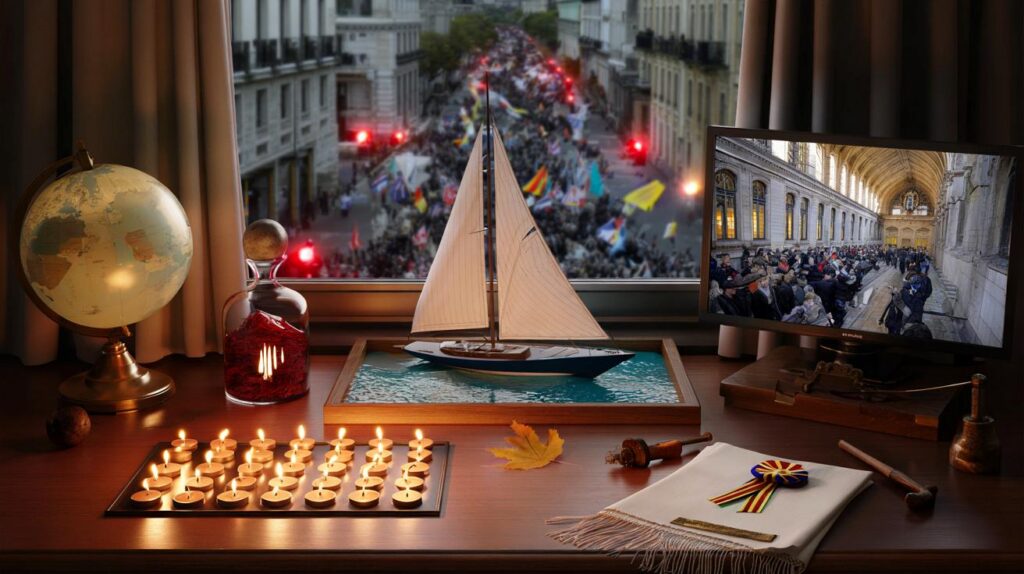
Open your browser and the world spills out: headlines, anniversaries, names you know, and whispers you almost missed.
Today’s Wikipedia front page stitches together a panoramic brief of 31 October. You get conflicts, domestic unrest, new names in the obituary roll, and milestones that stretch from the Reformation to a world of seven billion.
What the front page surfaces today
Wikipedia’s daily mix brings a fast snapshot. A featured piece revisits a thirty‑month siege. A note on Ivorian politics points to a contested fourth presidential term. The news-in-brief mentions an extension of Israeli-held lines in Syria. The ticker keeps you near the action, but it also points you towards context and source trails.
Live conflicts anchor the day. The Gaza war remains a centrepiece. The Sudanese civil war stands alongside it, quieter in headlines, heavy in human cost. Two European stories pull focus as well. Demonstrations in Serbia pick up pace. A French political crisis keeps Parliament-watchers busy. Sport cuts through the gloom with an ocean race, the Transat Café L’Or, now entering strategic waters.
Six historical milestones, two live wars, one transatlantic race, and 21 names in the obituary column: that is your 31 October digest.
At a glance: today’s sections and why they matter
| Section | What’s there today | Why it matters |
|---|---|---|
| Featured article | A thirty‑month siege revisited | Shows how endurance, logistics and politics decide outcomes beyond the battlefield |
| Current conflicts | Gaza war; Sudanese civil war | Humanitarian, regional and energy impacts land on your bills and your screens |
| Protests and politics | Serbia; a French political crisis | Street pressure and parliamentary arithmetic can redraw national calendars fast |
| Obituary roll | 21 entries from 27–30 October | Signals cultural and political losses across generations and continents |
| On this day | From 1517 to 2011 | Connects a door in Wittenberg to a world of seven billion |
| Did you know | Qin Shi Huang’s cinnabar; a French outpost that held; a Tibetan exile honoured | Small facts sharpen judgement and historical memory |
Conflicts and crises that shape your feed
The Gaza war tops the page because it reshapes alliances, supply chains and public debate. Casualty tallies change by the hour. Aid corridors open and shut with statement-level diplomacy. Regional escalation risk remains the number that traders and diplomats watch.
The Sudanese civil war receives less airtime yet moves millions of people and strains neighbours. Border towns become logistics hubs. Diaspora communities wire money to keep families moving and fed.
In Europe, Serbian streets push back at power. Crowd size, policing style and arrest numbers form a pattern you can track day by day. In France, government survival turns on votes, court rulings and coalition moods. One line in a parliamentary agenda can set the tone of a winter.
The Transat Café L’Or slices through the Atlantic with tactics on sleep, sails and storms. Offshore skippers juggle boat speed against fatigue, while shore teams hunt weather windows in files measured in gigabytes.
Follow three numbers to cut through the noise: fuel prices, border crossings, and parliamentary vote margins.
Names you might recognise in the obituary roll
Wikipedia’s necrology for 27–30 October lists 21 entries. You may recognise Prunella Scales, a face of British stage and screen. Lise Bacon appears, a figure in Canadian public life. Jazz saxophonist James Senese features for a Naples sound that travelled far. Photographer Mimmo Jodice leaves a stark eye on urban space. Hui Shiu‑hung represents Hong Kong cinema’s flexible character roles.
You will also see Erik Marchand, linked to Breton song; Maria Riva, whose family name evokes a Berlin‑born star; and athletes such as Odd Martinsen. The list moves from politics to art to sport without drama. It reads like a ledger, and that is the point. It anchors memory without spectacle.
On this day: why 31 October always lands hard
In 1517, Martin Luther posted 95 theses and set Europe on a path that reconfigured authority, literacy and money. In 1793, the Girondins met the blade after a revolutionary court moved with speed. The First World War front between Italy and Austria‑Hungary expanded in 1916 as fresh terrain pulled in fresh tragedy.
Fast forward to 1968. Lyndon B. Johnson ordered a halt to the bombing of North Vietnam as a bargaining chip and a television moment. In 1978, Spain’s Cortes Generales approved the architecture that frames a modern monarchy. In 2011, we crossed a demographic headline: seven billion people, each with a queue at a clinic, a bus stop or a job centre.
Did you know: small facts, big perspective
A Tibetan exile in France received the Légion d’honneur, a first for that community and a quiet nod to endurance. Qin Shi Huang sought immortality and swallowed cinnabar, a metal-laced dream that carried a poison of its own. Nine French soldiers at Pont‑Saint‑Louis held position for two days after an armistice, cut off but steady. A 15th‑century Saint Louis of Toulouse by Antonio Vivarini hangs in Tours and reminds us that sainthood often wears the clothes of politics. A 1971 Grateful Dead concert gets a sideways mention and shows how setlists and cities weave subcultures into history.
How to read today’s page like a pro
- Set a 10‑minute timer, then scroll with purpose. Skim headings first, then pick two items to read.
- Check dates and places before you share. Conflicts and protests shift by the day and the city block.
- Open the “Talk” tab when you can. You will see how editors test claims and weigh sources.
- Note one number per story: vote margin, casualty count, or race position. Numbers unlock trendlines.
- Balance grim news with a DYK item. Curiosity keeps fatigue at bay and memory sharper.
What to watch next
Serbia’s protests may grow or cool with a single court ruling or a police decision. France’s crisis hinges on calendar traps and late‑night negotiations. The Transat Café L’Or skippers face a strategic split near the trades; routings differ by as little as 0.2 knots yet decide podiums. In Gaza and Sudan, aid convoys and ceasefire hours dictate survival; map layers change as checkpoints move.
If you track markets or policy, set up a quick simulation in a notebook: model fuel at +8%, a currency slide of 3%, and a 48‑hour port disruption. Watch how that flows through food prices, flight delays and hospital procurement. Then adjust your own week: plan shopping, travel and energy use around the parts you can control.
For newcomers who want to improve articles, start small. Fix a date. Add a citation. Trim a duplicate claim. If a topic touches your community, gather three reliable sources and write one clear paragraph. The front page shows where readers look today; your edits help them leave better informed than they arrived.



Tight write‑up; bookmarked.