
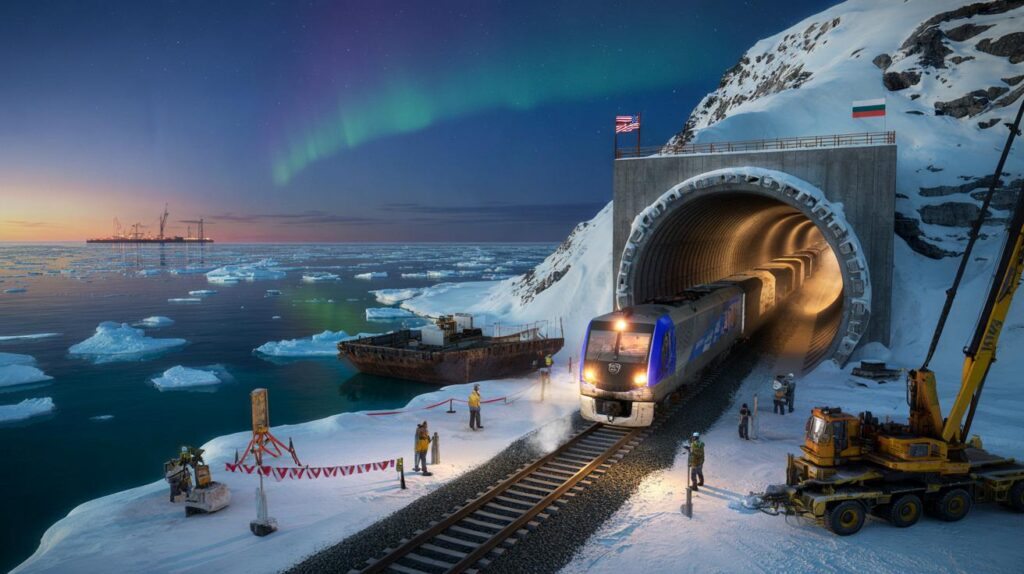
A century-old dream of bridging continents has resurfaced, stirring curiosity, sharp scepticism, and fresh questions about cost and purpose today.
Talk of a rail tunnel beneath the Bering Strait returned after Russia’s investment envoy promoted a study and Donald Trump called the idea “interesting”, prompting a flurry of figures, speculation and geopolitical subtext.
What was actually proposed
Kirill Dmitriev, Russia’s investment envoy, said research into a United States–Russia tunnel began six months ago. He invoked a “Putin–Trump Tunnel” linking Alaska to Russia’s Chukotka region under the Bering Strait. He framed the concept as a 70‑mile (about 113km) rail corridor intended to symbolise unity and unlock new trade routes across the Northern Pacific.
Dmitriev pointed to a reference project: the first railway bridge between Russia and China, financed on a commercial basis by the Russian Direct Investment Fund (RDIF) with partners. He said that bridge shaved more than 700 kilometres off a key cargo route. He argued a Bering link could deliver similar efficiencies at global scale.
The pitch: a 70‑mile rail tunnel under Arctic waters, six months into feasibility work, with a headline cost pegged at around $65bn.
He also posted at entrepreneur Elon Musk, implying that The Boring Company’s tunnelling technology could push costs down. There has been no public response from Musk. RDIF says it has reviewed earlier concepts, including a broader US–Canada–Russia–China rail link, and would back the most viable design.
The Bering crossing is not new. Proposals date to the early 20th century, and Russia announced a version in 2007. None advanced past paper and political speeches.
How the conversation unfolded in Washington
The subject surfaced at a joint press conference with Ukraine’s President Volodymyr Zelenskyy. Trump labelled the tunnel concept “interesting”, then asked Zelenskyy for his view. Zelenskyy replied, “I’m not happy with this idea,” which drew laughter on the US side of the room. The exchange underscored the political sensitivities around any large US–Russia infrastructure project while war rages in Ukraine.
“Interesting,” said Trump. “I’m not happy with this idea,” replied Zelenskyy. The room laughed; the policy questions did not.
The numbers that matter
| Proposed length | 70 miles (≈113 km) under the Bering Strait |
| Indicative cost cited | $65bn+ (≈£51bn at recent exchange rates) |
| Feasibility timeline | Study said to have started six months ago |
| Reference project impact | Russia–China rail bridge: cargo routes shortened by >700 km |
| Potential transit mode | Rail freight and possible passenger services |
What this could mean for you
A Bering tunnel would not only redraw maps. It would touch everyday costs, travel plans and local livelihoods across two continents.
- Prices: shorter freight journeys can trim shipping times and fuel use, nudging down costs for goods over long corridors.
- Jobs: design, tunnelling, rail, ports and maintenance would create skilled work in Alaska and Chukotka during a multi‑year build.
- Border checks: any passenger link would add security screening and immigration controls, changing the experience compared with air travel.
- Local impact: indigenous communities on both shores would face construction traffic, land acquisition and environmental monitoring.
- Resilience: an overland rail option adds redundancy when seas ice over or geopolitical tensions disrupt ocean routes.
Engineering hurdles in the Arctic
Geology, ice and safety
The Bering Strait is relatively shallow, but its environment is unforgiving. Sea ice grinds through winter. Storms push heavy loads. Subsea tunnelling would need robust linings, water sealing and emergency egress galleries. Ventilation, fire safety and evacuation plans must handle long distances between portals.
Seismic design adds complexity. Infrastructure would need to absorb shaking and differential ground movement. Construction would likely rely on multiple tunnel boring machines (TBMs) starting from both sides, with precision navigation to avoid deviation over tens of kilometres.
Rail standards and operations
Rail gauge mismatch sits in the critical path. Russia uses 1,520mm; the US uses 1,435mm. Engineers could introduce variable‑gauge axles, bogie exchange facilities or a break‑of‑gauge terminal to swap rolling stock. Each choice affects throughput, speed and cost. Power systems, signalling and safety certification would also require interoperability or segregation.
Money, sanctions and governance
Even at $65bn, financing would strain balance sheets. Sanctions and export controls complicate equipment procurement and capital raising. A binational treaty would need to settle jurisdiction, operator liability, policing, revenue sharing, environmental safeguards and dispute resolution. Without a joint authority, investors face unacceptable risk.
Financiers will ask three questions first: who pays if something goes wrong, who sets the rules, and who earns the tolls.
Could new tunnelling tech cut costs?
Dmitriev hinted that @boringcompany equipment might lower the bill. TBMs have become faster and more automated, and segment fabrication can cut cycle times. Yet the Bering proposal differs from urban road bores. It is longer, underwater, and likely twin‑bore with cross‑passages, full rail fit‑out, life‑safety systems and Arctic hardening. Smaller‑diameter machines improve speed, but a rail tunnel demands large clearances, high‑capacity ventilation and resilient power, which add expense back in. Any saving claims must survive independent review.
A notional journey, in minutes and miles
A modern freight train cruising at 90–110 km/h would clear a 113 km tunnel in roughly 70–80 minutes, excluding inspection and yard time. Passenger services could be faster, but border formalities would set the pace. Compared with sea routes that rely on trans‑Pacific legs and port handling, a direct rail corridor swaps ocean weather risk for fixed‑guideway reliability, so long as winter operations keep the portals and approaches clear.
Why the idea keeps coming back
Megaprojects promise scale economies and political theatre. A tunnel would bind supply chains from North America to Asia overland, with new hubs in Alaska and the Russian Far East. It could pair with energy or fibre‑optic conduits inside service ducts. That vision, revived every few decades, fades when costs, politics and risk close in. The current study shows ambition remains; execution still looks distant.
What would need to happen next
To move beyond talk, backers would have to publish scoping results and a realistic timetable. That means baseline geology, navigational risk assessment, gauge strategy, border procedures, procurement routes and a funding stack that accounts for sanctions. Local consultations in Alaska and Chukotka would sit alongside federal approvals and environmental impact statements. Without those building blocks, no contractor will mobilise.
From glossy render to breaking ground, expect years of studies, permits and treaty work before the first TBM turns.
Context for readers weighing the risks and rewards
If you run a logistics firm, model scenarios with and without a Bering link: transit time reductions, inventory turns, and carbon intensity. If you live near the proposed corridors, track land use notices, noise mapping and job training programmes. If you follow markets, focus on who underwrites tunnel risk and whether any toll revenue is guaranteed. Big numbers grab headlines; governance will decide whether trains ever run.



Seventy miles under Arctic ice? Im not convinced—sounds like £51bn of wishful thinkng.