
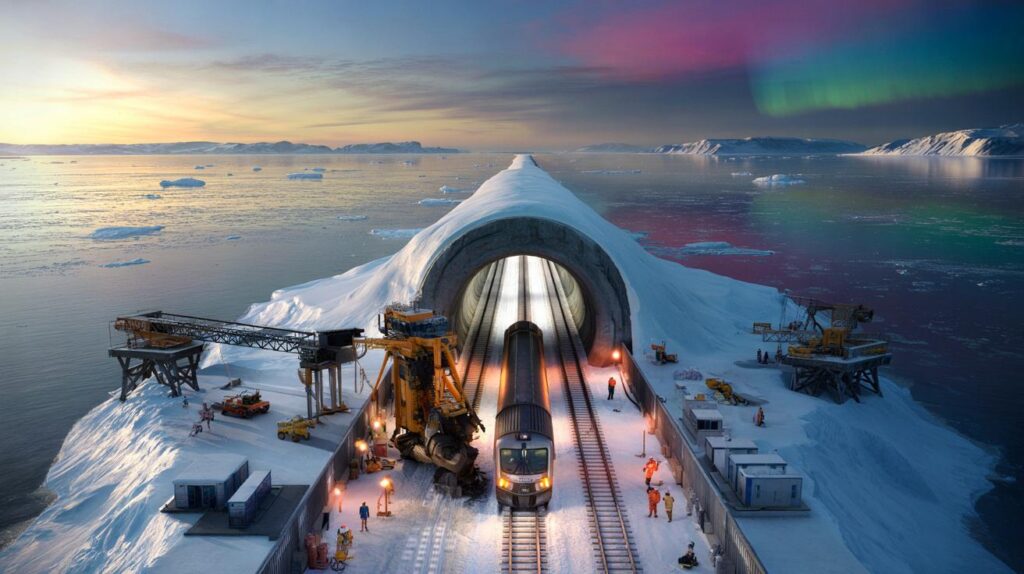
An eye-catching idea resurfaced this week, drawing chuckles in Washington and fresh calculations in Moscow’s investment circles worldwide.
Talk of a rail tunnel between Russia and the United States has leapt from fringe dream to policy chatter, after Donald Trump called the concept “interesting” and a Kremlin-linked financier claimed engineers began a feasibility study six months ago.
A throwaway remark, a serious study
What Trump said beside Zelenskyy
Standing alongside Ukraine’s President Volodymyr Zelenskyy at a press conference, Donald Trump fielded a question about a Russia–US tunnel and called it “interesting”. He then asked Mr Zelenskyy for his view. The Ukrainian leader answered bluntly: “I’m not happy with this idea,” which drew laughter from the American side of the room. The exchange turned a notional megaproject into a viral talking point.
Moscow’s pitch and the money math
Kirill Dmitriev, a Russian investment envoy, said his team started a feasibility study for a Russia–Alaska tunnel half a year ago. He framed the plan as a “Putin–Trump” link beneath the Bering Strait, a 70‑mile corridor connecting Chukotka to Alaska. He cited the Russian Direct Investment Fund’s role in financing a Russia–China rail bridge, which he said cut certain cargo routes by more than 700 kilometres. He also tagged Elon Musk on social media, suggesting the Boring Company could dig the route.
Feasibility work began “six months ago”, according to Kirill Dmitriev, with a 70‑mile sub‑sea rail link under review.
Dmitriev floated a headline price above $65bn, while hinting that newer tunnelling methods could reduce costs. Elon Musk has not responded publicly.
What the tunnel would take
Engineering hurdles in the strait
The Bering Strait is shallow by ocean standards, iced for much of the year, and shaken by regional seismicity. The narrowest point, near the Diomede Islands, offers two landfalls but harsh winds and drifting pack ice complicate staging. A rail tunnel of 70 miles would exceed every existing undersea tunnel by a wide margin, requiring multiple ventilation shafts, crossover caverns, and emergency egress points to meet modern safety codes.
Engineers would assess permafrost behaviour on the Russian side, coastal erosion on both shores, and long winter logistics windows. They would need robust electrification, advanced TBMs capable of mixed face conditions, and a string of service portals reachable by ice-capable vessels or seasonal roads.
The scheme would be longer than the Channel Tunnel and Japan’s Seikan, demanding redundancy, rescue access and year-round maintenance.
Who would build it, and how fast
Any build would need US and Russian permits, environmental approvals, and a mutual governance framework for construction and operations. Sanctions present a prohibitive barrier today. Without exemptions, equipment, finance and insurance would stall. Even with full political alignment, a realistic delivery would span more than a decade, including surveys, design, procurement and staged excavation from multiple headings.
The Boring Company specialises in smaller-diameter urban tunnels. A freight-capable rail tube under the strait would require larger bores, heavy-gauge track, power systems and pressurised emergency galleries. That implies a consortium of heavy civil contractors, rolling stock suppliers and state-backed lenders, not a single tech firm acting alone.
Politics, sanctions and the road to somewhere
Security and climate concerns on both sides
Border security would dominate the political debate. A fixed link raises questions about customs control, migration screening and military vulnerability. Alaska’s indigenous communities would weigh land rights and subsistence impacts. On the Russian side, the Chukotka region would need ports, depots and housing tied to the project’s demands.
Climate risk factors into design. Permafrost thaw alters ground stability. Sea-level rise and storm surge change shoreline stressors. Any tunnel plan would include decades-long adaptation measures, including watertight linings, flexible joints and power redundancy.
What it could change for trade
Proponents argue that a rail corridor could reroute freight between North America and Eurasia, offering an alternative to sea lanes through the Panama Canal and the Suez chokepoint. A through-link might cut days from certain intermodal journeys if border formalities moved at pace. Critics counter that sanctions, gauge differences, and the lack of continuous, high-capacity rail on either side would sap those benefits.
Without aligned customs regimes and continuous high-speed freight track, time savings remain theoretical, regardless of the tunnel’s length.
The numbers at a glance
- Proposed tunnel length: 70 miles under the Bering Strait
- Indicative cost: $65bn+ before contingencies and new rail approaches
- Claimed freight precedent: Russia–China rail bridge cut routes by 700+ km
- Timeline if greenlit: design and build likely beyond 10–15 years
- Key unknowns: sanctions relief, finance terms, safety regime, border controls
How it compares with existing mega-tunnels
| Tunnel | Country/region | Type | Approximate length |
|---|---|---|---|
| Channel Tunnel | UK–France | Rail | 31 miles (50 km) |
| Seikan Tunnel | Japan | Rail | 33.5 miles (54 km) |
| Proposed Bering link | Russia–US | Rail (concept) | 70 miles (112 km) |
A century-old dream with modern complications
The concept is not new. Planners discussed a Siberia–Alaska railway as early as 1904. Moscow revived variations in the 2000s, including a 2007 outline that sketched a freight corridor across the strait. Each time, cost, geopolitics and engineering risk parked the idea. Today’s pitch borrows that lineage but adds a Silicon Valley twist: faster TBMs, digital twins, and modular construction. The fundamentals remain stubborn. A project of this size needs aligned states, sovereign guarantees and a clear commercial case.
On the economics, a through-rail works best when both continents feed high volumes of time-sensitive cargo into a predictable timetable. That means new yards in Alaska, upgraded links through Canada and the contiguous US, and standardised tariffs to keep trains moving. In the Russian Far East, the line would need connections to the wider network, with winter-proof logistics and ample power. Without those, the tunnel becomes an expensive cul-de-sac.
What happens next
Trump’s single word — “interesting” — does not equal policy. Zelenskyy’s scepticism signals how entwined this idea is with wartime politics. Dmitriev’s claim of a six‑month study suggests a desk-based scoping exercise rather than a signed, funded programme. Investors will watch for concrete steps: requests for proposals, marine geotechnical surveys, and any sign of cross-border working groups. None of that appears in public yet.
For readers weighing the scale, a back‑of‑the‑envelope simulation helps. If two TBMs started from each side and averaged 25 metres per day per machine — a figure that already assumes elite performance in stable ground — four headings might advance about 36 km a year in total. At 112 km, excavation alone could span three years, before fit‑out, systems integration and commissioning. Real-world delays, ice logistics and seismic design iterations could easily stretch that schedule.
Practical add-ons that would shape the price tag
Financing would likely blend sovereign loans, export credit, and project bonds. Insurers would price political risk, sanctions snapback, and sanction-compliant supply chains. Safety systems — pressure doors, smoke extraction, refuge chambers, cross-passages every 250–500 metres, continuous radio — add billions but cut risk. A through-rail might also demand new ice-capable rescue craft and a dedicated emergency base near the Diomedes.
If the concept ever moves, expect a staged package: coastal rail upgrades first, then near-shore portals, followed by marine sections. That spreads cost and allows pause points. It also gives both sides leverage to stop if politics sour. For now, the tunnel sits where big ideas often live — between a headline and a spreadsheet, with a lot of cold water in between.



Who’s paying for maintenance and rescue infrastructure when the ice rolls in? $65bn feels like the teaser, not the bill.
So we’re speed-running the Channel Tunnel on hard mode—with earthquakes, permafrost, and geopolitics on top—what could possibily go wrong?