
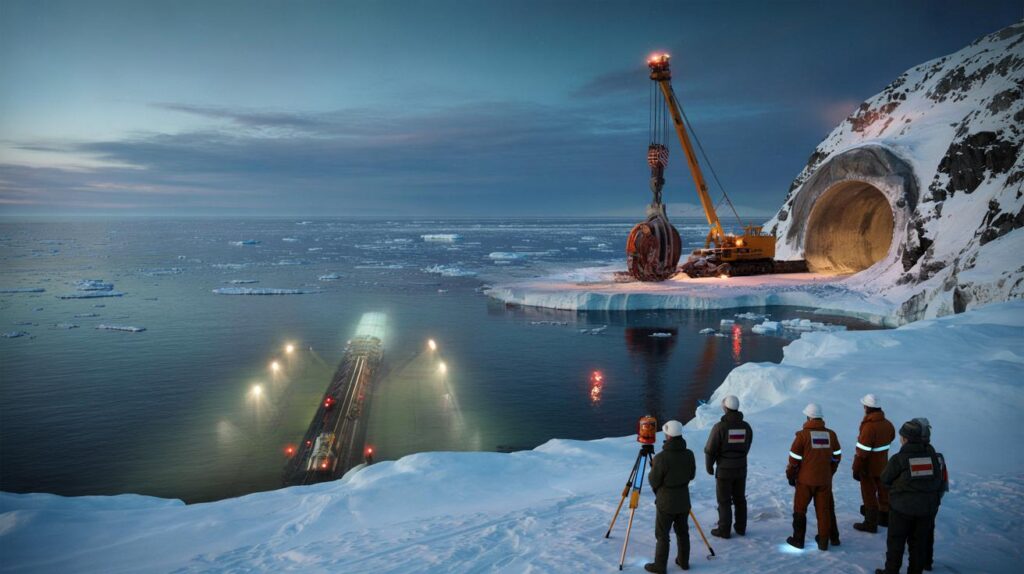
An audacious Arctic link is back on the table, stirring hope, scepticism and a surprising dash of tech-world bravado.
Talk of a tunnel between Alaska and Russia resurfaced after a Kremlin-linked financier said a six-month feasibility review is already under way, drawing a brief but telling response from Donald Trump and a cool reaction from Volodymyr Zelenskyy.
How the idea resurfaced
Kirill Dmitriev, Russia’s investment envoy and head of the Russian Direct Investment Fund (RDIF), posted that work began on testing the feasibility of a Russia–Alaska tunnel half a year ago. He framed the link as a 70-mile connection beneath the Bering Strait, invoking historic schemes from the early 20th century and a 2007 Russian proposal, and pitched the project with a striking label tying together two of the world’s most recognisable political figures.
The plan envisages a 70-mile tunnel under the Bering Strait, with a stated headline cost north of $65bn.
Dmitriev also nudged Elon Musk on social media, suggesting The Boring Company could take on construction. He argued newer tunnelling methods might cut costs that have historically run into tens of billions of dollars for mega-bore rail links.
What Trump and Zelenskyy said
Asked about the concept during a press conference alongside Ukraine’s President, Donald Trump called the idea “interesting”. He then turned to Volodymyr Zelenskyy, who made clear he was not pleased by the notion, prompting laughter from the US side of the room. The exchange briefly turned a grand piece of infrastructure speculation into a glimpse of current geopolitics—war, sanctions and diplomatic signalling—colliding with engineering ambition.
Who is backing it—and why that matters
Dmitriev pointed to RDIF’s role in financing a cross-border rail bridge between Russia and China that, he said, cut freight routes by more than 700 kilometres. He cast the tunnel as the next leap: a piece of infrastructure designed to fuse North America to Eurasia.
RDIF is under US sanctions, raising immediate questions about financing, partners and permissions on American soil.
Any serious attempt to advance design work would need clarity on sanctions, export controls, and potential carve-outs. Without that, Western contractors, insurers and equipment suppliers would face legal and financial risks.
Engineering realities across the Bering Strait
The strait narrows to around 85 kilometres at its tightest points, punctuated by the Diomede Islands, where the United States and Russia sit just a few kilometres apart across the International Date Line. The seaway carries sea ice, strong currents and harsh storms, but a tunnel would avoid ice crush hazards that bedevil bridges. It would still have to contend with seismology, permafrost, deep foundations for portals, and reliable emergency egress for trains in remote, sub-zero conditions.
Long undersea rail tunnels demand large-bore TBMs, robust ventilation, fire safety refuges and power redundancy across vast distances.
The Boring Company specialises in smaller-diameter urban tunnels. A full-scale undersea rail tunnel requires different tooling, certifications and safety systems. That does not preclude innovation, but it sets a high bar for design, testing and international approvals.
What it could mean for people and trade
A rail link could, on paper, shorten transcontinental freight journeys and rewire logistics between North America, Russia and beyond. For Alaskans and residents in Russia’s Chukotka region, it could promise jobs, new utilities corridors and expanded supply options. Indigenous communities on both sides would expect a central role in consultations and agreements covering land, culture, subsistence routes and environmental safeguards.
- Length proposed: about 70 miles (112 kilometres) beneath the Bering Strait
- Feasibility work: claimed to have started six months ago
- Indicative cost: $65bn+ using traditional methods, with hopes of reductions via new tech
- Past reference: Russia–China rail bridge credited with cutting routes by 700 kilometres
- Potential builder: The Boring Company mentioned; no public response so far
Regulation, money and the politics of timing
Any binational tunnel needs not just billions, but treaties, joint operating standards, customs integration and security frameworks. Questions over who pays—state budgets, sovereign wealth funds, private investors or a blended model—sit beside the harder question: who guarantees demand and revenue for decades?
Regulatory hurdles
Permits would span federal, state and local agencies in the US and equivalent layers in Russia. Environmental impact assessments in Arctic conditions demand extensive fieldwork. Evacuation modelling for long trains, ventilation scenarios for fires, and the handling of hazardous freight would be scrutinised line by line.
Financing constraints
Market appetite for a sanctioned counterparty is weak. If sponsors seek to separate the project company from sanctioned entities, they would still need banking, insurance and export licences acceptable to US authorities. That takes time, and an unambiguous policy steer from Washington and Moscow—neither of which currently looks likely.
Why the idea keeps returning
The vision of walking or riding from the Americas to Eurasia carries romance and scale that captures imaginations. The Channel Tunnel and Japan’s Seikan Tunnel prove the concept of long, safe undersea rail links. The Arctic presents distinct conditions, but engineering does not rule it out.
The real test is not technology alone but consent, capital and a durable political compact between two estranged neighbours.
For now, the proposal operates as a signal: a pitch for post-conflict connectivity, an invitation to tech optimism, and a reminder that megaprojects live or die on public legitimacy.
What readers should watch next
Look for hard evidence of contracted design teams, named engineering consortia, and scoped geotechnical surveys on both shores. Monitor whether any US agency acknowledges talks, and whether Alaska’s elected officials back even preliminary studies. Absence of these markers over the next 12–18 months would suggest the plan remains aspirational messaging.
Extra context to frame the stakes
Key risks
- Seismic and permafrost behaviour affecting long-term stability
- Emergency evacuation across dozens of kilometres in Arctic winter
- Sanctions and export controls restricting finance and equipment
- Environmental impacts on marine life, ice regimes and local fisheries
- Security and customs protocols in a high-tension bilateral relationship
Potential benefits
- Shorter rail corridors between North America and Eurasia
- New utility conduits for power and data across the Arctic
- Employment and infrastructure upgrades in remote regions
- Redundancy for global supply chains under strain
If you want to gauge feasibility at home, compare announced steps with how past megatunnels progressed: preliminary studies, site investigations, procurement of specialised TBMs, and signed bilateral accords. Each milestone tends to take years. A realistic build would likely span multiple electoral cycles, so any serious effort must survive changes in leadership on both sides of the strait.
The Bering Strait sits between Little Diomede (US) and Big Diomede (Russia), communities that can literally see each other across a few kilometres of water. That human proximity, set against present-day geopolitics, explains both the seduction of a 70-mile promise and the many reasons it may remain on the drawing board for some time yet.



Trust it after 6 months? Arctic enviromental baselines, seismic studies, and cross‑border treaties take years, not quarters. Feels like PR, not P3.
Is there a gift shop on Little Diomede halfway through, or do we just high‑five tomorrow across the Date Line? 😅 Also, who’s paying the $65bn tab—billion$ with asterisks?