
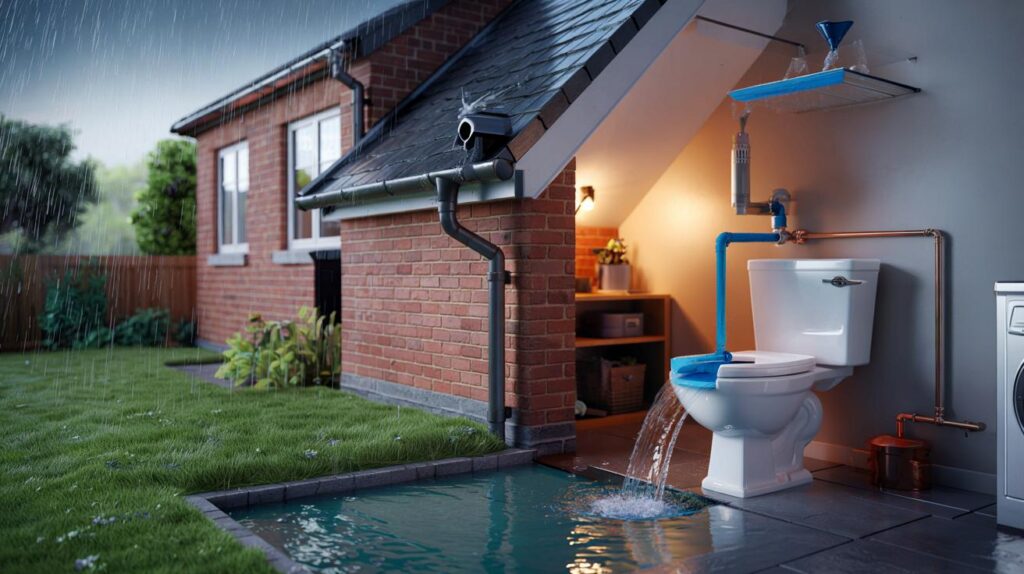
Households across the UK are watching their water bills creep up while winter storms dump weeks’ worth of rain onto our roofs in a day. There’s a quiet, practical shift happening in kitchens and under stairs: people are catching that rain and using it way beyond the garden tap.
On a wet Saturday in Sheffield, I follow a plumber into a narrow utility room that smells faintly of pine cleaner and damp coats. Outside, the gutters chatter; inside, the toilet cistern hums gently as a small pump kicks in, sipping rain from a tank buried under the lawn. The homeowner laughs when the flush finishes — a tiny moment of thrift that feels oddly satisfying. What if your loo ran on rain?
Beyond the watering can: bringing rain indoors
Most people think “water butt, tomatoes, job done.” That’s the starting line, not the finish. Toilets, washing machines, mopping floors — all of these don’t need drinking-quality water, yet we pay for mains water as if every drop were a latte.
Toilets alone can swallow around a quarter to a third of a home’s water use. Switch that to rain and the numbers shift. It’s not glamorous, but neither is paying for six to nine litres every time the chain gets pulled.
Take a semi in Leeds with an 80 m² roof and average UK rainfall. You can harvest tens of thousands of litres a year once you fit a leaf guard, a simple filter, and a tank that actually keeps the light out. A family of four, flushing five or six times each per day, can burn through roughly 50,000 litres a year just on loos — all of it perfect rainwater territory.
On a water meter, you’re billed per cubic metre (1,000 litres), and the sewerage charge generally tracks what you buy. Replace even 25 to 50 m³ of mains water with rain for toilets and cleaning, and you’re shaving meaningful pounds off each year. The pump’s electricity use is small — often in the order of pennies per day — while the habit builds resilience when summer hosepipe bans roll around.
How to set up a simple rain-to-toilet system
Start with the route water takes. Roof to gutter, gutter to downpipe, diverter to filter, filter to storage, storage to pump, pump to a small header tank, then gravity to toilets on a dedicated pipe. Keep rain and mains totally separate, label every non-potable tap, and include an air gap where a backup trickle of mains can top up the header safely.
The kit list doesn’t have to be exotic. A 500–1,500 litre tank (underground if you’ve got a small garden), a leaf trap, a first-flush diverter, a 100–300 micron filter pre-pump and a finer 5–20 micron inline filter post-pump, plus a quiet pressure pump with a float switch. A common path is to begin with a large above-ground tank plus a diverter, then add the pump and toilet feed once you trust the supply. This staged approach keeps costs sane and confidence high.
We’ve all had that moment when a bill lands and you wonder how a simple life costs this much. Don’t let enthusiasm ruin the install. Too-small tanks leave you dry after a weekend’s flushes; too-large tanks go stagnant if you don’t turn the water over. Keep tanks shaded and opaque, service filters quarterly, and route overflow somewhere sensible, like a soakaway or rain garden. Let’s be honest: nobody really does this every day.
The Big No-Nos are easy to avoid. Never cross-connect rainwater and drinking water. Put clear “Do not drink” stickers on lids and taps. Keep pump noise in mind when choosing where it sits. And if you’re adding a washing machine to the rain line, check your appliance handbook for filter requirements and warranty fine print. If it feels like you’re overthinking it, you’re probably doing it right.
“I tell people: treat rain like a second utility. You’re not trying to drink it — you’re trying to stop paying to flush it,” says Mark Downes, a Bristol plumber who’s retrofitted more than 40 homes.
- Pick an underground tank if you want silent, cool storage year-round.
- Add a dual-flush tune-up to older toilets to cut each use to 4–6 litres.
- Label every rain-fed outlet and use a Type AB air gap for top-up safety.
- Service filters with the seasons — after leaf fall and after pollen.
- Keep a simple ledger of rainfall vs. usage for the first year to right-size.
The mindset shift that saves you on every rainy day
There’s something disarming about watching a storm and realising you’re literally topping up tomorrow’s flushes. Friends start to notice the small signs — the discreet “non-potable” sticker near the cistern, the tiny whirr when the pump breathes, the water butt that never seems to overflow. You end up telling a story not about plumbing, but about respect for the obvious: rain falls, roofs catch it, homes use it, wallets sigh with relief. That’s not off-grid romance; that’s just common sense wearing a raincoat.
| Key points | Details | Interest for reader |
|---|---|---|
| Harvest beyond the garden | Toilets and cleaning don’t need drinking-quality water | Biggest savings come from everyday uses |
| Start simple, grow smart | Diverter, filter, tank, pump, labeled pipework | Lower upfront cost, faster wins |
| Design for reality | Right-size tank, safe separation, easy maintenance | Reliability, quiet operation, no nasty surprises |
FAQ :
- Can I legally use rainwater to flush toilets in the UK?Yes. Follow BS 8515 (rainwater systems), use proper backflow prevention (Type AA/AB air gap), keep supplies separated, and label non-potable outlets.
- How much could I save each year?A family of four switching toilets and some cleaning to rain could displace 25–50 m³ of mains water, translating to roughly £50–£200+ depending on your tariff and usage.
- What size tank should I pick?Aim for a balance: 500–1,500 L for modest homes, larger if your roof is big and you’ve space underground. Track a few months of usage to fine-tune.
- Will the water smell or go green?Keep light out, fit a leaf guard and a first-flush diverter, and maintain filters. Regular turnover prevents stagnation; underground tanks stay cooler and darker.
- Can I run a washing machine on rainwater?Often, yes for the cold feed with good filtration, but check your manual. Use a fine inline filter and keep rain and mains strictly separate.



This is the first guide that actually demystifies rain-to-toilet setups. The staged approach feels sane, and I appreciate the reminders about proper labeling and Type AB air gaps. Only thing I’m unsure about: how noisy are those pumps in real life, especially at night? My utility room shares a wall with a bedroom.
I get the savings, but what about water quality over time? If the tank sits half-full through a warm spell, isn’t there a risk of smells or even Legionella? Do you need UV or biocide tablets, or is the leaf guard + first-flush + turnover genuinely enough?