
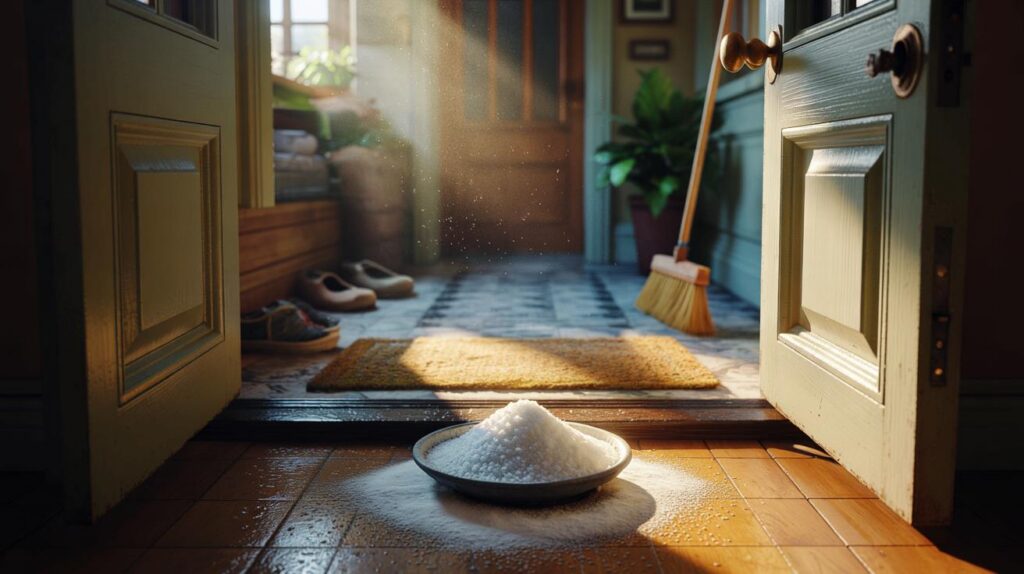
Behind the front door of countless homes, a small pinch of salt sits quietly in the corner, folded into paper or poured into a saucer. Some call it protection. Others call it nonsense. The line between superstition and “energy hygiene” has never felt thinner. Are we simply scattering crystals on the floor, or are we doing something measurable to the mood of a room? The ritual travels fast on social feeds, faster still across kitchens and hallways, and it sticks because thresholds carry stories.
It started with a soft knock and the sort of conversation you have on a doorstep, shoes on, kettle not yet boiled. My neighbour—sharp laugh, paint-stained hoodie—tilted her head and whispered, “I put salt behind the door after the row.” The air in her hallway smelled like last night’s rain and old wood. She didn’t believe in magic, she said. She believed in clearing the air. She smiled, almost guilty. Something had shifted.
The threshold ritual: what people actually do — and why it lingers
You’ll see it in old Italian kitchens, in West African diaspora rituals, in Japanese genkan etiquette and TikTok tips with a soundtrack. The gesture is small: a spoon of salt, placed where shoes cross and tempers fray. The reasoning is bigger, like a story that outruns its author. Salt is a threshold marker. It absorbs, it binds, it reminds the body to pause at the border between out-there and in-here. It’s housekeeping for the heart.
A friend in Naples told me her grandmother sprinkled coarse sea salt behind the door after funerals and the first night in a new flat. She did it again after a break-up, sweeping it out the next morning with a whoosh you could feel, as if the corridor exhaled. On social platforms, the tag “salt cleanse” has racked up big numbers, often framed as a reset after arguments or bad days. We’ve all had that moment when the room feels heavy and you want a fresh start that doesn’t cost anything but a handful of kitchen cupboard grit.
Salt is a workhorse: hygroscopic, mildly antimicrobial, a bully to slugs and a friend to damp. It draws water from the air and surfaces, so a saucer of crystals near a door can reduce that clammy smell older buildings know too well. That’s chemistry, not mysticism. The “energy” part lives in ritual psychology. We mark an intention, then our brain tags the space as calmer, which shifts our behaviour and tone. The home listens because we do. Maybe the real threshold is in the mind.
From superstition to practice: a simple way to try it without wrecking your floorboards
Here’s a low-stakes method that respects both science and story. Use a small ceramic dish, not bare floor, and add a heaped teaspoon of coarse sea salt. Place it behind the main door or beside the sill where traffic is high, away from pets and little hands. Name your intention out loud—ten seconds, no drama—and leave it overnight. In the morning, lift, check for damp clumping, then discard the salt into the bin and wipe the dish dry. That’s it. One minute, top to tail.
People go wrong when they overdo it: piles of salt in corners, weeks left untouched, crystals grinding into wood grain. Don’t pour it straight on floorboards or metal thresholds—it can trap moisture and, over time, bite into finishes. If you share the flat, a quiet heads-up keeps it from being Hoovered mid-process. Let’s be honest: nobody really does this every day. Try a weekly or monthly cadence, or tie it to moments that naturally echo—new moon, Sunday reset, the day after guests leave.
Think of it as a cue, not a cure. Sweep first, open a window, then let the pinch of salt be your punctuation mark. **Salt is not a magic vacuum for bad vibes.** It’s a ritual that helps you mark a shift and choose a tone.
“Rituals change us first; rooms second.”
- Use a dish or envelope, not bare floor.
- Keep away from pets; salt can be harmful if ingested.
- Discard and wipe within 24 hours.
- Pair with real actions: airing out, tidying, kind conversations.
Superstition or science? The honest middle ground
Salt has measurable properties—moisture absorption, odour reduction, mild inhibition of microbial growth—that can make a hallway feel cleaner and smell fresher. The “energy” change many people describe likely stems from a cocktail of sensory shifts and expectation: a small ritual creates agency, which softens stress responses, which alters how we perceive a space. **Belief becomes a tool, not a trap.** Skeptics aren’t wrong to ask for proof; believers aren’t wrong to trust their felt experience. Between them lies a workable lane: use salt the way you use a candle or an open window—practically, mindfully, with care for materials and animals—then let the rest be story. What’s at stake isn’t paranormal power. It’s how we choreograph the threshold so home begins on the right foot.
| Point clé | Détail | Intérêt pour le lecteur |
|---|---|---|
| Salt does things | It absorbs moisture and can reduce musty smells near doors | Explains why the hallway can feel lighter after a simple ritual |
| Ritual shifts mood | Intention plus action reframes how we behave in the space | Gives a practical lever for calmer entries and exits |
| Protect your home | Use a dish, keep away from pets, clear within 24 hours | Avoids damage to floors and keeps the ritual safe and simple |
FAQ :
- Does salt behind the door really “absorb negative energy”?There’s no lab test for “negative energy,” but salt does absorb moisture and smells, and the ritual can shift your mindset. That combination can feel like a palpable reset.
- What kind of salt should I use?Coarse sea salt or rock salt is easier to handle and check for clumping. Table salt works in a pinch, though it can cake faster in humid homes.
- Is it safe for pets and kids?Keep it out of reach. Ingesting salt can be harmful to animals and small children. A high shelf by the door or a lidded dish is a safer tweak.
- How often should I change the salt?Within 24 hours for this threshold ritual. If you’re using it like a mini dehumidifier, check daily and refresh when clumped. Frequency depends on humidity and traffic.
- Can I pair it with other practices?Yes—open a window, sweep the threshold, light a candle for five minutes, or play a favourite track. **What you believe shapes what you feel in your own doorway.**



Intéressant, mais j’appelle ça surtout un bon vieux effet placebo. La partie sur le sel hygroscopique tient la route, d’accord, mais avez-vous des mesures avant/après (humidité, odeurs) pour étayer ? Sinon on reste dans le récit et les métapaphores de couloirs qui « exhalent ».
Merci pour l’honnête milieu: « cue, not cure ». Ça recadre bien. Et merci d’insister sur la sécurité pour les animaux; trop de posts oublient ça. Je vais tester avec une coupelle, pas direct sur mes vieux planchers!