
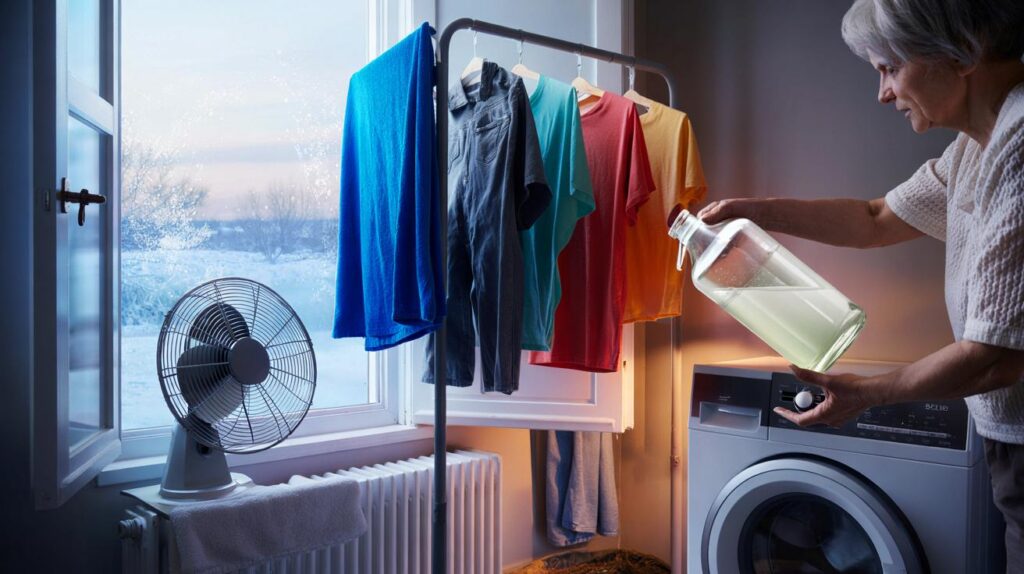
Radiators on, windows closed, damp creeping in—your clothes line stalls for days, and the house starts to smell.
Across the country, budget‑minded households are turning to an old‑school laundry move to beat sluggish winter drying. The approach blends a splash of white vinegar with clever airflow, and it’s cutting indoor drying times by half without touching the tumble dryer.
Why winter washing lingers
Cold air carries less moisture, so evaporation slows when the heating is on and windows stay shut. Water from wet textiles adds litres of vapour to your rooms. Humidity rises, air becomes saturated, and drying stalls. Dense fabrics—towels, denim, cotton fleece—hold onto water in their seams and loops. Clothes crowded on an airer add another bottleneck by blocking air currents.
The remedy isn’t brute heat. It’s cleaner fibres, freer air, and gentle, constant movement. That’s where the grandmother’s method earns its place in 2025 homes.
The method that halves the wait
what you need
- 250 ml white vinegar for the fabric softener compartment (or 200 ml lemon juice as a citrus alternative)
- Your usual detergent
- Sturdy indoor line or foldable airer, plus pegs
- A small oscillating fan (optional, yet strongly recommended)
step by step
- Add 250 ml white vinegar to the softener drawer and run your normal wash. Vinegar dissolves mineral residue and leftover surfactants that stiffen fibres and slow evaporation.
- Stretch a line or set your airer near a window or mild heat source. Leave at least 60 cm between clothing and any wall or furniture so air can move.
- Before hanging, snap each item three times to open the weave. Leave a gap of about 10 cm between garments. Hang heavy items by their hems, delicate tops by the shoulders to keep shape.
- Place a fan about 1.5 metres away on a low, sweeping setting to mimic a light breeze. Keep door ajar to avoid turning the room into a damp box.
- Four hours in, rotate or flip garments so seams and waistbands face the airflow. This prevents damp patches and speeds the last stretch of drying.
Keep it airy: 10 cm between garments, at least 60 cm from walls, a fan 1.5 metres away, and a door left open. Those numbers matter more than cranking heat.
What results look like
With cleaner fibres and a steady draught, water leaves faster. Towels feel softer because rigid residue no longer glues loops together. The slight vinegar scent vanishes as items dry, taking musty notes with it.
| Fabric | Set‑up | Typical time with the method | Typical time without the method |
|---|---|---|---|
| Synthetics (sports tops, microfibre) | Spaced with fan | 6–8 hours | 12–16 hours |
| Cotton T‑shirts, bedding | Spaced with fan | 8–12 hours | 18–24 hours |
| Towels and dense terry | Spaced with fan | 24–36 hours | 2–3 days |
Households report cuts of around 50% in total drying time. A rack that once hovered for three days can be cleared in roughly a day and a half, even during cold spells.
Questions about vinegar, fabrics and machines
White vinegar is a weak acetic acid, typically 5%. At 250 ml in the rinse it breaks down detergent film and neutralises alkaline residue from hard water. Fabrics come out easier to aerate, so they dry faster. The dose sits within typical care advice for home laundering.
- Avoid pairing vinegar with chlorine bleach; they react and create harmful fumes. Use one or the other, never both.
- Go gentle with garments that contain elastane or acetate: keep vinegar to the rinse only and avoid soaking.
- Modern machines tolerate occasional vinegar rinses well. If you use it often, rinse the dispenser monthly and run a maintenance wash to protect seals.
The drying boost doesn’t come from heat. It comes from cleaner fibres and consistent airflow around every centimetre of fabric.
Cutting damp and mould risk indoors
Indoor drying raises humidity, which can feed condensation and mould on cold walls. Keep relative humidity between 40% and 60%. That range protects your home and speeds drying.
- Crack a window for 10–15 minutes each hour when the fan runs. The slight air exchange helps carry vapour out.
- Avoid draping items directly over hot radiators. You’ll trap steam and may raise moisture levels in the room.
- If you own a dehumidifier, place it near the airer and set it to 50% RH. A low‑power unit often beats a tumble dryer on energy use.
- Use moisture‑hungry materials near the rack—unglazed clay discs or a bowl of rock salt can help in small rooms.
Pro tweaks from seasoned laundry hands
- Turn pockets inside‑out and unroll cuffs. Thick seams are last to dry, so face them towards the airflow.
- For socks and smalls, peg them across a hand towel and hang the towel by two corners. The wider spread gives air a path between each item.
- Reshape knitwear flat on a mesh shelf to avoid sagging, but keep the fan running to move air across the surface.
- Consider two short sessions: fan on for an hour, off for an hour. Pulsed airflow can outperform constant heat in tight rooms.
The money and energy angle
Energy bills make this method attractive. A vented or condenser tumble dryer often uses 3–5 kWh per cycle. At 28–35p per kWh, that’s roughly £0.84–£1.75 a load. White vinegar costs pennies per rinse—about 15–20p for 250 ml—and the fan sips power compared with a dryer. If a family of four runs four loads a week indoors, swapping two of those loads to this airflow method can shave several pounds a month in winter.
There’s another dividend: less wear on fabrics. High‑heat drying roughens fibres and shortens garment life. Air‑drying with improved evaporation keeps towels springy and reduces pilling on cotton tees.
What to do when the air is still
Some homes lack cross‑ventilation. Create your own by placing the rack in a hallway or near a stairwell where warm air naturally rises. A desk fan on the floor, angled upward, sets a vertical stream that lifts moisture away. Keep doors open between two rooms to form a simple channel. Even a small shift in airflow can lop hours off drying times.
Alternatives and extras
- No vinegar to hand? Use 200 ml lemon juice in the softener drawer. It’s mildly acidic and leaves a brighter scent.
- Prefer fragrance after drying? Lightly mist garments with cooled cinnamon‑infused water while turning them mid‑dry. A faint spice note masks residual damp odours as items finish.
- Hard‑water areas benefit most. If limescale deposits are heavy, repeat the vinegar rinse for two or three washes, then use it every few loads.
Curious how much time you could save? Track one load this week with and without the fan. Note start and finish, room humidity, and fabric types. Most people find synthetics hit wardrobe‑ready condition by bedtime, while cotton towels move from two or three days down to a neat 24–36 hours. That reduction frees space on the airer and keeps the home from smelling like yesterday’s wash.
Finally, use a simple rule when space feels tight: less on the rack equals less time to dry. Split a heavy load into two smaller hanging sessions. The extra 10 minutes of pegging can save half a day of waiting, spare your walls from condensation, and deliver fresher‑smelling laundry without the spend of a tumble cycle.



I followed the steps—250 ml vinegar in the softener drawer, items snapped and spaced, small fan sweeping—and my towels dried in ~26 hours instead of nearly 3 days. House doesn’t smell damp anymore. Brilliant tip, cheers!
Genuine question: does using vinegar this often degrade door seals or elastane legings over time? My manual mutters about acids and I’m a bit skittish. Anyone with long‑term results?