
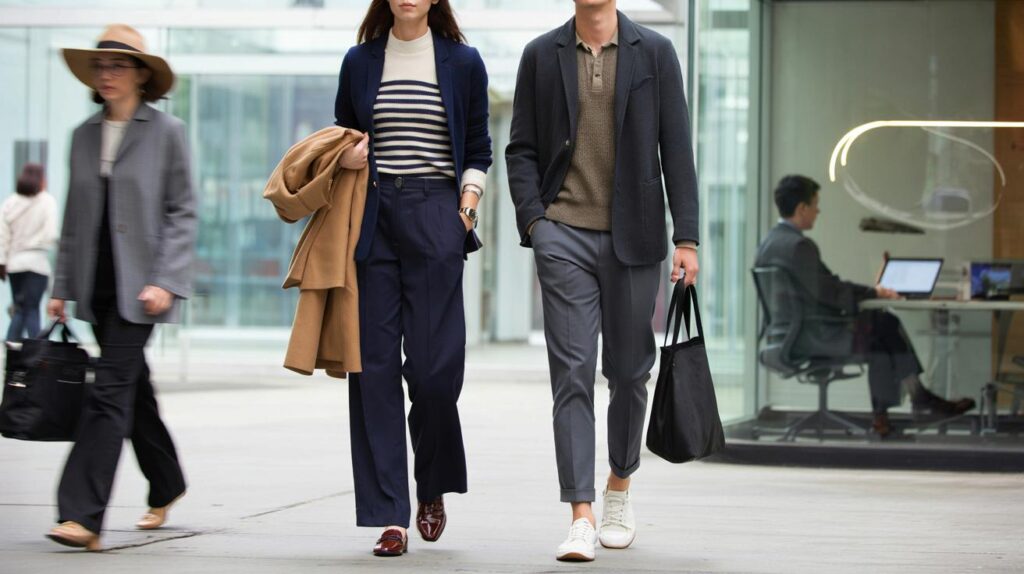
Smart casual used to mean “chinos and a shirt.” Today, it’s a moving target shaped by Teams calls, hot-desking, and a commute that swings from bike to bus to boardroom. The hybrid week asks you to look credible on-screen, relaxed in person, and ready for a last‑minute 1:1 without swapping your shoes. That’s the rub: how to be polished without looking stiff, unfussy without drifting into weekend mode. The trick isn’t to buy more. It’s to dress with purpose across two realities at once.
I watched a man in Liverpool Street at 8:41am juggle a flat white, a laptop, and a jacket he clearly wasn’t sure about. He’d thrown a soft blazer over a knitted polo, trousers cropped above clean trainers, and a tote that had seen better days. On the escalator, he checked his front camera, smoothed his hair, then smiled at something only he could see. That look—half-presenter, half-commuter—felt exactly right for right now. He walked on, missing a step, then laughed. The jacket stayed on.
Smart Casual, Rewritten by the Hybrid Week
Smart casual isn’t a midpoint between suit and sweatshirt. It’s balance you can dial up or down, not a fixed spot on a line. The baseline is ease; the signal is one crisp element that frames everything else.
Picture a colleague who nails it without trying. On Mondays she wears wide-leg navy trousers, a Breton knit, and loafers; by lunch, a soft trench lifts the whole thing. On Wednesdays she swaps in a grey flannel overshirt, same trousers, same jewellery, suddenly warmer on-camera and sharper in person. One switch, fresh energy.
The logic is simple. Choose a single “anchor” piece that reads smart at a glance—trousers with a crease, a structured jacket, leather loafers—then let the rest whisper casual. Add or remove that anchor as the day demands. **You’re not dressing for Friday or Tuesday anymore; you’re dressing for moments.**
How to Nail It Without Looking Boring
Start with a two-palette rule: a core trio (navy, charcoal, stone) and one accent (olive, rust, soft lilac). Build a mini-capsule: two trousers, four tops, one jacket, one knit, two pairs of shoes. Keep silhouettes clean, fabrics tactile—merino, crisp cotton, airy linen, smooth twill. Your webcam loves matte textures and mid-tones; shiny black can glare, stark white can blow out.
Think in moves, not outfits. Swap trainers for loafers and you’ve moved one click toward “smart”. Replace a hoodie with a cardigan or overshirt for the same effect. We’ve all had that moment where the calendar pings and your face goes hot—this is how you buy breathing space. Let’s be honest: nobody really does that every day.
Plan the top half like a presenter, the bottom half like a commuter. Keep a jacket you trust on the back of your chair, plus a lint roller and a spare belt in your bag. **A crisp collar, a neat neckline, and clean shoulders do 80% of the work.**
“Smart casual isn’t about relaxing standards. It’s about shifting where the effort sits,” says London stylist Priya Shah. “If your trousers are structured, your knit can be soft. If your jacket is unstructured, your shoes carry the formality.”
- Swap a rigid blazer for an unstructured one in cotton or jersey.
- Trade loud checks for subtle herringbone or micro-stripe on camera.
- Choose leather trainers with a slimmer profile for instant polish.
- Roll, don’t shove: a jacket rolled in your tote survives the commute.
- Keep jewellery quiet but intentional—one watch, one ring, done.
Read the Room: Culture, Climate, Camera
Every office has a mood board you can’t see, so read the clues. Look at shoes on day one, not jackets: footwear tells the truth about formality. Notice the meetings where jackets appear, the clients who like a collar, the Fridays where denim shows up without a memo.
Two more lenses matter now: climate and camera. Your morning might be damp and windy, your afternoon overheated by a meeting room fan, your 4pm a video call that turns your navy shirt black. Plan layers in thin, breathable steps. Keep colours mid-tone above the waist, texture subtle, and collars soft enough to sit well without a tie.
The quickest way to escape boring is to add one quiet signature. A fisherman’s beanie in winter. A suede belt in summer. A slim silver bangle you never take off. *Style sticks when it tells a story you don’t have to explain.*
Hybrid life rewards those small, precise choices that travel across spaces. If your wardrobe works both on-screen and in motion, your day feels smoother before you’ve sent a single email. Pick your anchor, rotate your textures, keep your palette tight, and you’ll find the sweet spot that doesn’t shout. The best looks do their job and get out of the way. They make room for the work.
| Point clé | Détail | Intérêt pour le lecteur |
|---|---|---|
| Anchor first | Choose one smart element (trousers, jacket, shoes) and keep the rest relaxed | Instant balance without overthinking outfits |
| Two-palette rule | Core neutrals + one accent that flatters your skin tone | Fewer decisions, more combinations that always click |
| Camera-aware textures | Matte, mid-tone, minimal shine on the top half | Sharper video presence, no glare or washout |
FAQ :
- What counts as “smart” if I never wear a blazer?A pressed trouser with a crease, leather loafers, or a collared knit. One of these elevates everything else.
- Can I wear denim in a hybrid office?Dark, clean denim with a structured top works in many offices. Add leather shoes if you need the dial turned up.
- How do I stop repeating outfits?Rotate anchors and accents. Same base, new layer or shoe. Small swaps read as new looks.
- Are trainers acceptable with tailoring?Yes, if they’re low-profile leather and the tailoring is relaxed. Keep socks tonal to keep the line clean.
- What’s an easy way to look less boring?Add one texture or tone shift—a knitted polo instead of a shirt, suede instead of smooth leather. Tiny change, big lift.



Loved the “anchor” tip—one smart piece does the heavy lifting. Any suggestions for summer fabrics that don’t crease on the commute?