
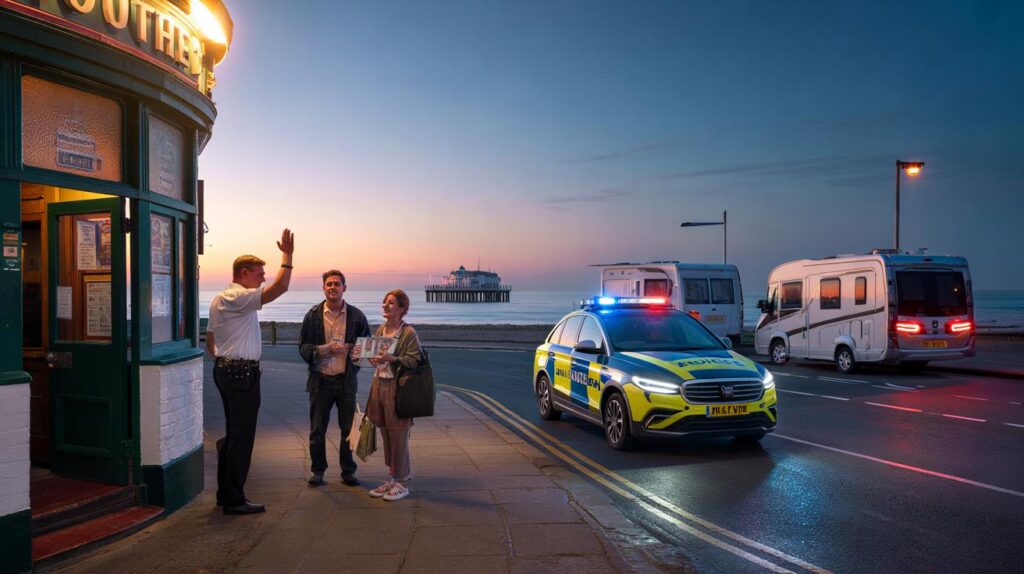
A late-summer evening on the Sussex coast took an unexpected turn, as whispers spread and pub doors briefly stayed shut.
By nightfall on 28 August, a line of motorhomes along Marine Parade had prompted swift changes from several Worthing venues. Police arrived shortly before 8pm, businesses weighed extra precautions, and regulars wondered if a quiet pint might have to wait. By the next day, the vehicles had gone and pubs stood down their contingency plans.
What happened on marine parade
Motorhomes began lining the seafront on Marine Parade on 28 August, drawing crowds and concern in equal measure. As the evening approached, the sight of multiple vehicles in prime parking spots set off a flurry of phone calls between business owners. Some decided to shut for the night. Others prepared to tighten up entry.
Pubs returned to normal trading after reports that the motorhomes had left. Police had attended shortly before 8pm.
Two town-centre staples — Thieves Kitchen and Harlequins — closed their doors for the evening, according to local reports. O’Connor’s considered a simple knock-to-enter policy, prioritising regulars and nearby residents. The Egremont initially eyed a 4pm opening before reverting to its usual hours once the situation eased.
Which venues changed plans
- Thieves Kitchen: closed for the night on 28 August.
- Harlequins: closed for the night.
- O’Connor’s: weighed a door policy offering entry to known regulars and local residents.
- The Egremont: considered opening from 4pm, then returned to standard service.
West Sussex County Council confirmed it was aware of the temporary encampment and reviewing available powers. Sussex Police were approached for further detail after officers appeared on the seafront shortly before 8pm.
How council and police responded
The county council’s statement signalled a familiar balancing act. Authorities can examine options under highways and anti-social behaviour law where encampments raise concerns, while recognising that parking on public roads may be lawful if no specific restrictions apply. Police attendance near 8pm offered reassurance and helped steady nerves among businesses and residents.
Officials reviewed legal options while officers maintained a visible presence as the evening trade began.
In practice, councils can consider measures such as time-limited bays, seasonal overnight restrictions, Public Spaces Protection Orders and targeted Traffic Regulation Orders, all of which require clear signage and due process. Where encampments occur on public land, agencies may also evaluate powers under the Criminal Justice and Public Order Act and recent changes in the law relating to residing on land without consent. On busy seafront roads, however, enforcement hinges on whether restrictions exist and whether vehicles cause obstruction or anti-social behaviour.
Knock-on effects for businesses and residents
For venues, the timing could hardly have been trickier: a late-August evening with strong footfall forecast. Closing early meant lost takings, staff hours in flux and frustrated customers. Those that stayed open toyed with door policies to keep a lid on potential flashpoints while protecting regular trade.
Local hospitality promoters urged people not to abandon the town centre. Community voices stressed that dining and drinking venues rely on steady custom and that most visitors, motorhome owners included, come to spend money and enjoy the sea air.
Support your local pubs and restaurants, they said, and don’t let the actions of a few derail a good night out.
What happens next
With the vehicles gone and doors open again, attention turns to how Worthing manages similar situations. Seafronts attract road-trippers and motorhome users, particularly in high summer. Designated overnight bays, clearer time limits, or better waste and water facilities can channel stays into managed spaces. Height barriers and blanket bans, by contrast, can displace the problem and deter ordinary visitors with larger vehicles.
Pubs and restaurants will also refine their playbooks: rapid messaging to customers, coordinated opening times, and a short, sharp set of door steps that can be switched on for a few hours and removed just as fast.
| Time | Event |
|---|---|
| Daytime, 28 August | Motorhomes reported along Marine Parade |
| Just before 8pm | Police attend the seafront as pubs weigh changes |
| Evening | Two pubs close; others consider door policies |
| Following day | Motorhomes leave; venues return to normal operations |
Practical advice for your next night out
- Check a venue’s latest updates before you set off, especially on busy summer evenings.
- Carry photo ID. Temporary door policies may apply without long notice.
- If a favourite spot is full, have a backup plan nearby to keep your evening moving.
- Report genuine safety concerns via non-emergency channels; use 999 only if there’s an immediate risk.
- Give staff some slack. Quick decisions at the door often aim to keep regulars safe and the atmosphere calm.
Context: how motorhome stays become flashpoints
Coastal towns face a familiar pattern each summer: more visitors, tighter parking, and a minority of instances where overnight stays jar with local expectations. Many motorhome users are careful, spend generously and leave no trace. Friction tends to arise when waste disposal, noise or crowding collide with peak trading hours on busy streets.
Authorities across the UK increasingly try blended approaches. Some introduce paid, time-limited bays with clear overnight rules. Others create small, serviced areas on the edge of town, drawing vehicles away from promenades while keeping visitors within easy reach of shops and pubs. When policies are signposted and consistent, the pressure eases on frontline staff and businesses can plan with confidence.
For Worthing, the latest episode shows the value of calm coordination. A line of vehicles appeared, police checked in, and the town’s pubs adapted. By the next day, the seafront had cleared and doors were open again. The lessons are practical: have a plan, keep customers informed, and press for clear, lawful parking rules that work for residents, traders and visitors alike.



Was anyone actually turned away at 8pm? I rocked up to O’Connor’s about 7:50 and got a “knock-to-enter” sign but they still let me in as a local. Curious if tourists had a different experiance.
Closing Thieves Kitchen and Harlequins felt like a knee‑jerk. Police were on Marine Parade before 8 and the vans left by morning. Designated overnight bays would definately help next time instead of losing a prime August evening.