
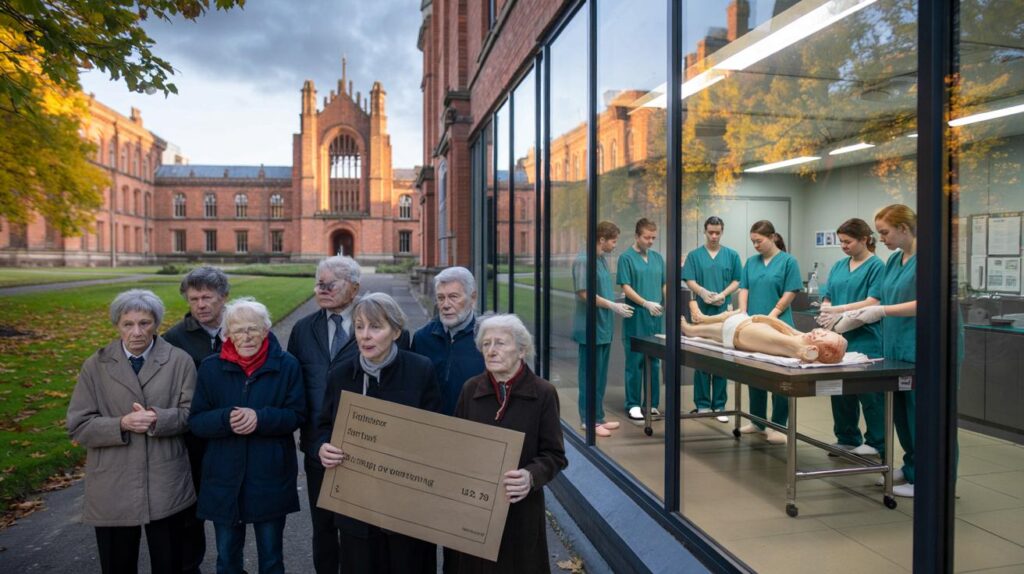
A quiet decision about what happens to a body after death is stirring strong feelings across Northern Ireland this autumn.
For many, the question has shifted from whether to donate organs to whether to donate everything. A reopened scheme at Queen’s University Belfast is making that decision feel real, immediate and unusually personal.
Why a thousand people have already said yes
Queen’s University’s Body Donation Programme is back in operation after a pause during the pandemic and subsequent staffing gaps. Around 1,000 people are already registered donors. A further 250 have signalled interest and are being assessed for suitability. The university has confirmed the first new donor under the restarted scheme has already been accepted, with medical students due in teaching labs this term.
About 1,000 registered donors, 250 more being assessed, and the first new donor already accepted.
The programme underpins anatomy teaching for undergraduate medical students. It gives trainee doctors the rare chance to study structures in three dimensions, see variations between bodies, and understand how disease changes tissues. Many international applicants choose Queen’s because it still teaches dissection. They want the hands-on discipline that software cannot replicate.
Altruism meets practicality
People come forward for mixed reasons. Some want to leave something useful behind. Others have no close family and prefer clear arrangements. A 95-year-old woman in Strangford described signing up decades ago because she saw it as an act of kindness. She also valued the order it brought to her affairs. That blend of generosity and pragmatism appears often in donor motivations.
“My body won’t help me when I’m gone, but it might help someone else.” That sentiment drives many registrations.
Training doctors the way textbooks cannot
Queen’s paused the scheme during Covid-19 and as technical staffing thinned, turning to digital tools and 3D models to keep teaching going. Those workarounds helped, but the School of Medicine says there is no true replacement for a real body. Surgeons and GPs of the future must learn depth, texture, variation and the unexpected. Dissection remains the most effective way to learn that craft.
How the programme works at Queen’s
The university’s medical school leads the scheme with a dedicated team. Donors make an informed choice during life. When a registered donor dies, the university assesses whether the body can be accepted based on medical history, cause of death and practical criteria. If accepted, trained technicians prepare the remains for teaching. Later, the university arranges respectful final steps and communicates with the family.
From registration to the anatomy lab
- Register interest while alive and complete the university’s consent documents.
- Tell your next of kin and executor; share the programme’s contact details.
- On death, the programme checks suitability; acceptance is not guaranteed.
- If accepted, the body is prepared for teaching under strict standards.
- After teaching ends, remains are handled with dignity; families can hold a memorial.
Organ donation or whole-body donation: what’s the difference?
| Topic | Organ donation | Whole-body donation |
|---|---|---|
| Main purpose | Transplantation to save or improve lives | Education and research to train clinicians |
| Consent model in Northern Ireland | Opt-out system (deemed consent) | Explicit, written consent by the donor |
| Timing | Immediate post-death retrieval | Acceptance depends on condition and logistics |
| Family role | Family is consulted; wishes considered | Family notifies programme; donor’s consent leads the process |
| Costs | No cost to family for donation | Programmes often arrange a simple cremation; families may still plan a service |
| Exclusions | Few medical exclusions for specific organs | Certain conditions, surgeries or post-mortems may prevent acceptance |
Who is signing up
Donors span ages and backgrounds. Some, like the Strangford woman who registered 30 years ago, see it as a gift to future generations. Others point to the relief it brings their relatives: paperwork sorted, clear instructions in place, and a sense that something meaningful will happen afterwards. For families at a difficult moment, certainty can feel like care.
What you should know before you consider it
- Consent must be given by you while alive. Relatives cannot usually authorise whole-body donation on your behalf after death.
- Acceptance is never automatic. Recent major surgery, some infections, or a coroner’s post-mortem can make donation impossible.
- Timing matters. Programmes work within specific windows to maintain teaching standards.
- Faith and culture matter. Many religious traditions support donation as an act of charity; speak with your faith leader if unsure.
- Funeral plans should reflect donation. Tell your executor which type of memorial you want later.
- Keep contact details handy. Put the programme’s number in your wallet and with your GP and next of kin.
Write it down, tell your family, and file the documents where people can find them fast.
Technology helps, but the human body still matters
Virtual anatomy, high-resolution imaging and 3D printing have raised the bar for medical teaching. They let students rehearse procedures, rotate organs on screen and learn tricky anatomy at home. Even so, lecturers at Queen’s argue that real bodies show complexity that software smooths out. Veins twist slightly; nerves surprise; adhesions from old surgeries tell a story. Those lessons sit in the fingers as much as the eyes.
Key numbers at a glance
- 1,000 people on the donor register for Queen’s University’s Body Donation Programme.
- 250 expressions of interest currently being reviewed for suitability.
- Programme paused during Covid-19 and staffing shortages; now reopened with new technical staff.
- First new donor under the restarted scheme already accepted.
Your next steps if you’re thinking about it
Start with a conversation at home. Explain why you want to donate and how it aligns with your values. Put your decision in your will and complete the university’s consent forms. Ask your GP to note your decision, and add a card to your purse or wallet with the programme’s phone number. If your circumstances change, you can usually withdraw consent at any time.
Think, too, about the practicalities. Many programmes later arrange a simple cremation and, where possible, return ashes to the family. If you want a church service or a gathering in a community hall, plan it now and tell your executor. Small details—music, readings, a favourite charity—can lift pressure from relatives when the time comes.
Why this matters for patients you will never meet
The students who benefit are tomorrow’s clinicians. The GP who finds a lump early. The emergency doctor who reads a chest with confidence. The surgeon who navigates scar tissue safely. Those skills begin in anatomy labs staffed by technicians and supported by donors who made a clear, generous choice. For many readers, that may be the most persuasive legacy of all.
If you remain undecided, try a simple exercise. Write down your top three values about death and legacy: care for others, family ease, or scientific progress. Match them to the options open to you—organ donation, whole-body donation, both or neither. When values and actions line up, decisions become easier to live with, and easier for loved ones to carry out.



Genuine question: if you’re registered as an organ donor under the opt‑out system, can you still consent to whole‑body donation at Queen’s, or do the two conflict in practice? Which takes precedence on the day, and who decides—family, coroner, or the programme?