
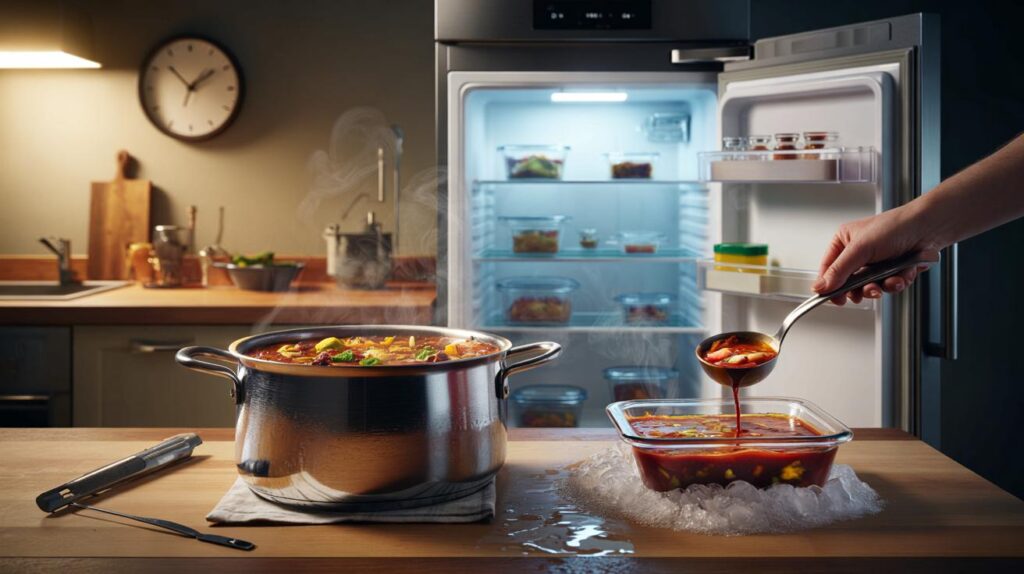
Cold nights, crowded tables, generous portions. The season invites second helpings, yet a quiet kitchen habit keeps catching families out.
Many home cooks still park steaming pots on the worktop “to cool down”. That pause feels harmless. It isn’t. The minutes tick by. Warm food drifts through the microbial fast lane. Modern fridges can handle the heat. Your gut may not.
Why we still wait for food to cool
Old myths about heat and the fridge
Plenty of people grew up hearing that warm dishes break fridges, fog shelves or spoil nearby food. The appliance gets the blame. The real culprit is time at room temperature. Modern models cope with a modest heat load. They cycle more often and return to target temperature quickly.
Worries about condensation and aroma transfer led to a ritual: lids on the side, pans on the hob, and a plan to “deal with it later”. Later arrives after a chat, a show, and the washing up. That gap is the danger.
The clock, not the warmth, drives risk. The longer food stays out, the more bacteria get a head start.
Family wisdom meets food science
Handed-down advice kept pace with old kitchens and cold sculleries. Central heating and compact flats changed the game. A cosy 21°c living space gives microbes a perfect lane for growth. Food safety guidance now centres on speed, not superstition.
What actually happens on the worktop
The so-called danger zone
Cooked food cools slowly in deep pots and roasting trays. As it drifts between 63°c and 8°c, bacterial growth can race. That band, often called the danger zone, suits many pathogens. Steam does not keep them at bay for long. The surface cools first while the core stays warm, creating layers that suit different microbes.
Keep hot food above 63°c or move it to the fridge before the 2-hour mark. That single habit blocks a cascade of problems.
How germs reach your plate
Kitchens are busy spaces. Air currents, utensils, hands, tea towels and chopping boards all spread microscopic passengers. Spores from soil can survive cooking, then wake as food cools. Each extra half-hour on the counter gives them a further window to multiply.
The health risks you can’t see
The usual suspects
Salmonella, Listeria, Escherichia coli and Staphylococcus aureus show up in recall notices for a reason. They also sit on worktops, knives and hands if hygiene slips. Cooked rice, pasta, stews, sliced meats and dairy-rich dishes offer moisture and nutrients. Bacillus cereus, often linked to rice, produces toxins that reheating cannot remove once formed.
Given warmth and time, numbers rise fast. A pan of risotto, a tray of roast chicken, or a creamy gratin can tip from safe to risky within a couple of hours. Sensitive groups — babies, older adults, pregnant women and people with weakened immunity — face higher odds of severe illness.
Real-world symptoms
Food poisoning usually announces itself with nausea, cramps, vomiting, diarrhoea and sometimes fever. Many cases pass in a day or two, yet some trigger dehydration or worse. Weekend leftovers often get the timing wrong. A dish sits out while everyone unwinds. Monday tells the story.
Do warm dishes wreck the fridge?
What engineers actually design for
Domestic fridges tolerate a moderate load of warm food. The compressor works a little harder for a while, then normal cycles resume. Shelves spread heat. Fans move air. The effect on nearby items remains brief if the door stays shut.
Modern fridges can accept warm, covered food in shallow containers. The risk lies in the wait, not the equipment.
To limit energy use, portion hot food before storage, keep the door closed, and avoid placing a large roasting tray that blocks airflow. These tweaks reduce the burden and cut cooling time inside the cabinet.
What to do within two hours
Fast-cooling tactics that work
- Transfer food to shallow containers no deeper than 5 cm to shed heat quickly.
- Split big batches into smaller portions to chill the core faster.
- Vent briefly to let steam escape, then cover before refrigerating to prevent drips and cross-contamination.
- Stand containers in a cold-water bath for 10–15 minutes if the room is warm.
- Place items apart on fridge shelves to speed airflow; avoid stacking while still warm.
Mistakes to bin tonight
- Leaving pans on a switched-off hob or windowsill “to cool” beyond two hours.
- Sealing hot food tightly with cling film so condensation rains back onto the dish.
- Repeatedly moving the same pot in and out of the fridge to “serve from the source”. Portion into a clean plate instead.
How long leftovers last — and where
Time-and-temperature cheatsheet
| Food | Fridge (≤ 5°c) | Freezer (−18°c) | Reheat target |
|---|---|---|---|
| Cooked rice or pasta | Up to 1 day | Up to 1 month | Steaming hot throughout |
| Cooked meat, stews, curries | Up to 2 days | 2–3 months | 70°c for 2 minutes or equivalent |
| Soups and sauces | Up to 2 days | 2–3 months | Rolling boil, stir well |
| Quiches, gratins, casseroles | Up to 2 days | 2–3 months | Piping hot in the centre |
Set your fridge to 5°c or below and your freezer to −18°c. Check with a simple thermometer, not guesswork.
Make your kitchen plan foolproof
Label, rotate, reheat once
Write a date on each container. Put older items at the front. Reheat only what you intend to eat. Return leftovers to the fridge within two hours of cooking, or within one hour in a warm room. When reheating, stir or turn food so cold spots don’t lurk in the middle.
Who should take extra care
- Babies and young children.
- Pregnant women.
- Older adults.
- Anyone with reduced immunity or long-term illness.
These groups benefit from tighter timings, smaller portions and swift refrigeration. Avoid raw milk cheeses, undercooked eggs and deli meats in these cases, and treat rice with special care.
Answers to the fridge fears
Your appliance isn’t the enemy
A full fridge runs more efficiently than an empty one. Warm dishes add load for a short spell, yet the internal thermostat compensates. Place items on glass shelves, leave space for airflow and shut the door promptly. The payoff is big: less time in the danger zone, fewer bacteria, fewer upset stomachs.
Practical example you can copy tonight
Picture a 3-litre pot of chilli at 90°c after dinner. Ladle it into six shallow containers, each roughly 500 ml. Leave lids ajar for 10 minutes to release steam. Snap lids on. Place the containers separately on two shelves. Close the door and don’t reopen for 30 minutes. Each box cools through 8–63°c far faster than the original pot would have done on the counter. Energy use rises slightly for an hour. The risk drops sharply.
Extra pointers that save money and stomachs
Batch cooking without the gamble
Cook once, chill fast, and freeze early. Move half of a big batch to the freezer the same evening. That habit cuts waste and makes weekday meals safer. Thaw in the fridge, not on the worktop. If you’re short on time, reheat from frozen on the hob or in the microwave, stirring often.
When to bin it
Trust time and temperature, not sight or smell. Toxins from some bacteria don’t announce themselves. If food sat out beyond two hours, or beyond one hour in a hot room, throw it away. If reheated food cooled again and sat out, don’t keep it. A small loss beats a night of cramps.



So it’s actually fine to put warm food straight into the fridge—as long as it’s in shallow containers and briefly vented first? I’ve always waited for it to “cool” on the counter. If I portion a stew within 30 minutes of cooking, does that keep it out of the 8–63°C danger zone?
I’m skeptical that a single pot of chilli can’t sit out 2+ hours in winter without issues. Do you have data showing growth curves for Salmonella/Listeria at 18–20°C? Otherwise this feels a bit like safety theater. Also, doesn’t frequent door opening negate the “fridge can handle it” claim?